
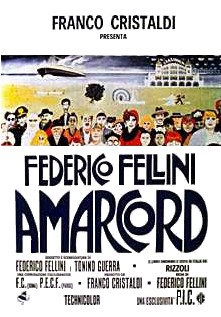
Behind the film
- Year
- 1973
- Director
- Federico Fellini
- Writers
- Federico Fellini, Tonino Guerra
- Genres
- Art, Coming-of-age, Comedy, Drama
- Country
- France, Italy
- Cast
- Bruno Zanin, Pupella Maggio, Armando Brancia, Magali Noël, Ciccio Ingrassia, Nando Orfei, Giuseppe Ianigro, Maria Antonietta Beluzzi
About the film
Contains story spoilers.
Amarcord opens with poplar fluff arriving on the wind, a seasonal cue that makes the town feel like a storyteller. The setting is Borgo San Giuliano, a seaside community modeled on Federico Fellini’s Rimini childhood, remembered rather than reconstructed as strict autobiography. Titta, played by Bruno Zanin, is an adolescent at the center of a large orbit of relatives, classmates, teachers and local eccentrics. The film follows no single chain of suspense; one episode gives way to another as the calendar advances. That loose shape suits a world where public rituals and private daydreams overlap, and where the boy’s embarrassment or desire can be as important as an official event. The town square and schoolrooms keep returning as shared stages: the lawyer tries to deliver a civic lesson while children and adults answer with jokes, noise or distraction. These encounters place Titta inside a generation learning public behavior through ritual and embarrassment. When the grandfather later becomes disoriented in a heavy fog, the family’s familiar house itself loses its shape, briefly making domestic life as strange as the village fantasies.
Spring brings the town’s bonfire celebration, fireworks, pranks and noisy irreverence. At school, Titta and his classmates sit through dry lessons and theatrical displays for visiting Fascist officials. Ciccio imagines himself married to Aldina beneath a giant papier-mâché Mussolini head, while a secretly wired gramophone plays a forbidden song from the church tower before authorities shoot it down. Political control appears as both threat and absurd pageantry. Titta’s father Aurelio, whose past includes anarchist politics, is interrogated and forced to drink castor oil. The humiliation reaches the family home, where Miranda nurses him, connecting national intimidation to the routines and vulnerabilities of private life.
Titta’s own concerns are less organized than his father’s politics. He is curious about sex, but confession provides little clarity: the priest is more absorbed by church flowers than by the boy’s evasions. Titta and his friends invent romantic victories and stare at the glamorous Gradisca, whose movie-star aura makes her seem to belong to a more dazzling world than theirs. His encounter with the tobacconist is another mixture of fantasy and awkward reality. When she responds to his strength, he is overwhelmed rather than transformed into the confident lover he imagined. The comic episode gives desire a bodily, embarrassing scale, while the film avoids making adolescence feel like a neat series of lessons.
Family life has its own unruly spectacle when Titta and the others take Uncle Teo, who lives in an institution, on a country outing. Teo escapes up a tree and repeatedly calls for a woman; stones thrown from above keep the family and helpers at a distance until a dwarf nun climbs a ladder and persuades him to come down. The scene is funny in its escalating practical problem, yet it also hints at how the community manages anyone who does not fit its expectations. Fellini lets the incident remain eccentric rather than turning Teo into a symbolic explanation. Each person’s peculiarities are simply part of the village’s collective weather.
The passage of the SS Rex becomes one of the town’s most memorable shared dreams. Residents take small boats out to watch the liner, celebrated by the Fascist regime as a symbol of national achievement. They wait through the night and nearly fall asleep before the foghorn reveals the ship. The enormous vessel glides past in moonlight, waking the crowd into awe and leaving their boats rocking in its wake. The scene gives the townspeople a moment of wonder while making the grand state spectacle seem remote and almost unreal. Later, the boarded-up Grand Hotel and the boys’ imagined dance with invisible partners turn longing into a ghostly private performance.
Autumn and winter bring different kinds of uncertainty. The annual car race lets Titta fantasize about winning Gradisca as a prize. His dream is less a plan than a way of translating admiration into a story where he can matter. His mother Miranda, a steady presence through his mischief and illness, dies after nursing him back to health during a severe winter. The loss is not staged as a grand speech; it alters the emotional temperature of the film. The town continues, but Titta’s family center is gone, making the cycle of seasons feel irreversible rather than merely picturesque.
At Gradisca’s wedding reception, she leaves the village with a Carabiniere, and Titta is noticed to be gone as well. This ending does not resolve every episode; it lets a young person drift out of the childhood world assembled around him. Fellini’s episodic, carnivalesque form—full of abrupt shifts between public ritual and intimate fantasy—keeps memory from becoming a polished chronology. Nino Rota’s music and Giuseppe Rotunno’s saturated imagery give the village a warmth that coexists with fear, cruelty and grief. The film’s nostalgia is double-edged: the place is vivid enough to invite return, but remembering also means recognizing what has changed.