
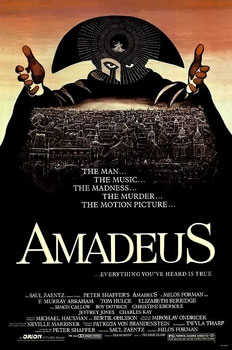
Behind the film
- Year
- 1984
- Director
- Miloš Forman
- Writers
- Peter Shaffer
- Runtime
- 2h 38m (theatrical version)
- Genres
- Biographical, Musical, Drama, Flashback
- Production
- Orion Pictures
- Country
- United States, Czechoslovakia
- Cast
- F. Murray Abraham, Tom Hulce, Elizabeth Berridge, Simon Callow, Roy Dotrice, Christine Ebersole, Jeffrey Jones, Charles Kay
About the film
Contains story spoilers.
Miloš Forman’s Amadeus begins after the events it will recount. In 1823, Antonio Salieri attempts suicide and is placed in a hospital, where Father Vogler visits him. Salieri claims he murdered Mozart and tests whether the priest recognizes melodies from his past. The priest recognizes Mozart’s Eine kleine Nachtmusik, not the pieces Salieri wrote. That small exchange sets the film’s central imbalance: Salieri understands enough to hear the difference in their talent, while his own skill has brought him respectable success and a place at the Viennese court.
The flashbacks move to Salieri’s youth and his vow to serve God through music. After his father dies, Salieri believes his ambitions have been accepted and becomes court composer to Emperor Joseph II. Mozart arrives in Vienna as a brilliant but immature young man whose unguarded laughter and crude manners offend Salieri. More painfully, Mozart’s compositions seem to arrive fully formed. Salieri recognizes their beauty even while resenting the person who made them. The film dramatizes their difference not as a contest between talent and incompetence, but between disciplined labor that earns status and effortless work that seems beyond explanation.
Mozart’s musical ideas are not matched by financial stability. He and Constanze spend beyond their means, and he struggles to secure lasting employment. He persuades Joseph to approve The Marriage of Figaro, despite objections to its politically controversial source and its use of ballet; the emperor’s boredom during a performance later becomes another setback. Salieri uses his position to obstruct Mozart’s work, though he is also drawn to it. After Leopold Mozart dies, Wolfgang turns toward the darker Don Giovanni. Salieri sees the opera’s Commander as evidence of Mozart’s complicated feelings about his father, while using that insight to manipulate him rather than offer help.
Salieri approaches Mozart anonymously in the costume Leopold wore at a masquerade and commissions a Requiem. He intends to exhaust Mozart, take credit for the completed work and present it at his funeral. Mozart meanwhile composes The Magic Flute and the Requiem, with Constanze increasingly worried by his health and erratic behavior. She leaves with their son. Mozart collapses after conducting The Magic Flute and dictates parts of the Requiem to Salieri from bed. The collaboration gives Salieri a direct view of Mozart’s process, but also puts him close to the consequences of his own scheme.
Constanze returns and orders Salieri out, putting the unfinished Requiem away before discovering that Mozart has died. A modest funeral and communal burial follow the intimate work at his bedside. Salieri’s confession does not establish that he literally caused Mozart’s death; the film presents the murder claim through an unreliable narrator who has built a life around resentment and guilt. In the present, Salieri calls himself the patron saint of mediocrities as he is wheeled through the hospital corridors. The ending returns to his self-image rather than offering a historical verdict. His pain comes from recognizing greatness and believing that a just God would not have chosen Mozart to possess it.
The film’s musical performances turn composition into dramatic action: the audience hears an opera tested before the emperor, the changing mood of Don Giovanni and the Requiem taking shape under pressure. The court’s rooms, theatres and crowded domestic spaces distinguish public recognition from private hardship. Peter Shaffer’s screenplay adapts his play, and Forman frames the plot as Salieri’s confession rather than a neutral biography. The story contains deliberate inventions about Mozart and Salieri; its rivalry is a dramatic structure, not evidence that Salieri murdered the historical composer.
Salieri’s position gives him access but not the freedom he envies. He can influence which operas reach the emperor and can make Mozart’s precarious employment worse, yet he cannot reproduce Mozart’s musical insight. Constanze’s attempts to secure support for her husband reveal how money pressures artistic life in this court; talent alone does not settle rent or household needs. Those practical concerns make Salieri’s covert commission believable within the film’s plot: Mozart is vulnerable to a patron who appears to offer paid work at the moment his career is under strain.
One of the rivalry’s sharpest scenes begins with Constanze bringing her husband’s manuscripts to Salieri in the hope that he can secure paid employment. She sees a possible solution to the household’s problems; Salieri sees pages that seem to need no correction. As he reads, the music fills the soundtrack, allowing the audience to hear what he can imagine from the written notes. His ability to understand their beauty makes the discovery more painful than ignorance would. Later, Mozart transforms a formal march Salieri has written to welcome him, making musical superiority audible in front of the court. Those exchanges explain why Salieri cannot dismiss his rival as merely badly behaved. His outrage is directed toward the gap between the man’s social awkwardness and the art he produces. At the bedside, the roles change again: Mozart dictates faster than Salieri can follow, and the older composer has to ask for clarification while briefly helping create music he could never have written alone.