
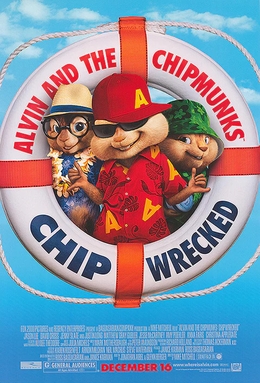
Behind the film
- Year
- 2011
- Director
- Mike Mitchell
- Writers
- Jonathan Aibel, Glenn Berger
- Genres
- Musical, Comedy, Family, Fantasy
- Production
- 20th Century Studios, Regency Enterprises, Bagdasarian Productions
- Country
- United States
- Cast
- Jason Lee, David Cross, Jenny Slate, Justin Long, Matthew Gray Gubler, Jesse McCartney, Amy Poehler, Anna Faris
About the film
Contains story spoilers.
Dave brings the Chipmunks and Chipettes on a cruise, but a stunt sends them to a tropical island. They meet castaway Zoe; a spider bite turns cautious Simon into the adventurous Simone, who discovers treasure. Dave and Ian search for the missing group as the island's volcano becomes dangerous. Zoe's obsession with the treasure leads her to abduct Jeanette. The others rescue her and prepare to escape by raft, but another confrontation leaves Dave hanging from a collapsing crossing. Alvin and Ian persuade Zoe to save him, and everyone gets away before the eruption overtakes them. The reunited group returns to its performance career with Alvin and Dave's trust repaired. The adventure changes responsibility from something imposed by an exasperated adult into something the youngsters must practise themselves.
A holiday is a useful setting for that change because it suspends the familiar organisation of home without removing the relationships formed there. Mike Mitchell's film lets the youngsters carry their habits into surroundings that respond differently to them. Attention remains easy to seek, but attention is not the resource most likely to solve a practical difficulty. The shift from a controlled leisure setting to an exposed landscape therefore gives the comedy an underlying argument about dependence. Someone accustomed to being entertained must learn to notice what keeps a group secure. The exaggeration belongs to a family adventure, but the transition is recognisable: freedom feels different once a person shares responsibility for how other people will get through the day.
The film’s strongest organizing device is the shift from a public stage to a landscape where fame and performance no longer solve immediate problems. A cruise ship offers bright surfaces, enclosed corridors and constant access to spectacle; on the island, small resources and physical cooperation matter more than celebrity. The stranded group has to move from treating the trip as entertainment to noticing weather, food, shelter and one another. That change stays in family-comedy territory, but it gives the adventure a clear practical shape: each bit of chaos forces the characters to respond together.
Alvin’s arc is built around the gap between confidence and dependability. He is accustomed to directing attention and assumes that a bold idea will carry everyone along, even when the consequences fall on Dave. Island life makes the cost of that habit visible. His eventual willingness to apologize does not erase his showmanship; it gives him a more useful way to lead, especially when the group must evacuate. Dave’s role also shifts. On the ship, he is the adult trying to restrain a famous but unruly group. Away from them, his determination to find them becomes a measure of affection, not simply exasperation.
The ensemble works through contrasts in temperament as well as contrasting voices. Confidence, caution and curiosity can each help a group, yet each can also become a problem when treated as sufficient on its own. Alvin's certainty needs someone able to question it; a more hesitant character may need someone prepared to attempt the next step. Brittany's forcefulness adds another claim to leadership, while Jeanette's openness makes attention to another person part of the adventure. These differences give cooperation a concrete meaning. Working together does not require everyone to become interchangeable. It requires making space for another person's contribution without assuming that the most conspicuous personality must always decide what happens next.
Zoe brings the adventure's interest in attention to a sharper point. A goal can become so absorbing that its apparent importance survives the loss of everything that originally made it useful. The film makes that danger accessible through a broad comic antagonist rather than an elaborate psychological account. Possession begins to replace connection, and another person becomes valuable chiefly for what she might help obtain. This is the opposite of the lesson the stranded group needs to learn. A resource has practical value only inside a life that can use it; caring for someone cannot be reduced to collecting the right object. The clash keeps the rescue attached to character rather than functioning only as a new obstacle on the way home.
The animation is designed to share a frame with human performers and recognizable environments. The chipmunks’ scale allows sight gags to arise from ship furniture, improvised island shelters and the physical mismatch between their small bodies and the world around them. Song sequences carry the franchise’s pop-performance identity into the adventure, while the live-action characters keep the stakes situated in practical spaces. The cut between spectacle, dialogue and physical comedy helps the story remain legible even when several tiny characters scramble in one image. Music is part of their public persona, but the island plot repeatedly shifts attention from performing to responding.
The family-comedy tone gives reconciliation more weight than punishment. Jason Lee's Dave has to be recognisable as both a frustrated guardian and someone whose affection persists through the frustration. That combination gives Alvin's behaviour a consequence the audience can understand without requiring the character to lose his exuberance altogether. Growing more dependable means finding a useful place for that energy. The adventure's physical tasks make the adjustment visible, while its musical identity allows the characters to remain performers after learning that performing is not the answer to every problem. The film ends by reconnecting those sides of their lives: a group can enjoy the spotlight while also recognising the less visible work through which someone keeps it together.