
Behind the film
- Year
- 1976
- Director
- Alan J. Pakula
- Writers
- William Goldman
- Genres
- Crime, Historical, Drama, Political thriller
- Production
- Warner Bros. Entertainment, Warner Bros. Pictures
- Country
- United States
- Cast
- Robert Redford, Dustin Hoffman, Jason Robards, Jack Warden, Martin Balsam, Hal Holbrook, Jane Alexander, Ned Beatty
About the film
Contains story spoilers.
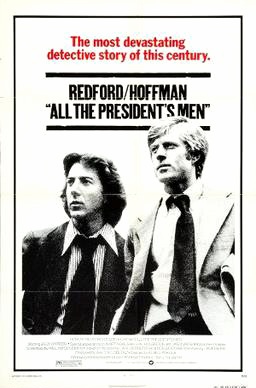
Alan J. Pakula’s All the President’s Men begins with the 1972 Watergate break-in, first treated as a modest courthouse assignment for Washington Post reporter Bob Woodward. Carl Bernstein joins the story, and the two connect the burglars to political operatives and a web of campaign money. Their editors demand corroboration as the reporters work through contacts, records and guarded interviews. Woodward’s secret meetings with an official he calls Deep Throat offer direction but few usable facts; careful reporting must fill the gaps. As evidence points toward people close to the White House, the Post faces denial and pressure to prove its claims. The film closes with the reporters typing during Nixon’s second inauguration, then a montage of headlines carries the story through his resignation. Its focus remains on how the reporting is assembled, not on a complete account of every consequence.
The newsroom is the film’s central landscape. Desks, telephones, files and typewriters form a world in which information moves through people before it becomes public. This setting makes journalism look neither like solitary genius nor like a simple race for revelation. The work depends on colleagues asking what is known, how it is known and whether another source can confirm it. Pakula’s drama finds suspense in process: a name written down, a call placed or an unanswered question can change the weight of a claim. That emphasis is especially useful for a political story because it gives the audience a way to understand how uncertainty is handled. Facts do not arrive as a finished pattern; they are tested into one.
Robert Redford and Dustin Hoffman give Woodward and Bernstein contrasting working styles without reducing them to a neat introvert-extrovert pair. Redford’s Woodward is measured and attentive, often seeming to listen for what a source is unwilling to say. Hoffman’s Bernstein is more visibly improvisational, testing approaches and adapting his manner to the person in front of him. Their differences create friction, but the film treats collaboration as a discipline rather than instant friendship. Each reporter’s method can help the other see a gap. Their characters are defined by professional habits—how they prepare, question and follow up—more than by private biography. That choice keeps the story’s perspective close to the work and prevents the political stakes from swallowing the human texture of the newsroom.
Jason Robards’s Ben Bradlee brings another standard into the room. He does not accept a compelling theory just because the reporters believe it, and his skepticism has a practical purpose: the newspaper must be able to defend what it prints. That pressure shapes the film’s sense of risk more subtly than a direct threat would. Publication is not portrayed as a heroic button reporters simply press; it is a decision that depends on evidence, editorial judgment and the institution’s willingness to stand behind its staff. The editors are not obstacles placed in the way of truth. They represent the safeguards that make the work more credible. The drama’s respect for verification is one reason it still feels grounded in professional craft rather than in the mythology of a lone crusader.
Gordon Willis’s cinematography gives Washington an atmosphere of depth and enclosure. The newsroom can appear crowded with information, while corridors, offices and parking structures isolate a source or reporter inside a larger institution. The famous use of a dark garage for Woodward’s confidential meetings places secrecy in a concrete public space, where access and visibility are never fully under anyone’s control. Pakula’s compositions often organize characters through layers of glass, desks and doorways, making the act of watching part of the film’s visual grammar. Rather than decorate the political material with grand images, the camera stays close to the systems that produce it. The result is a thriller whose visual tension grows from ordinary architecture and the distance between people who may or may not trust one another.
The supporting cast makes the Post feel like an institution with multiple responsibilities. Editors, researchers, secretaries and sources each carry a piece of the process, so the story does not pretend the two central reporters operate alone. Hal Holbrook’s Deep Throat is particularly effective as a figure who can point toward significance while withholding the evidence the reporters need. That arrangement turns a source relationship into an ethical and practical problem: assistance is useful, but it cannot replace independent confirmation. The film gives the source a distinctive atmosphere while keeping the reporting itself visible. It leaves the audience aware that anonymity can protect a person and limit what can be established at the same time. Suspense comes from navigating that tension, not from treating secrecy as proof.
William Goldman adapts Woodward and Bernstein’s nonfiction book into a feature that has to compress a sprawling investigation into a focused dramatic line. That necessarily leaves context outside the frame, so the movie should be understood as a crafted screen account of reporting rather than an exhaustive history of Watergate. Its strongest organizing choice is to stay with the newsroom’s standard of proof. The political meaning of the story emerges through the labor required to establish it. The title’s reference to a president’s men points toward powerful figures, yet the camera repeatedly returns to ordinary workers deciding what can be printed. That choice keeps the film’s scale human while its stakes remain public.