
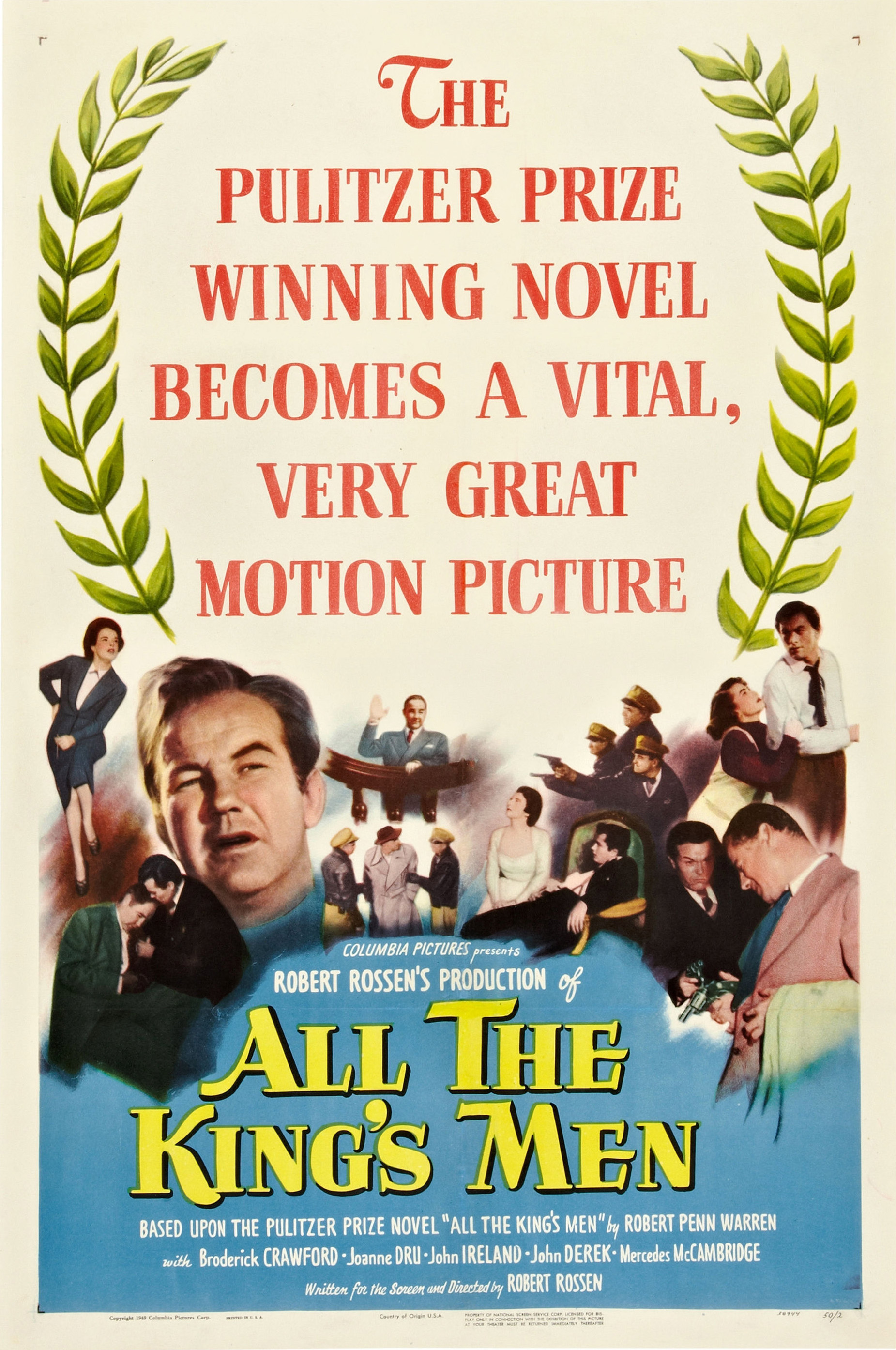
Behind the film
- Year
- 1949
- Director
- Robert Rossen
- Writers
- Robert Rossen
- Genres
- Drama, Film noir
- Production
- Columbia Pictures
- Country
- United States
- Cast
- Broderick Crawford, John Ireland, Joanne Dru, John Derek, Mercedes McCambridge, Shepperd Strudwick, Anne Seymour, Ralph Dumke
About the film
Contains story spoilers.
Reporter Jack Burden follows Willie Stark from reform candidate to powerful governor. Working for him, Jack helps gather leverage on opponents and becomes implicated in the compromises behind Stark's public promises. Private scandals and an impeachment contest expose the operation's violence. Judge Stanton dies by suicide after Stark pressures him; Stark survives impeachment but is shot by Adam Stanton at a celebration and dies on the capitol steps. The film makes Jack's proximity to these events central to its moral argument. A witness can know a great deal and still fail to resist the use of that knowledge. Robert Rossen's 1949 adaptation of Robert Penn Warren's novel follows that failure alongside the politician's rise.
The film’s defining formal tension is between public performance and private knowledge. Stark’s rise depends on speaking in ways that transform frustration into identification; Burden’s narration then sits beside those speeches, registering how political theater is assembled and how it can still persuade the person who knows its seams. The movie places listeners, cameras and crowds around the candidate so that authority appears relational: it is made by the person onstage and the people prepared to recognize themselves in him. This structure gives political ambition a dramatic texture rather than reducing it to a policy argument. The rhythm of applause and silence matters as much as the content of the speeches, making political consent feel like a social event that can be cultivated and redirected.
Jack’s position makes the film more than a portrait of a demagogue. His reporting begins at a distance, but employment draws him toward the machinery he once described. The camera’s attention to his reactions makes the journalist’s supposed neutrality unstable: he can gather information and still be implicated in how it is used. That shift supplies a moral thread through the campaign spectacle. The film’s voice-over does not simply explain events; it marks a consciousness attempting to arrange them into a coherent story after participating in their arrangement. Journalism becomes both method and self-protection. His changing proximity to power is reflected in the film’s structure: reporting first appears observational, then becomes a form of service with consequences for what remains visible.
Broderick Crawford’s physical presence shapes the role’s movement from frustrated outsider to commanding public figure. The performance fills rooms with blunt energy, yet the film does not treat volume as the same thing as conviction. Stark’s persuasive force emerges from his ability to sound like an answer to ordinary resentment, then redirect that trust toward his own authority. John Ireland’s quieter, more observant Burden creates a counter-rhythm, giving scenes space for skepticism even when the campaign around him grows louder. Their contrast lets the story explore power as a relationship between spectacle and witness. Crawford avoids making Stark a polished orator from the outset; awkwardness gives way to force, so charisma feels practiced and opportunistic instead of magically innate.
Rossen’s adaptation rearranges Robert Penn Warren’s novel, especially by centering the politician more strongly than the book’s reporter-narrator. That decision makes the film’s political arc direct and visible, while Burden’s voice-over preserves a measure of inward reflection. The state remains unnamed, a choice that widens the fable’s reach but also abstracts it from particular institutions. The result is not a case study of a specific Southern government. It is a crafted drama about how a reform impulse can be absorbed into the apparatus it opposes, and how personal access can make that transformation difficult to resist. The adaptation therefore exchanges some of the novel’s inward complexity for a more public drama, using voice-over to preserve the question of who is interpreting the politician.
The black-and-white photography and location-based settings give the film a documentary texture, but the effect is carefully shaped. Crowds and public spaces make political life seem immediate; interiors reveal how deals and loyalties narrow the meaning of public promises. The contrast between street-level campaign scenes and rooms where influence is exchanged helps the film move from civic spectacle to intimate compromise. Rather than making the images proof of historical accuracy, this visual approach is best understood as a style that lends plausibility to a fictionalized political landscape. This use of texture is not an invitation to read the unnamed state as any one exact place; its geography is deliberately generalized for dramatic purposes.
The ending refuses a clean division between innocence and guilt. Stark is dead, but the political habits that carried him to office cannot be disposed of with him, and Burden’s knowledge does not automatically restore moral clarity. This closing unease connects the film’s personal tragedies to its larger concern with power: private loyalties become instruments within public contests, and private remorse arrives after the system has already done its work. All the King’s Men remains compelling as a character-driven political drama because it asks how people become participants in a cause they once believed they were merely observing. Rather than presenting the killing as a cure for political corruption, the film leaves its institutions and the bystanders’ obligations hanging in the air.