
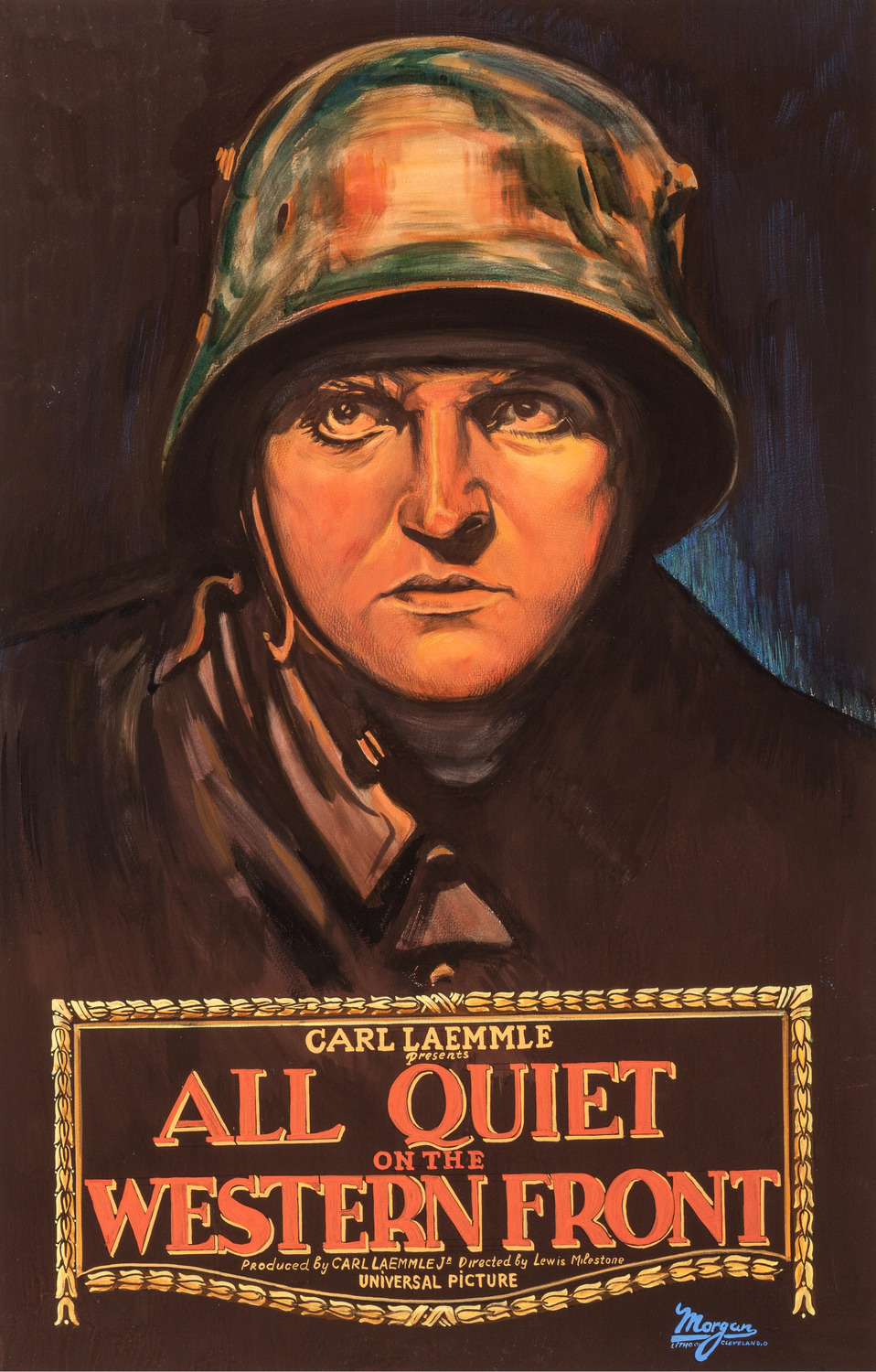
Behind the film
- Year
- 1930
- Director
- Lewis Milestone
- Writers
- George Abbott, Maxwell Anderson, Del Andrews
- Genres
- War, Drama, Anti-war
- Production
- Universal Pictures
- Country
- United States
- Cast
- Lew Ayres, Louis Wolheim, John Wray, Arnold Lucy, Ben Alexander, Russell Gleason, Slim Summerville, G. Pat Collins
About the film
Contains story spoilers.
The 1930 All Quiet on the Western Front begins with young men being given a story about the lives they are about to enter. In a classroom, their teacher turns patriotism into an invitation to become important, encouraging enlistment as though courage and collective enthusiasm can explain the war ahead. Paul Bäumer and his classmates respond as a group, which makes the decision feel easier than it would in isolation. Lewis Milestone then follows that group into experiences the speech has left out. The gap between the language used to send them away and the conditions waiting for them becomes the film's central argument.
Training initially replaces the teacher's confidence with another kind of authority. Himmelstoss, formerly a postman, relishes the power his uniform gives him, subjecting the recruits to humiliating drills that do not resemble the honour they imagined. The boys find ways to retaliate, but the comic energy of those encounters does not prepare them for the front. Once there, practical instruction comes from older soldiers who understand food, cover and the need to endure bombardment. Katczinsky, known as Kat, becomes especially important because his competence concerns staying alive rather than appearing impressive. Louis Wolheim makes that rough care a counterweight to the institutions that treat the boys as replaceable bodies.
Hunger and exhaustion quickly establish a scale of need different from the classroom's ideals. A meal can become an event, and a chance to sleep can matter more than any explanation of the campaign. Milestone's battlefield scenes move across bodies and positions rather than allowing every action to settle around a single heroic figure. Noise, movement and interrupted attention give the attacks a force that makes the recruits' earlier confidence seem unrelated to what they must do. When men argue about who wanted the war, the conversation comes from people living with its immediate effects, not strategists able to turn those effects into a distant calculation.
Kemmerich's injury introduces the way death changes the meaning of ordinary possessions. His boots are useful to the living even while their owner remains frightened and in pain, producing an uncomfortable contrast between friendship and the demands of survival. Their passage between soldiers makes loss tangible without requiring each death to be explained in a speech. Paul is forced to confront how quickly someone he knows can become absent, while the others learn to continue because the next danger does not wait for mourning. Lew Ayres gives Paul an openness that gradually becomes strained, preserving the young man within a role that increasingly requires him to suppress his reactions.
The encounter with a French soldier in a shell hole breaks through that suppression. Paul kills a man at close range and then remains beside him long enough for the act to lose the distance that uniforms and national labels provide. Documents and personal belongings reveal a life with connections outside the battlefield. His remorse cannot reverse what happened, and his attempt to address the dead man makes the scene a confrontation with his own conduct rather than a general statement that war is sad. The film narrows its enormous conflict to two bodies in one place, asking what the idea of an enemy can conceal until the killing has already occurred.
Leave at home offers another kind of dislocation. His mother's illness makes the family reunion fragile, and the men discussing military strategy cannot understand why their confidence troubles him. The classroom is still producing the same encouragement that sent his friends away, but Paul's attempt to describe the front disappoints those who want an example of bravery. He no longer fits the role his community prepared for him. That failure to communicate is one of the film's harshest consequences: survival has given him knowledge that the people welcoming him home do not readily want, leaving familiar rooms almost as alien as the trenches once seemed.
Returning to the front brings him back to the companionship that has become more reliable than patriotic assurance. Kat's presence offers a way to endure, but even that relationship cannot be secured against sudden injury. Paul carries him toward help without knowing that he has already died, turning an act of care into another discovery made too late. The closing butterfly draws Paul's attention toward something small and living beyond the parapet. The shot that kills him interrupts that gesture rather than a glorious attack, refusing to supply the meaningful battlefield ending promised by the classroom. The final images return the boys to a collective presence marked by their loss.
The film's early sound cinema makes its use of bombardment and silence especially consequential, while its moving views of combat resist the idea that talk alone must carry a story. Its German characters are presented through an American production without requiring the audience to approve their nation's cause in order to recognize their vulnerability. The account remains a fictional adaptation centred on this group, rather than a complete history of the war. What it follows in depth is the dismantling of a promised future: training changes the boys' behaviour, combat changes their needs, and returning home reveals that the language which once made enlistment attractive can no longer describe who they have become.