
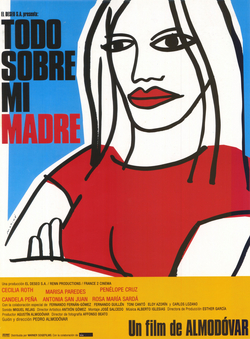
Behind the film
- Year
- 1999
- Director
- Pedro Almodóvar
- Writers
- Pedro Almodóvar
- Genres
- Comedy drama, Transgender
- Production
- El Deseo, Renn Productions, France 2 Cinéma
- Country
- France, Spain
- Cast
- Cecilia Roth, Marisa Paredes, Candela Peña, Antonia San Juan, Penélope Cruz, Rosa Maria Sardà, Fernando Fernán Gómez, Toni Cantó
About the film
Contains story spoilers.
Manuela and her seventeen-year-old son Esteban attend a stage production of A Streetcar Named Desire. Afterward, he runs through rain to get Huma Rojo’s autograph and is struck by a car. His death leaves Manuela facing a hospital decision about organ donation while still in shock. Her work has trained her to guide families through such moments, but now she is the parent asked to make the decision. She agrees, then secretly visits the area where the recipient of Esteban’s heart lives. The opening joins professional routine, grief and the ethical problem of how a person’s story continues through other people.
Manuela leaves Madrid for Barcelona, the city she left years before, hoping to find Lola, Esteban’s other parent, and tell her about their son. The film does not make the search a straight detective plot. Manuela follows personal ties and memories, meeting her old friend Agrado and becoming connected to actress Huma Rojo. Huma is performing Streetcar with Nina, a younger actor whose drug use and volatile relationship complicate their work. Manuela’s experience performing the play and her composure in emergencies make her useful to the company, and she becomes Huma’s assistant. The theater offers a second version of family: a group that rehearses intimacy nightly, with backstage labor holding the performance together.
Agrado is a transgender woman whose humor and directness mask the practical danger of her life on the street. When a client attacks her, Manuela finds her injured and helps her recover. Agrado also becomes the film’s clearest narrator of her own choices, speaking about identity as something built through body, style and self-definition rather than assigned by strangers. Huma is a different kind of public figure, surrounded by admirers yet lonely in private. Her devotion to Nina coexists with frustration about the younger woman’s addiction and unreliability. Manuela’s calm presence allows these women to lean on her, but her caregiving is not effortless: her own grief remains close beneath the competence.
Manuela eventually finds Rosa, a young nun who is pregnant and has contracted HIV. Rosa is estranged from her conservative mother and from a father whose Alzheimer’s disease has changed their household. Her unborn child’s other parent is Lola, the person Manuela came to find. Rosa knows that Manuela had a child with Lola years ago, though Lola has not known about him. Their shared history creates an uneasy intimacy: Manuela becomes a practical support for Rosa while carrying the knowledge of Esteban’s paternity. Rosa chooses to continue the pregnancy, and Manuela accompanies her through medical appointments and the frightening prospect that both the baby and Rosa may be at risk.
The theater’s rhythms continue alongside the pregnancy. When Nina cannot perform, Manuela steps in to keep the production moving, an echo of her earlier work with actors and a reminder that she can enter another person’s role without becoming that person. Huma and Nina’s relationship reaches a breaking point, while Huma and Agrado build a more dependable bond. Rosa goes into labor and asks to stop at a park where her father is with his dog; he does not recognize her, but the dog does. She dies giving birth to a boy named Esteban, and Manuela takes responsibility for raising him.
At Rosa’s funeral, Manuela finally meets Lola, now seriously ill with AIDS. She tells Lola about their son and his fatal accident. Later, while caring for Rosa’s baby at Rosa’s parents’ home, Manuela introduces the child to Lola. Rosa’s mother sees them together and reacts with anger and fear, blaming Lola for her daughter’s death and worrying about infection. Manuela leaves the house with the baby and returns to Madrid, where she raises him away from the hostility. The film is careful to distinguish HIV status from stigma: the later coda presents the child as healthy and free of HIV, while the adults around him must confront the harm caused by misinformation and rejection.
Two years later, Manuela returns to Barcelona with the child and meets Huma and Agrado at an AIDS conference. The women have continued building a working and chosen family; Nina has left the company, married and begun a life elsewhere. Manuela plans to return to Rosa’s parents so the boy can grow up near his maternal grandparents, even though that arrangement requires the family to acknowledge difficult truths. Pedro Almodóvar’s saturated color, theatrical framing and references to other plays make performance part of the film’s everyday world, not a decorative metaphor. Its title points toward mothers broadly: biological, adoptive, professional and chosen, each defined through acts of care as well as inherited ties. The later return also makes the child’s medical status a part of the family’s repair: Esteban has remained healthy, and Manuela can bring him back into a community that once excluded Lola. Her return does not erase her earlier flight or the unresolved loss of her own son. Instead, it allows her to care for the child while acknowledging the parents and friends who will shape his life.