
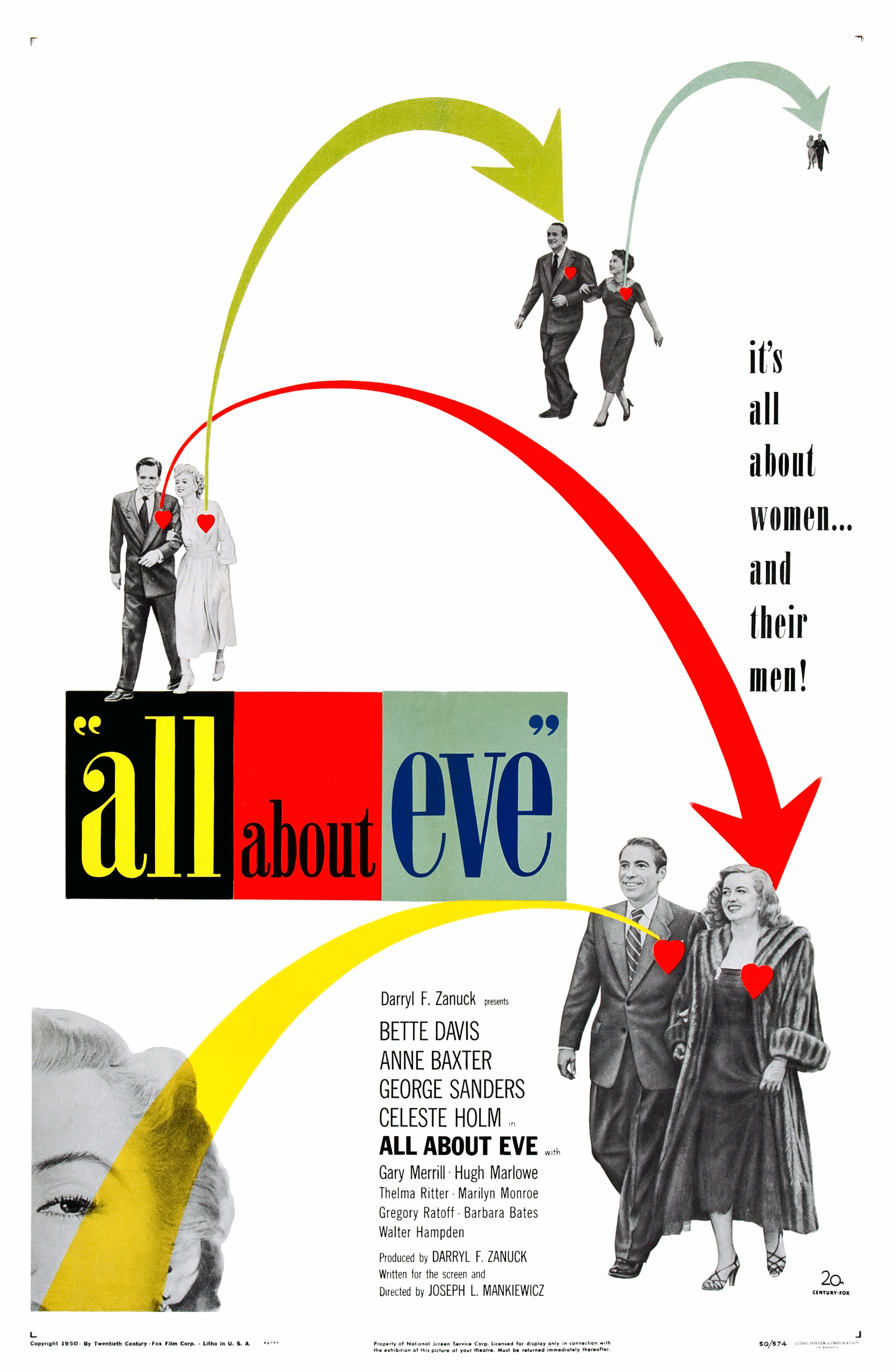
Behind the film
- Year
- 1950
- Director
- Joseph L. Mankiewicz
- Writers
- Joseph L. Mankiewicz
- Runtime
- 2h 18m
- Genres
- Drama, Comedy
- Production
- 20th Century Studios
- Country
- United States
- Cast
- Bette Davis, Anne Baxter, George Sanders, Celeste Holm, Gary Merrill, Hugh Marlowe, Thelma Ritter, Marilyn Monroe
About the film
Contains story spoilers.
All About Eve opens at the Sarah Siddons Award ceremony, where theatre critic Addison DeWitt introduces Eve Harrington as a rising actress and hints that the public story is incomplete. The narrative then shifts to Karen Richards, who remembers meeting Eve the previous October and introducing her to Broadway star Margo Channing. Eve says she followed Margo from San Francisco to New York after seeing her perform, and describes a hard life that includes losing her husband in the South Pacific during the war. Moved by her account, Margo takes Eve into her home as an assistant. Margo's maid Birdie is less impressed, and the film gives her skepticism a place alongside the admiration of Margo's friends.
Eve becomes part of Margo's routine, but she is also watching the relationships that keep the theatre company together. Margo is concerned about her romance with Bill Sampson, a director working in California who is younger than she is. Eve arranges a midnight call to him on his birthday without telling Margo, making herself useful within a relationship that is not hers. When Margo realizes she has been manipulated, she asks producer Max Fabian to find Eve another job. Karen intervenes and secretly convinces Fabian to make Eve Margo's understudy instead. The apparently helpful move gives Eve direct access to the role and sets up a performance opportunity Margo does not know she has created.
Karen later helps Margo miss a performance, hoping that Eve's understudy performance will humble Margo and settle her resentment. Eve instead invites theatre critics, including Addison, and wins the audience. She then attempts to seduce Bill, who rejects her. Addison's column praises Eve while criticizing Margo for resisting younger talent, and Eve subtly positions herself for the leading role in Lloyd Richards's next play. Margo and Bill become engaged, and at dinner Eve pressures Karen to recommend her for the new part, threatening to expose Karen's role in the missed performance. Margo surprises the group by stepping aside, admitting that she no longer needs to play an ingénue or make theatre her entire life.
Eve gets the role of Cora despite Bill's objections. Before the out-of-town opening, she tells Addison that she intends to marry Lloyd so he will write leading parts for her. Addison reveals that he knows her story is false: Eve's real name is Gertrude Slescynski, and the tale of her husband and San Francisco tour was invented. He says she had an affair with a married employer and was paid to leave town. Rather than expose her, Addison uses this knowledge to control her and forbids her from trying to marry Lloyd. The film's backstage world is not just a competition for roles; it is a web of favors, access and secrets in which a critic can exercise power as surely as a director or producer.
The frame catches up with the award ceremony. Eve is now a Broadway star preparing to go to Hollywood, but Margo, Bill, Lloyd and Karen respond to her speech with indifference. After the ceremony she returns home and meets Phoebe, a teenager who claims to be a devoted fan and has slipped into the apartment. Eve's irritation softens as Phoebe flatters her and asks to stay. When Addison returns with the award Eve left in a taxi, he recognizes that Phoebe is studying her new idol in the same way Eve once studied Margo. Phoebe holds the trophy and poses before a series of mirrors, suggesting that the cycle of ambition and imitation may repeat with a new actress at its center.
Joseph L. Mankiewicz's film uses layered narration to make theatrical gossip part of the structure: Addison begins the story, Karen supplies a long memory, and the award ceremony returns with a changed understanding of Eve. The backstage rooms, dressing tables and rehearsal spaces keep performance close to private life, while the characters continually manage how they are seen. Margo's shift away from the ingenue role is not simple defeat; she recognizes that Bill and a fuller life matter more to her than repeating a youthful part. Eve's rise, meanwhile, comes through calculated access and performance, and the closing mirror image gives the film a pointed ending without claiming that every aspiring actor follows the same path.
The award ceremony is public, but the routes into that room have been unusually intimate. Eve first gains access through a dressing room, then learns how to arrange a telephone call, manage an evening and anticipate the requirements of people who work together. Her opportunities emerge through apparently minor services before they become a claim on a leading part. Karen's decision to strand Margo away from the theatre is especially damaging because it comes from a friend who believes she is teaching a manageable lesson. She discovers that she cannot control what Eve does with the opening. Addison operates through a different kind of access: his column can convert a private rehearsal-room conflict into a professional reputation. When he confronts Eve with her invented past, praise and blackmail become two parts of the same leverage. Phoebe's private performance with the trophy finally brings these rooms together, turning an award meant to certify achievement into a prop for someone else's imagined ascent.