
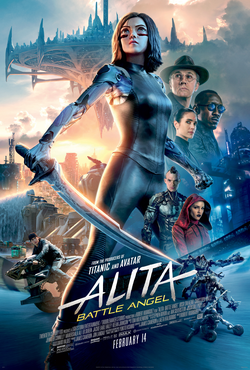
Behind the film
- Year
- 2019
- Director
- Robert Rodriguez
- Writers
- James Cameron, Laeta Kalogridis
- Genres
- Science fiction, Dystopian, Cyberpunk, Action
- Production
- Lightstorm Entertainment, 20th Century Studios, Double R Productions
- Country
- United States
- Cast
- Rosa Salazar, Christoph Waltz, Jennifer Connelly, Keean Johnson, Mahershala Ali, Ed Skrein, Jackie Earle Haley, Eiza González
About the film
Contains story spoilers.
Ido finds Alita's living brain in a discarded cyborg frame beneath the sky city Zalem and rebuilds her. With no memory, she befriends Hugo and discovers extraordinary combat instincts. A damaged body leads to her installation in an advanced Berserker form tied to her military past. Hugo steals cyborg parts while saving for promised entry to Zalem, but his employer Vector is deceiving him. Zapan mortally wounds Hugo; Chiren preserves his head with Alita's life support, and Ido gives him a cyborg body. Alita confronts Vector and destroys his enforcer, yet Nova remains in control from above. Hugo attempts to reach Zalem through a cargo tube and dies after Nova's defence ring destroys his new body. Alita later advances in Motorball, directing her resolve towards the still-unreached sky city.
The setting is organized vertically. Iron City is crowded with workshops, markets, bars, and industrial systems that keep people alive beneath Zalem, a clean silhouette hanging above their reach. The contrast is not only between poverty and wealth; it shapes how characters imagine the future. For Hugo, Zalem is a destination that can redeem years spent stealing cyborg parts. For Alita, the city is at first an unknown point on the skyline, while the streets below it become the place where she discovers friendships, danger, and purpose. The distance between ground and sky gives private longing a visible direction.
Alita’s body is the film’s most direct storytelling instrument. She begins with a human brain housed in a rebuilt mechanical frame, and the uncertainty between memory and sensation gives her awakening a childlike curiosity without making her helpless. Her face, gestures, and voice remain expressive as the body changes. The film uses performance capture to connect Rosa Salazar’s acting to an animated cyborg design, so a glance or pause can sit beside elaborate mechanical detail. Her physical form is not a costume layered over an already complete identity; it becomes part of the question she must answer about who she was and what she chooses to be.
Ido’s care for Alita is affectionate but cautious. He gives her a name drawn from his dead daughter and tries to keep her away from violence, while his own work as a Hunter-Warrior means he knows the danger better than she does. His hesitation about the Berserker body expresses both parental fear and knowledge of its military origin. The relationship becomes richer because his protective impulse can also restrict her. Alita is not a child in need of permanent instruction; she is a person who must interpret her abilities for herself, and Ido has to accept that love cannot decide her future on her behalf.
Hugo embodies the temptation of a promised escape. He is kind to Alita and helps her understand Iron City, yet his dream of entering Zalem makes him vulnerable to people who sell access as if it were a purchasable commodity. His criminal work is tied to the hope of leaving, and that arrangement places the relationship under moral pressure. Alita tries to help him because she cares, but the film does not let affection turn his choices into harmless detours. Hugo’s desire is understandable in a city that offers few routes upward, even as the lies surrounding that route put both of them in danger.
The city’s machinery and economy create a world in which bodies can be repaired, customized, traded, or destroyed. Cyborg limbs are ordinary enough to appear in street life, while a Hunter-Warrior license turns violence into regulated work. Motorball offers another formal channel for combat, combining spectacle with a possible route to Zalem for its champions. These institutions give the action scenes stakes beyond who wins a fight: each conflict takes place within a system that sorts people by usefulness and access. The movie’s science-fiction inventions are most coherent when they are attached to labor, sport, and the daily repairs required to live in Iron City.
Rodriguez places sudden physical combat alongside quieter scenes of discovery, letting Alita’s instinctive movement contrast with her uncertainty in ordinary social situations. The early fight reveals capability before she can explain it, while the bar confrontation gives that capability a public setting with other Hunter-Warriors watching. Fights are built around the specific shapes and limits of cyborg bodies; blades, gears, armor, and speed alter how space is crossed. The design keeps the action connected to character: Alita’s willingness to intervene is a decision about what she will accept, not merely a demonstration of a new weapon.
The unfinished ascent keeps the story's question of identity from becoming a simple reward for strength. Recovering evidence of a military past cannot by itself tell Alita what she should do next, just as entering a respected competition does not guarantee freedom from the surrounding order. She has to make choices with incomplete knowledge. That is what gives the open future its emotional significance: memory may help explain a capability, but judgement determines the purpose to which it is put. The film leaves room between being made for something and deciding to become someone. Its heroine's agency develops within that space, where inherited violence and personal care pull towards different possible lives.