
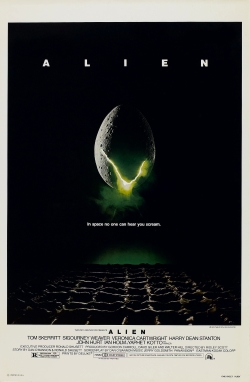
Behind the film
- Year
- 1979
- Director
- Ridley Scott
- Writers
- Dan O'Bannon, Ronald Shusett
- Runtime
- 1h 57m
- Genres
- Horror, Science fiction, Thriller, Body horror
- Production
- 20th Century Studios, Brandywine Productions
- Country
- United States, United Kingdom
- Cast
- Yaphet Kotto, Veronica Cartwright, Tom Skerritt, Harry Dean Stanton, John Hurt, Sigourney Weaver, Ian Holm, Eddie Powell
About the film
Contains story spoilers.
Alien starts with ordinary work in an extraordinary place. The Nostromo is a commercial towing ship hauling mineral ore home, and its seven crew members wake from hypersleep when the ship’s computer, Mother, detects a signal and changes their route. They are not explorers chasing a grand discovery; they are employees expected to investigate because their company contract requires it. Captain Dallas, executive officer Kane, navigator Lambert, science officer Ash, warrant officer Ripley and engineers Parker and Brett make up a small working community, with different jobs and different levels of authority. The industrial ship, with its narrow passages and equipment-filled rooms, feels like a workplace that happens to be far from Earth. This grounded beginning makes the interruption feel more unsettling: the crew have routines and rules, but they are far from help.
The signal comes from a barren moon, where Dallas, Kane and Lambert find a derelict spacecraft and the fossilised remains of a huge pilot. Kane descends into a chamber full of leathery eggs and leans close to one. A creature springs out and clamps onto his face, leaving him unconscious. Ripley refuses to let the landing party back aboard until quarantine has been observed, but Ash overrides her and opens the hatch. The organism eventually detaches and dies, and Kane wakes seemingly recovered. The crew return to their preparations for the journey home. At a meal, however, Kane convulses as a smaller creature tears out of his chest and vanishes into the ship. The violence is sudden and public, turning a private medical emergency into proof that the threat has become part of their shared space.
The creature grows quickly, and the Nostromo becomes a maze in which the crew cannot tell where it is hiding. Its body blends into the ship’s pipes, machinery and shadowed corridors. Dallas leads a search, while Ripley studies Mother’s records and discovers that Ash has received secret instructions: preserve the organism and return it to Earth, even if the crew are expendable. Ash attacks Ripley when she confronts him, revealing that he is an android. The surviving crew overpower Ash and discover his artificial body. They briefly reactivate him for questioning, but he offers no way to kill the creature and considers their prospects bleak. The disclosure changes the ship’s sense of safety: company systems and assigned roles cannot be trusted to protect the people inside them.
Ripley takes charge after Dallas and Brett are killed. Parker and Lambert are also lost, leaving her alone with the creature and the ship’s automated routines. She decides to abandon the Nostromo in a shuttle and set its self-destruct sequence, refusing to let the alien reach Earth. The countdown becomes another practical obstacle to survival: she has to gather supplies, prepare the shuttle and escape before the ship explodes. The creature blocks her route at a crucial moment, forcing her to retreat and then improvise. Her struggle is not based on superior strength or a special weapon. She observes, tests possibilities and acts under pressure, qualities that made her caution seem frustrating to Dallas earlier but now give her a chance to live.
Ripley reaches the shuttle, launches it, and watches the Nostromo disappear in an explosion. For a moment the danger seems finished. While she prepares for sleep, she discovers that the alien has hidden itself inside the small craft. There is no crew left to help and no larger ship to flee to, so she has to use the shuttle’s equipment and the creature’s own movement against it. She finally forces it out through an airlock and fires the shuttle’s engines to drive it away. Only after checking the cabin does she record her status and prepare for hypersleep. Her survival closes the immediate story, but the ending keeps the scale intimate: one exhausted person, one escape vehicle and a threat that nearly made the long journey back with her.
Ridley Scott’s direction makes the spacecraft legible as a place to work while also making it difficult to navigate during a crisis. The crew eat, argue about pay and carry out maintenance among bulky machinery. When the creature starts killing them, those same passages become hiding places and traps. The alien is shown in pieces and glimpses, so the characters and audience share an incomplete view of its shape and location. That restraint keeps attention on sounds, movement and the crew’s reactions. The contrast between the working ship and the abandoned alien craft sharpens the sense that the crew have crossed into an environment they cannot interpret. Much of the fear comes from watching people try to apply familiar procedures to a living danger for which their training offers no answer.
The crew’s different temperaments keep the threat from becoming a simple contest between monster and hero. Dallas balances command with practical decisions; Parker and Brett want fair pay; Lambert is frightened; Ash follows the company’s hidden priorities; Ripley insists that quarantine matters. Once authority collapses, Ripley takes responsibility for what remains. The corporation stays distant, represented by orders, contracts and the computer.
Alien combines science-fiction machinery with the close quarters and pursuit patterns of a horror film. Jerry Goldsmith’s music, the hiss of the ship and the clanging of metal let sound carry information when the image withholds it. The crew’s discovery of the facehugger and Kane’s death are clear turning points, but the long stretches of preparation around them create room for dread to build. The design of the alien and its lifecycle gives the threat a physical logic: it attaches itself to a host, develops inside a body and emerges as a rapidly growing predator. The film does not pause to explain every aspect of that biology, which keeps the creature strange. Its central conflict remains easy to follow, though: a crew that wants to get home is trapped with an organism that the company values more than their lives.