
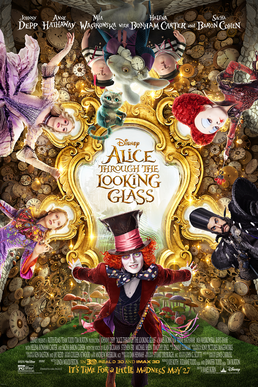
Behind the film
- Year
- 2016
- Director
- James Bobin
- Writers
- Linda Woolverton
- Runtime
- 1h 53m
- Genres
- Fantasy, Cinematic fairy tale
- Production
- Walt Disney Pictures, Roth Films, Team Todd
- Country
- United States
- Cast
- Mia Wasikowska, Johnny Depp, Helena Bonham Carter, Anne Hathaway, Sacha Baron Cohen, Rhys Ifans, Alan Rickman, Stephen Fry
About the film
Contains story spoilers.
Alice returns from a voyage to find her ship and family home caught in Hamish's demands. Through a mirror, she reaches Underland, where the Hatter's conviction that his family survives has become a crisis. She steals the Chronosphere from Time and visits the past, learning how a childhood lie shaped the royal sisters' conflict. She cannot change what happened, but discovers that the Hatter's relatives were captured rather than killed. His renewed hope leads to their rescue. The Red Queen takes the device and confronts her younger self, causing a paradox which spreads rust through Underland. Alice restores the Chronosphere, the sisters reconcile and the Hatter reunites with his family. Back in London, Alice and her mother retain the ship and build a business together.
The sequel uses time travel to ask what it means to revisit a painful memory. Alice is an adult who has built a life at sea, but the London conflict places pressure on the independence she inherited from her father. Underland gives the same question a fantastical form: its residents are caught in loops of grievance, blame, and nostalgia, and Alice hopes that access to the past will let her repair what the present cannot. The Chronosphere is therefore more than a gadget for moving between set pieces. It gives Alice the power to witness a history she did not experience and tempts her to treat insight as permission to change it.
Time’s character makes that temptation visible. He guards a mechanism that governs temporal movement, but his control is not the same as moral authority. His castle surrounds him with instruments, gears, and a sense of formal order; Alice’s curiosity immediately puts that order under strain. Sacha Baron Cohen plays Time with a precise, self-conscious manner that contrasts with the colorful impulsiveness of Underland’s familiar residents. The opposition is comic, yet it also gives the film a way to stage a debate between measurement and lived experience. A clock can track events without understanding the grief that makes someone want them undone.
The Mad Hatter’s crisis is the story’s emotional center. His eccentricity, normally a social performance that keeps the world off balance, becomes a visible response to loss. Alice must decide whether to treat his certainty as another absurdity or as a plea to take seriously. The film makes her act of belief the hinge between care and action: she cannot simply comfort him with words, so she investigates what happened to the Hightopp family. That choice connects the rescue plot to Alice’s own development. Courage here involves respecting another person’s memory even while the mechanism of time warns that intervention carries risk.
The sisters' conflict makes accountability more complicated than deciding which person looks kinder. An injury can explain resentment without giving every later response a moral justification. Equally, a pleasant manner does not remove responsibility for something a person would prefer to forget. The fantasy creates room for both questions instead of letting one character monopolise innocence. An apology matters because it acknowledges an event the injured person has carried alone, but it cannot make the event vanish. That is a different form of repair from the time-travel solution Alice initially seeks. The characters need an altered relationship with their history more than a world in which it never occurred.
The film’s visual world is organized around the contrast between London’s social rules and Underland’s animated disorder. Alice’s homecoming puts her among contracts, family status, and expectations about what a woman should inherit or command. Underland answers with impossible architecture, saturated color, and creatures whose bodies can express emotion as literally as dialogue. The design makes time tangible through the Grand Clock and Time’s mechanical domain, while the sea voyage gives Alice a grounded identity outside either world. Her final decision to work with her mother connects that independence to a practical future rather than leaving it as a costume or a single rebellious gesture.
Bobin directs the time-travel sequences as variations on familiar places rather than a purely abstract visual puzzle. The Chronosphere offers Alice a moving viewpoint through scenes from Underland’s earlier life, letting background details and character changes become part of the action. The film can shift from broad, kinetic fantasy to a close family memory without changing its central visual vocabulary of clockwork motion and exaggerated shapes. That continuity helps the audience follow a story in which events occur out of order. The setting stays recognizable even as its history is rearranged, and the danger becomes legible when the visual world begins to rust.
Alice's return connects the fantasy's lessons with a future she still has to construct. Understanding another person's history can clarify a choice without guaranteeing that the choice will be easy. Independence is also less lonely when it makes room for a partnership rather than demanding separation from every family connection. The sequel gives its heroine a practical expression of that possibility. Her confidence can support shared work without surrendering the curiosity that drives her. Across its two worlds, the story distinguishes looking backwards for an explanation from living backwards in the hope of undoing everything painful. The former may help a person act; the latter can prevent action altogether.