
Behind the film
- Year
- 1988
- Director
- Katsuhiro Otomo
- Writers
- Katsuhiro Otomo, Izo Hashimoto
- Runtime
- 2h 4m
- Genres
- Science fiction, Cyberpunk, Post-apocalyptic, Dystopian
- Production
- TMS Entertainment, Bandai, Kodansha
- Country
- Japan
About the film
Contains story spoilers.
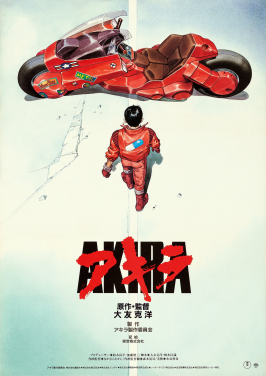
Akira opens in Neo-Tokyo, a vast city built after Tokyo was suddenly destroyed in 1988 and a world war followed. Thirty-one years later, street protests, political corruption and violent biker gangs compete for space in the crowded capital. Kaneda leads the Capsules, whose customised motorcycles make them easy to spot as they race through the city and fight the rival Clowns. Tetsuo, Kaneda’s oldest friend, rides with them but remains on the edge of the group, resenting the way Kaneda gives orders and jokes at his expense. During one night’s ride, Tetsuo crashes into Takashi, a small boy with strange psychic abilities who has escaped from a government facility.
The military captures Takashi and takes Tetsuo to a hospital, where doctors discover that he too has powerful psychic abilities. Colonel Shikishima and the research team recognize that Tetsuo’s potential resembles Akira, the child whose psychic development caused the earlier disaster. The colonel fears that another catastrophe is coming, but the city’s politicians dismiss his warnings and continue their arguments over control of the military. Tetsuo escapes from the hospital and steals Kaneda’s motorcycle to leave the city with his girlfriend, Kaori. The Clowns attack them, the Capsules rescue them, and the encounter leaves Tetsuo injured and increasingly unstable. He is taken back to the hospital, where researchers try to contain a power they helped awaken.
Tetsuo’s strength grows alongside his anger at being treated as the weakest member of the gang. He lashes out at the people who once protected him and refuses to accept Kaneda’s attempts to manage or rescue him. Headaches and hallucinations accompany his abilities, and he begins to push through walls, vehicles and armed guards without fully understanding what he can do. When the other psychics try to stop him inside the hospital, he turns on them and breaks away. Their warning that Akira may be able to help him sends Tetsuo toward the Olympic Stadium construction site, where the government has hidden Akira’s remains. The people around Tetsuo each see a different danger or opportunity in him, while Tetsuo sees another chance to escape their control.
Kaneda meets Kei, a member of a resistance group working against the government. He joins her in an attempt to reach Tetsuo, partly because he wants to protect his friend and partly because he does not want the military to decide what happens to him. Shikishima responds to the growing crisis by staging a coup and ordering the army to stop Tetsuo by any means. The public institutions that claim to keep Neo-Tokyo safe fracture into rival commands. Tetsuo returns to the Capsules’ former hangout and kills Yamagata during a confrontation over Kaneda’s motorcycle. When Kai tells Kaneda what happened, Kaneda sets out to confront him. Their personal history now sits inside a citywide emergency involving the military, the resistance and the three surviving child espers.
Tetsuo reaches the stadium and breaks into the underground chamber where Akira’s remains have been stored in jars. He expected to find another living psychic who could guide him, but discovers that Akira died years earlier and has been preserved for study. Kaneda arrives and fights him with a laser rifle, while Shikishima attacks from above with an orbital weapon that destroys Tetsuo’s arm. A mechanical replacement does not ease his pain or restore control. Kaori tries to restrain him, and Shikishima offers to help, but Tetsuo’s power overwhelms the people trying to reach him. His body expands into a gigantic mass that engulfs the stadium, Kaori and Kaneda. The transformation turns a contest of force into something the human body cannot survive on ordinary terms.
Takashi, Kiyoko and Masaru revive Akira’s remains in an attempt to stop the spreading mass. Akira creates a singularity that pulls Tetsuo and Kaneda into another dimension as Neo-Tokyo is destroyed again. Inside it, Kaneda experiences memories of his and Tetsuo’s childhood and of the experiments that shaped the three psychics. The flashes clarify how Tetsuo’s need to escape Kaneda’s shadow grew out of their shared past, but they do not reverse what has happened. The espers send Kaneda back to the ruined city and sacrifice their chance to return to this dimension. Tetsuo is taken somewhere beyond the collapsing singularity. In the closing image, he identifies himself as a new universe begins to form around him.
Kaneda returns to the flooded crater left by the destruction and finds that Kei and Kai have survived. They ride through the ruins together as Shikishima watches the sunrise. The city has lost its earlier skyline, its government and much of its population, but the final moments are quiet rather than triumphant. The film gives Tetsuo a form of transcendence while leaving Kaneda with grief and a world that must be rebuilt. Akira’s power appears as an event the state tried to study and contain, then failed to control; Tetsuo’s transformation repeats that failure on a new scale. The ending does not connect neatly to the full conclusion of the manga. It closes the film’s version of Kaneda and Tetsuo’s story on its own terms.
Katsuhiro Otomo’s animation makes Neo-Tokyo feel dense, lit and constantly in motion. The motorcycles, laboratories, stadium and crowded streets have precise mechanical detail, while the characters’ gestures keep their arguments legible amid the spectacle. The film’s action can expand from a gang chase to a coup and then to psychic catastrophe, but its emotional thread remains the unsettled bond between Kaneda and Tetsuo. A score built around percussion and wordless voices adds a ritual intensity alongside the crashes and explosions. The animation was made to recorded dialogue, which helps give facial movement and pacing an immediate, physical quality. That craftsmanship matters most when the image changes scale: Tetsuo’s mutation is horrifying partly because the film has made his earlier body and frustration so familiar.