
Behind the film
- Year
- 1972
- Director
- Werner Herzog
- Writers
- Werner Herzog
- Genres
- Drama, Adventure
- Production
- Hessischer Rundfunk, Werner Herzog Filmproduktion
- Country
- Germany, Mexico, Peru
- Cast
- Klaus Kinski, Cecilia Rivera, Ruy Guerra, Helena Rojo, Del Negro, Peter Berling, Daniel Ades, Armando Polanah
About the film
Contains story spoilers.
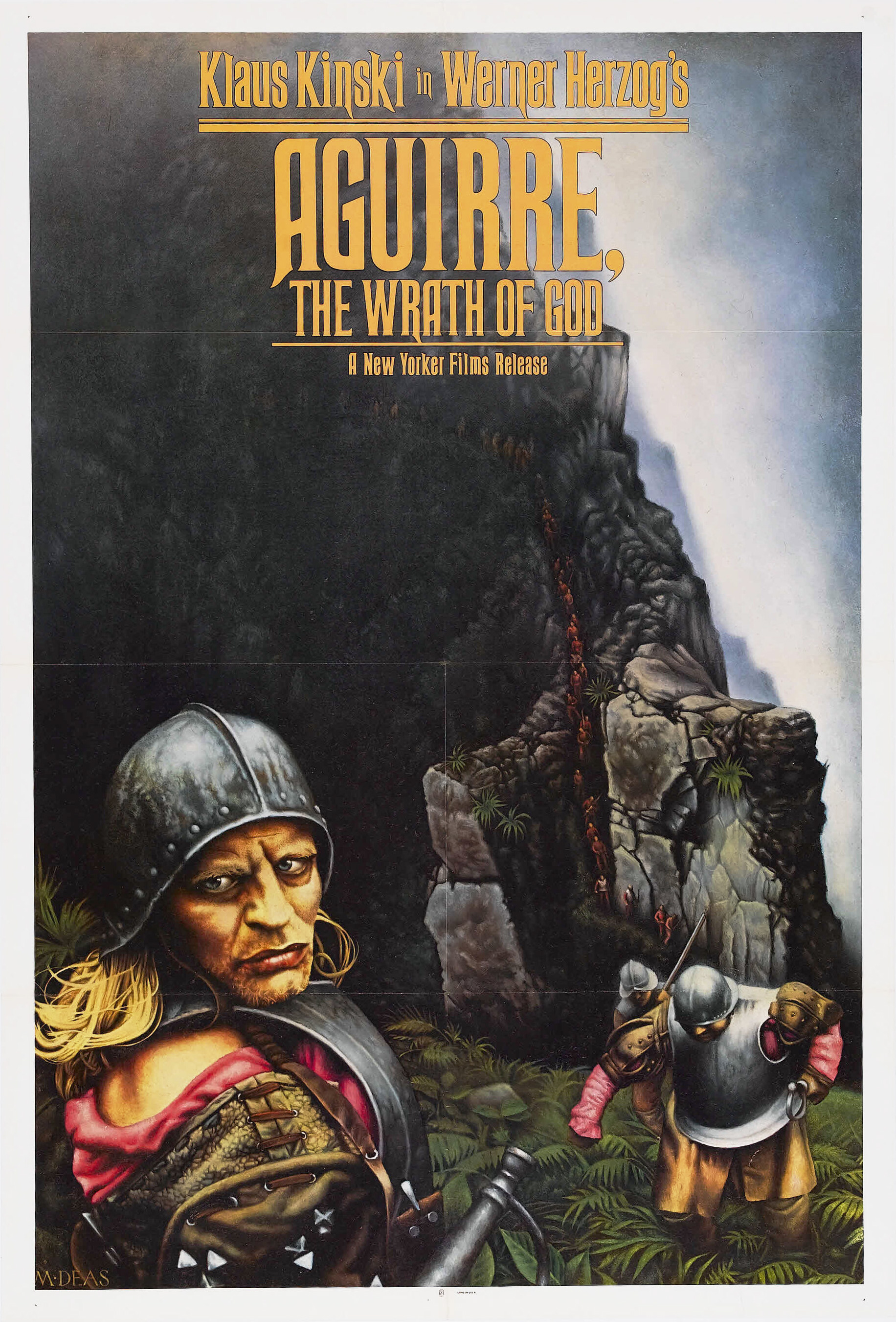
A conquistador force leaves the Andes for the Amazon in search of El Dorado, with enslaved Indigenous porters carrying supplies and equipment through the mountains. Pizarro sends a smaller group downriver to scout, under Pedro de Ursúa, with Lope de Aguirre as second-in-command. After a raft is trapped and its crew killed, the river carries the remaining rafts away from the main expedition. Ursúa decides to return, but Aguirre leads a mutiny and names Fernando de Guzmán emperor. Guzmán’s authority soon collapses, and Aguirre has Ursúa taken ashore and hanged. Inés disappears into the jungle, while hunger and attacks leave the party dwindling. Arrows kill the remaining crew, including Aguirre’s daughter Flores. Alone on a raft overrun by monkeys, Aguirre imagines conquering the New World and founding a dynasty.
Werner Herzog’s film takes an expedition story and steadily removes the familiar supports of an adventure. The group begins with a declared destination, a hierarchy and equipment meant to make the journey seem organized. As the river carries them away, those structures become less useful. The search for gold remains the expedition’s public purpose, but the men’s immediate needs shrink to food, safety and control over one another. Herzog lets the voyage lose forward momentum until ambition itself becomes the only engine left, creating a portrait of power detached from any workable plan.
The landscape is filmed as an active presence rather than a picturesque backdrop. Mist obscures the mountains, the river dictates the raft’s course, and the jungle’s scale makes the expedition look temporary. The men attempt to impose a European command structure on a place that does not respond to it. Long views of the terrain and closer observations of the laborers share the frame, so imperial ambition is surrounded by the bodies and conditions it tries to ignore. The film’s historical setting is fictionalized: Herzog uses real names and colonial circumstances to build an invented dramatic descent, not a reliable reconstruction of every event.
Klaus Kinski’s Aguirre makes authority visible as a physical posture. His damaged leg, rigid bearing and fixed stare give the character an unnerving presence even when he is not speaking. He is a subordinate who behaves as if hierarchy were only an obstacle to his personal sovereignty. That gap between rank and self-image shapes the mutiny: Aguirre does not merely argue that the mission should continue, he treats his own will as sufficient proof that it should. Kinski’s performance is severe but not abstract; gestures and shifts in attention expose how quickly the commander studies a room for weakness.
Authority becomes increasingly ceremonial when the group loses the practical means to sustain it. A title can still be announced, an order can still be issued, and allegiance can still be demanded, but none of those acts supplies food or makes a river obey. The grotesque distance between a claim and its consequences is part of the film’s political force. It is possible to preserve the appearance of hierarchy long after hierarchy has ceased to serve the people within it. Aguirre exploits that gap because command itself is what he wants. The expedition’s need for shared judgment becomes a weakness to be crushed rather than a resource to be used.
Herzog’s staging often holds the camera at a distance long enough for the expedition’s organization to appear fragile. The opening descent across the mountain is a miniature procession against enormous terrain; later, the raft offers a cramped stage with no stable horizon. The compositions make individual bodies seem caught between the landscape and the group, while the limited movement of the boat turns travel into a slow trap. Rather than relying on rapid action, the film allows waiting, silence and sudden violence to occupy the same visual world. The result is an adventure whose geography seems to narrow as it expands.
Popol Vuh’s score adds a strange, sustained atmosphere to the images. Its choral sound does not function like a conventional cue announcing a hero’s success; it makes the landscape feel ancient and indifferent to the expedition’s story about itself. Silence also matters. The river and forest remain audible around the men, while their plans sound increasingly disconnected from the environment that surrounds them. The film’s sparse dialogue keeps ideology from becoming a speech contest. Aguirre’s ambition is stated plainly, but the images continually measure it against the practical scale of hunger, current and distance.
The obsession with sovereignty makes power strangely lonely. To rule absolutely would mean excluding every competing will, yet an empire requires people whose actions give the ruler’s claims practical meaning. Aguirre’s fantasy cannot reconcile those demands. Anyone who resists threatens his authority, while anyone who obeys is gradually reduced to an instrument of a purpose that offers no security. The film’s harshness lies in making ambition persist without granting it dignity merely because it is immense. A grand claim can be childish, and unwavering conviction can be a refusal to recognise the conditions on which any achievement depends. What remains is a person insisting on command after command has lost its object.