
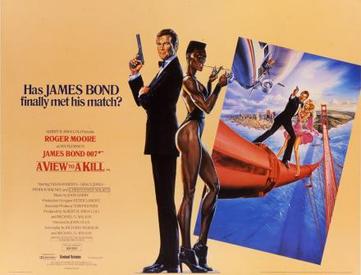
Behind the film
- Year
- 1985
- Director
- John Glen
- Writers
- Richard Maibaum, Michael G. Wilson
- Runtime
- 2h 11m
- Genres
- Action, Thriller, Spy, Adventure
- Production
- Eon Productions, Metro-Goldwyn-Mayer
- Country
- United Kingdom, United States
- Cast
- Roger Moore, Tanya Roberts, Grace Jones, Patrick Macnee, Christopher Walken, Patrick Bauchau, Willoughby Gray, David Yip
About the film
Contains story spoilers.
A View to a Kill begins with a compact Cold War problem: a British microchip is recovered from a Siberian military site, and Bond is sent to investigate how it got there. The investigation leads to Zorin Industries, whose polished public image conceals a plan to control the market for microchips. The film’s threat is not a single weapon so much as a chain of economic and physical consequences: if Silicon Valley is destroyed, the company expects to profit from the resulting monopoly. That premise gives the adventure an unusually legible connection between corporate power and spectacular disaster.
Bond’s first approach is social rather than forceful. He poses around the horse business, where Max Zorin’s operation intersects with Sir Godfrey Tibbett, an expert on horses posing as his chauffeur. Tibbett helps him inspect the stables and read the scheme from inside, but their cover is exposed. Zorin’s security chief May Day kills Tibbett, and Bond loses a trusted companion before the plot has even reached California. Roger Moore’s relaxed timing makes the shift from banter to danger feel especially abrupt; the joke is not that the stakes are unreal, but that Bond has to keep performing civility inside a lethal workplace.
The film moves through distinct arenas, each with a different physical texture. The Eiffel Tower sequence turns a public landmark into a vertical chase, with Bond pursuing May Day through the tower’s steel framework and across the city. In the San Francisco portion, the story leans on steep streets, industrial sites and the city’s signature bridges to keep geography visible. Director John Glen has described how the production mixed real locations and stunt work with studio construction and miniatures. The difference between a real façade and a controlled set is less important than the clear spatial problem each scene creates: where can Bond go, and how can the pursuer cut him off?
May Day is more than an obstacle in a striking wardrobe. She is Zorin’s leading security operative, a physically imposing presence whose loyalty seems secure until he sacrifices her to protect the larger plan. When he leaves her to die with a bomb, she recognizes that his promises have never included her survival. Her decision to help Bond remove the device does not erase her earlier violence; it gives her a final choice that is hers. Grace Jones plays her with a self-possession that makes the reversal intelligible without softening its cost. The film briefly lets an antagonist become a moral counterweight to the villain she served.
Stacey Sutton supplies another kind of resistance. She is a geologist whose knowledge of the land and business history gives her a practical role in exposing Zorin’s plan, though the film also places her in the familiar Bond-adventure position of being pursued and endangered. Bond alternates between protecting her and relying on her understanding of the company’s holdings. Their partnership is uneven, but the San Francisco sequences make her expertise relevant to the central question: the disaster is engineered around fault lines, flooding and the geography of the Bay. The landscape is not scenery alone; it is the mechanism the villains mean to exploit.
Zorin’s own story is shaped by the difference between public polish and private brutality. Christopher Walken plays him as charming enough to enter rooms without suspicion, then lets a sudden temper reveal how little he values the people around him. The scheme depends on technical ingenuity, but it is motivated by a simple appetite for control. His former KGB connection gives the plot a Cold War residue, while his Silicon Valley target updates the familiar spy-film contest from territory to infrastructure. The movie enjoys gadgets and disguises, but its most consequential instrument is Zorin’s willingness to make a local catastrophe look like an impersonal natural event.
The final confrontation takes place around the Golden Gate Bridge after Zorin escapes the failed mine operation with Stacey in his airship. Bond secures the airship to the bridge, climbs its structure and fights Zorin, who falls to his death. Mortner then mishandles dynamite aboard the airship, and its explosion kills him and Scarpine. Bond rescues Stacey. The distinct stages matter: May Day's earlier sacrifice removes the bomb that would complete the catastrophe, while the bridge struggle prevents Zorin escaping with his hostage. Defeating the plan and surviving its architect are separate problems. A scheme conceived on the scale of an entire industrial region ends with a fight over footing on a narrow piece of infrastructure.
John Glen’s direction emphasizes readable stunts over disorientation. The Eiffel Tower jump and the Golden Gate action rely on performers, doubles, practical structures and carefully composed effects, which gives danger a material scale. The locations also connect this film to Moore’s final Bond appearance: the character remains witty and improvisational, yet the world around him has become more corporate and technological. The film’s most distinctive tension is between the precision of its industrial plot and the broad, large-scale spectacle of its set pieces. It ends by treating adventure as a mixture of professional performance, local knowledge and split-second physical problem-solving.