
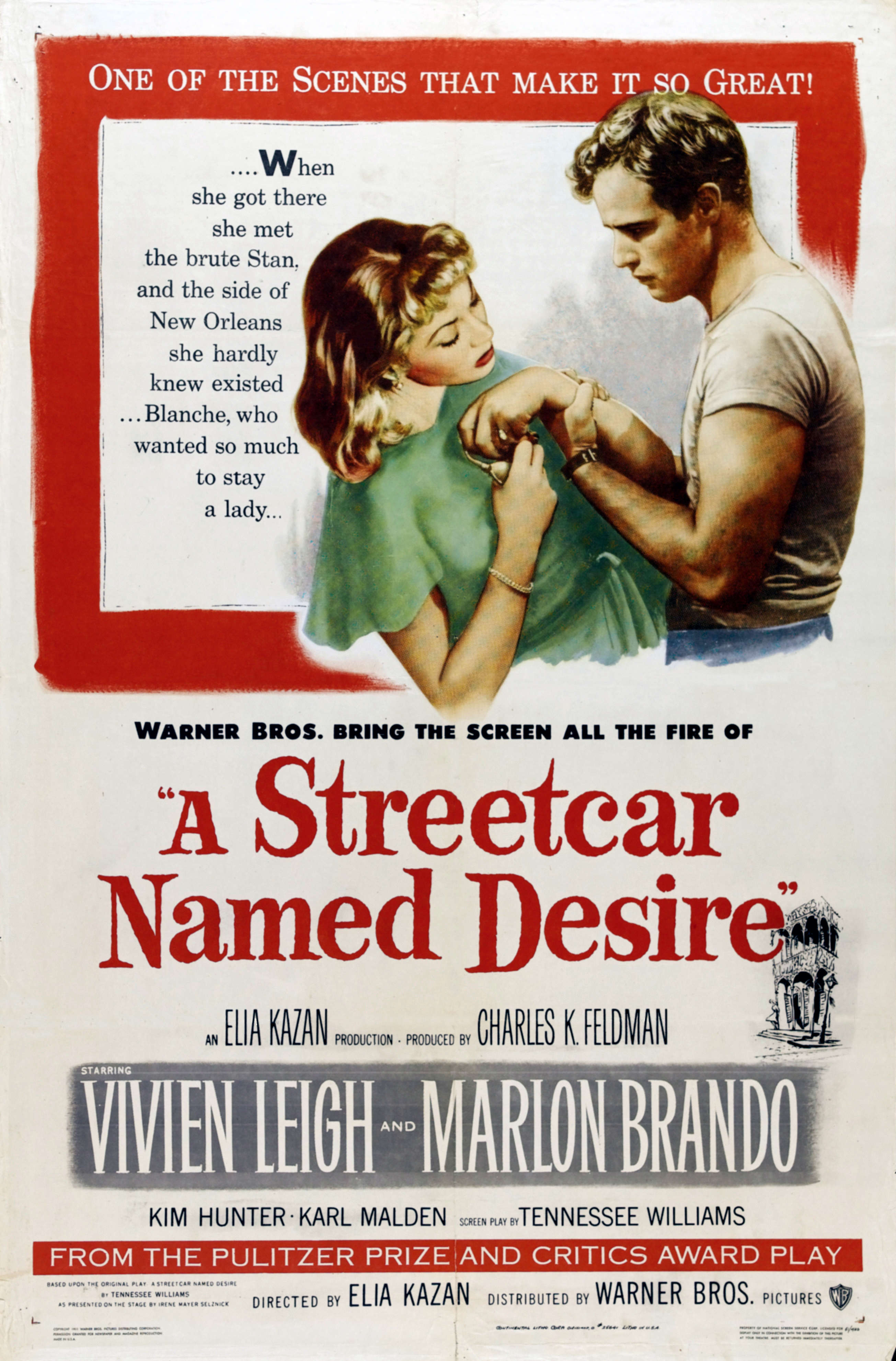
Behind the film
- Year
- 1951
- Director
- Elia Kazan
- Writers
- Tennessee Williams, Oscar Saul
- Genres
- Drama
- Production
- Warner Bros. Entertainment, Warner Bros. Pictures
- Country
- United States
- Cast
- Vivien Leigh, Marlon Brando, Kim Hunter, Karl Malden, Peg Hillias, Rudy Bond, Nick Dennis, Richard Garrick
About the film
Contains story spoilers.
Blanche DuBois arrives in New Orleans after losing the family estate and takes refuge with her sister Stella and Stella’s husband Stanley in their crowded apartment. Blanche and Stanley distrust one another almost immediately; he demands proof about the estate, while she disapproves of his rough manners. She grows close to Stanley’s friend Mitch, but Stanley uncovers Blanche’s history and tells him, destroying the possibility of marriage. When Stella goes into labor, Stanley and Blanche are left alone; he assaults her. Stella later arranges for Blanche to be taken to a sanatorium. Blanche leaves with a kindly doctor, while Stella, unable to remain with Stanley after what happened, takes her baby and runs to a neighbor’s apartment.
Elia Kazan keeps the film’s attention close to the Kowalskis’ apartment. The rooms offer little privacy, and the characters’ movements repeatedly bring them within earshot or sight of one another. This arrangement turns domestic space into a source of pressure: every conversation can be overheard, every visitor changes the balance of the room. The city outside supplies noise and heat, but the drama stays focused on a handful of rooms, a courtyard and the thresholds between them. The neighboring courtyard works as a pressure valve rather than a true escape, keeping the social world close. The compact setting makes emotional confrontation feel inescapable without requiring the film to make the apartment itself into a literal prison.
Vivien Leigh plays Blanche through deliberate self-presentation. Her careful speech, arranged clothes and practiced brightness suggest a person trying to control how she is seen, even as anxiety threatens to interrupt the performance. Leigh’s choices make vulnerability legible in small physical changes: a pause that lasts too long, a smile that arrives as a shield, a glance toward light. Blanche is neither simply dishonest nor safely romanticized. The film asks viewers to recognize how her fantasies help her endure shame and loss while also seeing how those fictions leave her exposed to other people’s power.
Marlon Brando gives Stanley a startlingly physical presence. His voice, posture and movements occupy the apartment with an ease that can feel welcoming one moment and intimidating the next. That everyday quality is central to the character’s danger: brutality emerges from a man who is not framed as a distant monster but as someone whose habits are accepted within his home. Stanley’s resentment of Blanche’s manners and class judgment does not excuse his conduct. The tension comes from watching social irritation harden into domination while the people closest to him struggle to decide what they can bear.
Kim Hunter’s Stella holds a difficult middle ground between sister and wife. She understands Blanche’s distress, but her attachment to Stanley and her desire to preserve a home pull her in a different direction. Hunter’s restrained acting makes Stella’s decisions painful because she often seems to be managing several incompatible loyalties at once. Karl Malden’s Mitch brings a more tentative energy to the ensemble; his longing for companionship is sincere, but he accepts Stanley’s account when Blanche’s past becomes a weapon. Together the performances make the household feel like a system of unequal dependencies rather than a simple contest between two opposing personalities.
The film’s black-and-white photography gives the apartment a layered visual texture. Doorways, windows and partitions divide the frame, while changes in shadow help distinguish what the characters show from what they conceal. Lighting becomes part of Blanche’s effort to manage appearances, but it also makes her setting feel more threatening as the story progresses. The camera can observe a conversation from close range, then let a face or gesture occupy the image long enough for an emotion to become uncomfortable. These visual choices adapt a play’s concentrated setting to cinema without dissolving its theatrical pressure.
Sound also shapes the apartment’s atmosphere. Music and street noise can interrupt conversation, and the characters’ voices carry through rooms that provide no real retreat. The result is a world in which private feelings are always close to public exposure. Alex North’s score supports the film’s unsettled tone without turning every conflict into a cue for melodrama. A remembered phrase, a burst of music or an abrupt silence can change the temperature of a scene. The sonic environment gives New Orleans a presence beyond scenery while keeping the story anchored in the characters’ immediate surroundings.
The final movement refuses to restore the apartment’s former balance or offer a consoling judgment that makes every choice simple. The film allows sympathy for Blanche and anger at Stanley to coexist with the troubling limits of Stella’s earlier loyalty. Its domestic frame makes protection feel like a question of action rather than sentiment: affection alone cannot undo harm. The close leaves the audience with recognition but no secure route to repair, preserving the story’s emotional unease after its most immediate crisis has passed.