
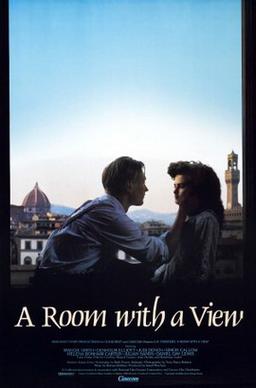
Behind the film
- Year
- 1985
- Director
- James Ivory
- Writers
- Ruth Prawer Jhabvala
- Genres
- Romantic comedy, Drama
- Production
- Merchant Ivory Productions, Goldcrest Films, Film4 Productions
- Country
- United Kingdom
- Cast
- Maggie Smith, Helena Bonham Carter, Denholm Elliott, Julian Sands, Daniel Day-Lewis, Judi Dench, Simon Callow, Rupert Graves
About the film
Contains story spoilers.
Lucy Honeychurch travels to Florence with her cousin Charlotte Bartlett. The Emersons give them rooms with a view, and George Emerson helps Lucy after she witnesses a fatal street attack. He kisses her during a countryside outing; Charlotte interrupts, demands secrecy and takes Lucy home. In Surrey, Lucy becomes engaged to Cecil Vyse, who unwittingly brings the Emersons nearby by recommending a rental cottage. At Windy Corner, Cecil reads Eleanor Lavish's novel aloud. Lucy and George recognise their private kiss in its pages: Charlotte has told Lavish. George kisses Lucy again. Lucy sends him away, then breaks her engagement to Cecil. Planning to escape to Greece, she encounters Mr. Emerson, who helps her acknowledge her love for George. Lucy and George marry and return to the Florentine pensione for their honeymoon, staying in the room with a view.
The choice of Forster's novel began with an invitation to Cambridge. James Ivory recalled that Forster's estate at King's College expected him and producer Ismail Merchant to take on A Passage to India. They had already decided they wanted A Room with a View. Having made Heat and Dust, Ivory wanted to return to Italy rather than repeat a Raj-period Indian setting. The estate agreed to their request. Merchant also made a direct approach to Maggie Smith: after seeing her in a London play, he went backstage and handed her the screenplay. Ivory described his approach to adaptation as keeping the author's basic story and tone while accepting that characters and passages must be cut. Work continued far from the Florentine locations. For this film, the upstairs of a barn at Ivory's home in New York became an editing room.
Ruth Prawer Jhabvala adapted the 1908 novel, with contributions from Ivory. The finished book was not their only Forster material. In his director's comments, Ivory identified The Lucy Novels, a collection of early drafts and notebooks, as another resource. Lucy's exchange with the guide inside Santa Croce, mixing Italian and English, came from Forster's notebook rather than the published novel. Other visual details also came from those notes. The film moves from Florence and the Tuscan countryside to Lucy's family home, Windy Corner, where her engagement to Cecil places George's kiss at a distance she tries to maintain. Location filming included the Piazza della Signoria and Santa Croce. Tony Pierce-Roberts photographed the landscapes, while Kiri Te Kanawa's performances of Puccini arias accompany them. Richard Robbins composed the score and Humphrey Dixon edited the film.
The opening introduces people with descriptive credits and divides the action with decorative scene headings. John Pym compared these to silent-film title cards; Te Kanawa sings Puccini's O mio babbino caro over the credits. Kent supplies the English countryside standing in for Surrey. Within this setting, manners become practical obstacles: Mr. Emerson's offer to exchange rooms alarms Charlotte because accepting help from strangers could leave her under an obligation. Lavish treats the journey differently, discarding the Baedeker guide and looking for material for her writing. The clergymen also differ. Reverend Eager tries to enforce propriety, including removing the carriage driver's girlfriend, while Reverend Beebe is readier to understand other people. Cecil's carefully cultivated bearing has its own physical interruptions. Pym points to the scene of him struggling with a bee, framed by a window, as his dignity falters.
Lavish's wardrobe gives her brisk manner a specific shape. Jenny Beavan and John Bright described her starched shirt, tie and ornamental pin, worn with a black cape and boater. Bright supplied the principal characters' clothes through Cosprop, and Judi Dench took an active part in choosing what Lavish would wear. Beavan recalled searching clothing racks with Bright to find pieces that felt right. For her, fittings allowed the actor's response to clarify a character in ways that drawings could not. Bright remembered finding the basics at a London fitting, then taking one or two suitcases to Italy for a second. The work moved quickly with a small crew. Beavan also recalled an awkward detail behind the picnic image: although the field looked picturesque, the ground beneath Eleanor and Charlotte's mackintosh squares was damp.
Lucy and Charlotte's clothes use different weights and shapes. The British Film Institute's account of Beavan's archive describes Lucy's light, flowing fabrics beside her older cousin's starchier, more rigid outfits. Cream, white and black dominate the costume palette. The archive's continuity files record each component of a character's clothing alongside reference photographs, arranging the costumes in their order through the film. Annotated scripts and photographs connect these choices to the scenes where they appear. Fabric samples and records of accessories document the attention given to individual garments, extending the distinction between Lucy and Charlotte beyond the outline of a dress.
Ivory gave Pierce-Roberts a broad brief for the photography: he wanted the film to feel light, happy and sunny, with a sense of frivolity. In his Walker Art Center conversation with David Sterritt, he described choosing photogenic locations as part of that approach. He generally discussed a scene's mood with the cinematographer and left the detailed lighting to him, occasionally asking for a particular effect. Getting the project before a camera had involved a delay. Ivory remembered putting Jhabvala's screenplay aside for about a year and making The Bostonians. A proposed contemporary film set in New York was then not ready, without a script they wanted to use. They returned to A Room with a View. His recollection leaves the precise point of the earlier shelving uncertain.