
Behind the film
- Year
- 1984
- Director
- Wes Craven
- Writers
- Wes Craven
- Runtime
- 1h 31m
- Genres
- Horror, Teen, Slasher, Supernatural horror
- Production
- Media Home Entertainment, New Line Cinema's House of Horror
- Country
- United States
- Cast
- Heather Langenkamp, Robert Englund, Johnny Depp, John Saxon, Ronee Blakley, Amanda Wyss, Nick Corri, Joseph Whipp
About the film
Contains story spoilers.
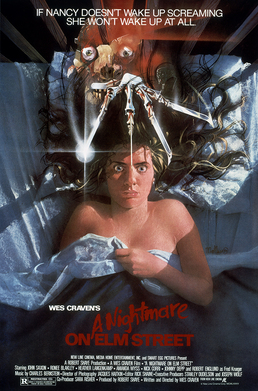
Tina dreams of a burned attacker with a bladed glove, then dies during another nightmare while her boyfriend Rod watches an unseen force kill her. Nancy and Glen have dreamed of the same figure. Rod is arrested, but Nancy's investigation reveals that dream injuries persist after waking; Rod is killed in his cell. Nancy pulls the attacker's hat into reality. Her mother admits that local parents burned child murderer Fred Krueger after his release from prosecution. Glen falls asleep and dies. Nancy rigs traps, brings Freddy into the waking world and sets him on fire, but he attacks her mother. Nancy denies him the fear that sustains him. An apparent peaceful morning turns sinister when a car traps the teenagers and Freddy seizes her mother.
The premise makes an ordinary bodily need into a source of danger. Escaping a threatening place may work in another horror story, but sleep cannot simply be removed from a life. Its characters have to remain alert while their ability to remain alert becomes less reliable. The situation also destabilises the audience's usual way of reading a scene. A familiar room can become threatening without first announcing that it belongs to a separate world. Wes Craven uses the relationship between dream and waking life to make reassurance provisional. Something may look normal and still be arranged according to a different logic, so recognition alone cannot provide the confidence that an ordinary environment usually offers.
Nancy's importance comes from how she responds to that uncertainty. Heather Langenkamp's character has to observe, test and connect experiences that other people would prefer to dismiss. Her effort gives the story a practical intelligence without requiring her to possess a complete explanation at the beginning. She is frightened, but fear does not make every decision for her. That distinction matters in a film where the threat gains force from its victims' responses. Nancy's agency develops through attention to what has actually happened, including details that do not fit the adults' preferred account. The audience follows a young person trying to make her experience intelligible in a world that keeps classifying it as something less urgent. Her resourcefulness is shaped by the failure of the reassurance she is offered.
Freddy's appearance gives that failure a recognisable presence. Robert Englund's figure is both bodily damaged and deliberately equipped to cause damage, joining the vulnerability of flesh to an instrument of control. The glove makes a hand into something that defeats the ordinary intimacy associated with touch. His ability to operate inside dreams extends the same violation into a supposedly private space. The frightening point is not simply that a monster can find someone at home. It is that the person can no longer assume any clear boundary between an internal experience and an external consequence. The film makes that boundary unstable while keeping the attacker identifiable, allowing uncertainty about the world to coexist with certainty that a particular figure is exploiting it.
The adults occupy a different relationship with knowledge. Their authority depends partly on presenting the neighbourhood as a place whose dangers can be understood and managed. The concealed past makes that presentation less dependable than it appears. John Saxon's policeman father and Ronee Blakley's mother bring different forms of attempted protection, but neither can supply a complete response by repeating a familiar role. That gives the generational conflict a material consequence. A young person may be told to trust adults who have withheld the very information she needs to assess what is happening. The film's suburban setting therefore contains more than an intrusion from outside. Its danger is connected to decisions already made within the community, and to the community's difficulty in living openly with those decisions.
The dream spaces allow the film to change the meaning of familiar objects and movements. A route that appears available can become a trap, while a reassuring surface can conceal a hostile action. That plasticity gives the horror a sensory force beyond the disclosure of the backstory. Understanding why the danger exists does not immediately make the danger easier to navigate. The character still has to move through environments whose rules can shift. The film balances that instability against the physical consequences that remain after a change of scene. A dream may refuse ordinary logic, but the harm does not become harmless when somebody wakes. That combination gives the imagined world a weight which purely symbolic nightmares would not necessarily possess, and makes the boundary itself part of the struggle.
Nancy's confrontation with fear also needs to remain within the film's fantasy. The story imagines a relationship between attention, terror and a supernatural attacker; it is not an explanation of real sleep disorders or a practical instruction for overcoming distress. Its dramatic value lies in how it changes the position of a character who has been forced into repeated reaction. Refusing an imposed relationship can become a form of agency, even when the ending leaves the security of that agency uncertain. The film does not offer a straightforward return to an untouched everyday world. Its last movement keeps the audience alert to how quickly a comforting arrangement can become another means of entrapment, preserving the unease that made ordinary experience unreliable from the beginning.
A Nightmare on Elm Street makes the familiar frightening by questioning what familiar appearances promise. A home, a parent, a police explanation and an ordinary morning can each seem to provide a stable account of reality, yet stability proves difficult to maintain. The teenagers' vulnerability comes partly from having to discover that difficulty before those responsible for them acknowledge it. That gives the film a specific emotional world beneath its supernatural violence. It concerns the effort required to trust one's observations when a more powerful voice insists on a simpler explanation. Nancy's persistence supplies a point of orientation within the nightmare, while the world around her resists becoming fully settled. The lasting disturbance is the possibility that waking up may change the scene without finally ending the threat.