
Behind the film
- Year
- 2025
- Director
- Jared Hess
- Writers
- Chris Bowman, Hubbel Palmer, Neil Widener, Gavin James, Chris Galletta
- Runtime
- 1h 41m
- Genres
- Adventure, Family, Comedy, Action
- Production
- Mojang Studios, Legendary Pictures, Vertigo Entertainment
- Country
- United States, Sweden
- Cast
- Jason Momoa, Jack Black, Emma Myers, Danielle Brooks, Sebastian Hansen, Jennifer Coolidge, Rachel House, Jemaine Clement
About the film
Contains story spoilers.
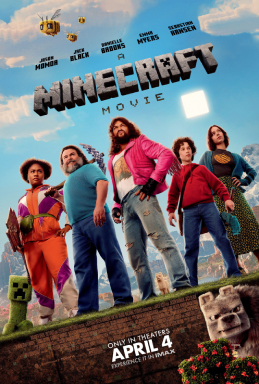
Steve discovers a portal to the Overworld, learns to build there and is imprisoned by piglin ruler Malgosha in the Nether. His dog Dennis hides the portal's Orb and Earth Crystal on Earth. Garrett acquires them at an auction; young inventor Henry activates them, drawing himself, Garrett, his sister Natalie and Dawn into the Overworld. After the Crystal breaks, Steve guides a quest for a replacement. Henry retrieves one from a mansion, but Malgosha steals the Orb and uses it to blot out the sun. The group builds defences; Henry recovers the Orb with an Ender Pearl, restoring daylight and defeating the piglins. Garrett survives an apparent sacrifice. Back home, the friends turn their experience into creative ventures, and Steve encounters Alex at his old house.
The film gives creativity a very literal form. An idea is not merely something a character describes or hopes to pursue later; it can become an object that changes the immediate situation. That makes the block-built landscape more than a distinctive visual backdrop. It offers a world in which making something is a way of acting, and where unfamiliarity can turn into competence through experiment. For someone entering without much knowledge of Minecraft, that is the most useful starting point. The environment rewards attention to materials and possibilities, while the adventure gives those possibilities a deadline. You can follow the emotional logic without recognising every creature or item: people who feel constrained elsewhere encounter a place where their choices can visibly reshape what surrounds them.
Henry brings that idea closest to an ordinary experience of being misunderstood. His imaginative energy is not automatically a comfortable fit with the expectations around him. In the Overworld, the same tendency can become useful rather than merely troublesome. That shift gives the fantasy an emotional purpose beyond escaping into an attractive setting. It asks what happens when a person's abilities meet an environment willing to respond to them. The answer is not that imagination removes every difficulty. Making something still involves risk, judgment and responsibility towards other people. Henry's place in the group keeps invention attached to a relationship with the world, rather than presenting it as a private talent that excuses everything else. His ingenuity matters most when it helps a shared undertaking.
Natalie offers a different relationship with that freedom. As Henry's older sister and guardian, she cannot approach every possibility as an interesting experiment without considering its consequences. Emma Myers's character gives the adventure a perspective shaped by responsibility, so creativity and care do not have to become opposing values. The contrast between the siblings makes the portal fantasy more substantial than a simple division between imaginative children and dull adults. Someone has to think about safety, and someone has to remain open to what safety alone might overlook. Their relationship gives those competing needs a personal setting. It also helps explain why going home matters: the characters are not empty visitors whose lives begin only when the blocks appear around them.
Garrett complicates the promise of a fresh start because his identity is attached to an old form of recognition. Jason Momoa plays a figure whose confidence and insecurity can occupy the same space, allowing the comedy to grow from how much he wants his standing to be acknowledged. Beside Steve's exuberance, that creates an odd partnership rather than a straightforward meeting of competent guides. Both men can fill a scene with personality, but their different claims to importance make cooperation less automatic. The film uses that friction to explore what happens when being impressive stops being the most useful goal. A shared task offers another measure of worth, one that depends on contribution rather than an audience agreeing to celebrate your old achievements.
Steve makes the Overworld feel inhabited before the newcomers understand it. Jack Black's performance treats knowledge as something that can be delivered with enthusiasm, bravado and a sense of personal attachment. That approach is important for a world whose rules could otherwise arrive as a dry instruction manual. An expert guide can explain a possibility and make it feel exciting at the same time. He also allows the film to distinguish familiarity from universal competence. Knowing your surroundings does not mean having solved every problem they can produce, especially when other people's needs enter the picture. The newcomers therefore retain a purpose beyond listening. Their different instincts create the possibility of an answer the established resident would not produce on his own.
Malgosha gives the conflict a particularly direct ideological shape: a world built around making and remaking confronts an enemy invested in domination. The contrast turns creative freedom into something the characters can defend together, rather than a slogan attached to unrelated action. It also gives the visual extravagance a readable emotional structure. The audience does not need an exhaustive account of fictional politics to grasp why a place offering possibility would be threatened by someone who wants control. At the same time, the film's broad comedy keeps that struggle within a family adventure. Its monsters, grand declarations and outsized personalities belong to a deliberately playful register. The danger supplies momentum without requiring the world to become a solemn treatise on its own mythology.
A Minecraft Movie translates a flexible game environment into a particular group adventure, so the useful expectation is a story built from that world's possibilities rather than a comprehensive guide to playing it. The distinction matters because discovery serves a different purpose on screen: it has to reveal something about a character as well as introduce an object or place. Dawn's presence and the contrasting personalities around her help make that discovery collective. Belonging comes through people finding ways to use what they can do, not through everyone becoming interchangeable experts. The film's emotional proposition is that an unusual ability can become a shared resource. Its fantasy makes that proposition visible, giving uncertain people a landscape they can change and a reason to change it together.