
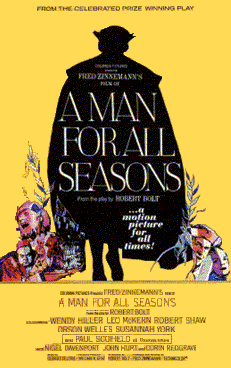
Behind the film
- Year
- 1966
- Director
- Fred Zinnemann
- Writers
- Robert Bolt
- Genres
- Biographical, Trial, Drama
- Production
- Columbia Pictures
- Country
- United Kingdom
- Cast
- Paul Scofield, Wendy Hiller, Leo McKern, Orson Welles, Robert Shaw, Susannah York, Nigel Davenport, John Hurt
About the film
Contains story spoilers.
Fred Zinnemann follows Thomas More as Henry VIII seeks an annulment and supremacy over the English church. More succeeds Wolsey as Chancellor but resigns rather than endorse the royal break with Rome. He refuses the required oath and is imprisoned, using silence to avoid an explicit denial that could convict him. Cromwell's pressure reaches a decisive turn at trial: Richard Rich falsely claims More rejected Parliament's authority to make Henry head of the Church. More denies the alleged statement and recognizes the office Rich has gained through his betrayal. Convicted, he finally speaks openly against the Act of Supremacy before his execution. Robert Bolt's adaptation then describes the surrounding figures' later fates. Its conflict turns on conscience, but also on a legal defense defeated by fabricated testimony.
The drama’s pressure comes from language that is carefully withheld. More does not deliver a long speech to defeat the king; he tries to preserve a boundary between what he believes and what the state can prove. In a courtly world, silence is not empty. It can be interpreted, recorded and punished. The film makes this tension legible through pauses, questions and the changing terms in which loyalty is described. More’s caution is often mistaken for evasion by those who want him to speak plainly, but that caution is also a method of survival. He understands how a sentence can be separated from intention and used as evidence. His eventual defense is forceful because the audience has watched him measure words for so long.
Paul Scofield’s performance gives More a calm surface without making him passive. He can use courtesy as a shield, but the shield does not hide the strain of being forced to choose between public compliance and private conviction. Scofield’s precision makes small changes in attention meaningful: a moment of humor, a hesitation or a sharper reply shifts the balance in a room. His More is neither a saint detached from ordinary concerns nor a rebel seeking martyrdom. The film shows his attachment to family and office, which makes the decision costly. His conscience is not presented as an abstract virtue that costs nothing; it threatens the relationships and security he has spent years building.
The supporting performances give the political system multiple faces. Leo McKern’s Cromwell is persistent and practical, treating the law as an instrument to bring the state’s wishes into enforceable form. Robert Shaw’s Henry appears only briefly, but his presence changes the scale of each discussion: the people around him are reacting to a ruler whose personal desire has become national policy. Wendy Hiller’s Alice More supplies a domestic counterpoint, challenging her husband in terms of the household’s immediate danger. Susannah York’s Margaret is impatient with the language games and more willing to question the premises of authority. These characters do not simply echo More’s position. Their distinct responses make visible how the same crisis reaches a court, a family and a private conscience differently.
Bolt adapts his own stage play, and the film retains the concentration of a courtroom and chamber drama while using cinema to move between political spaces. Rooms, corridors and formal gatherings become arenas in which the rules of speech shift. A private conversation can feel more dangerous than a public ceremony because the characters know how much may be inferred from a phrase. Zinnemann’s restrained staging keeps attention on people negotiating proximity, status and listening. The audience is not given a battle sequence to externalize the conflict; the conflict is in procedure, access and the authority to define a refusal. The limited physical scale sharpens the film’s central question: how much control can an individual retain when the state controls the setting in which his words will be judged?
The story also distinguishes moral consistency from political influence. More’s office gives him access to power, but leaving it does not stop the policy he opposes. His refusal cannot reverse the king’s decision or protect everyone around him. It can only define what he will personally affirm. This is why the film’s treatment of conscience is severe rather than triumphant. It recognizes that a principled act may have little immediate practical effect, while still maintaining that the act matters. The danger in the story is not only the threat of execution; it is the effort to make a person’s silence signify the opposite of what he intends. The trial sequence exposes that conflict between meaning and official interpretation without turning it into a general lesson about every legal system.
Bolt’s dialogue carries the story’s wit as well as its argument. More can be playful, and the humor is important because it keeps him connected to the ordinary world even when officials try to reduce him to a political problem. The film’s measured exchanges let rhetorical skill become action: a question can delay pressure, a qualification can protect another person, and a refusal can close off a route back to safety. Yet language has limits. Rich’s testimony shows how words can be arranged by ambition and power, while More’s defense cannot undo the verdict already forming around him. The final movement from courtroom to public execution narrows the drama to its bodily consequence. The film leaves the audience with a man who could not control the outcome, but who still chose what he would say about himself.