
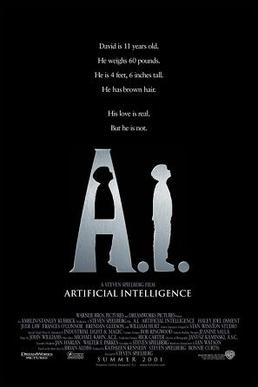
Behind the film
- Year
- 2001
- Director
- Steven Spielberg
- Writers
- Steven Spielberg
- Runtime
- 2h 25m
- Genres
- Science fiction, Post-apocalyptic, Drama
- Production
- Amblin Entertainment, The Kennedy/Marshall Company, DreamWorks
- Country
- United States
- Cast
- Haley Joel Osment, Frances O’Connor, Jude Law, Sam Robards, Jake Thomas, William Hurt, Brendan Gleeson, Jack Angel
About the film
Contains story spoilers.
In a future altered by rising seas and scarce resources, humanoid robots called mechas serve people in a society wary of machines that imitate human life. David is a prototype child designed to love whoever activates his imprinting protocol. Cybertronics gives him to Monica Swinton and her husband Henry while their son Martin remains in suspended animation with a serious illness. Monica is initially unsettled by David, but eventually activates him and introduces him to Teddy, Martin’s robotic bear. The arrangement turns a technological experiment into a family relationship with consequences no one has planned.
Martin unexpectedly recovers and returns home. His jealousy makes David a target for teasing, and one night David frightens Monica with scissors while trying to take a lock of her hair. At a pool party, Martin’s friend jabs David with a knife; his self-protection programming activates, and he grabs Martin, pulling them both into the pool. Martin is rescued, but the adults see David as a danger. Henry persuades Monica to take the child back to Cybertronics for destruction. On the way, she cannot go through with it and abandons him in a forest of scrap mechas, telling him to avoid humans.
Teddy stays with David, who takes the story of Pinocchio literally: if he can find the Blue Fairy, he believes she can make him a real boy and restore Monica’s love. A traveling Flesh Fair captures them, where obsolete mechas are destroyed before a hostile crowd. David pleads for his life, and the spectators turn against the organizers, giving him a chance to escape with Gigolo Joe, a mecha who has been framed for murder. Joe becomes their guide through a world where humans depend on robots but still fear and exploit them.
Their search takes them to Rouge City, a decadent resort where an information hologram called Dr. Know points David toward the flooded ruins of Manhattan. At Rockefeller Center, David meets Professor Hobby, his creator, who argues that David’s ability to love and desire is evidence of a genuinely human-like inner life. David then sees copies of himself waiting to be shipped, including female versions. The discovery devastates his sense of being unique. He attempts suicide by plunging into the water, but Joe rescues him in an amphibious aircraft before authorities capture Joe with an electromagnet.
David and Teddy take control of the aircraft and find what appears to be the Blue Fairy in a Coney Island attraction. The Wonder Wheel collapses onto their vehicle, trapping them underwater beside the statue. David keeps asking the figure to make him human until his power runs down. The film then jumps forward two thousand years: humanity is extinct on Earth, Manhattan lies beneath ice, and evolved mechas called Specialists discover David and Teddy. They reconstruct the Swinton home from David’s memories and explain that he cannot become a biological boy.
The Specialists use the lock of Monica’s hair that Teddy preserved to recreate her for one day. David spends that limited time with the mother he has been searching for, experiencing the ordinary closeness he could not secure when she was alive. As Monica falls asleep, she tells David she has always loved him. David lies beside her and closes his eyes while Teddy watches. The ending grants David a final day rather than a transformation into a human being; the wish at the center of the journey is answered emotionally, under a strict and irreversible limit.
Steven Spielberg's screenplay carries David through three very different environments: the family home, the violent road adventure and a frozen future without people. Inside the house, the child-sized robot must read pauses, routines and expressions whose meanings have not been explained to him. Outside it, obedience and attachment cannot protect him from adults who see an object they are free to use or destroy. The final landscape changes the scale again, placing that private attachment beyond the lifetime of the civilization that created it. The transitions are severe, but Teddy supplies a small continuity. He remains a companion and preserves the object that can eventually make a reunion possible. A domestic keepsake survives transformations of place and time that David himself cannot predict.
Haley Joel Osment plays David with an unnervingly steady gaze and carefully controlled physicality, while Frances O’Connor’s Monica moves between affection and fear as the family situation changes. Jude Law’s Gigolo Joe brings a polished, performed identity to a robot navigating human spaces. Teddy serves as companion and keeper of the one object that can make David’s final day possible. The film’s science-fiction setting is built around questions of dependence and responsibility: the humans create a being capable of attachment, but they treat his devotion as a feature they can switch on and off. Rouge City turns the search into a surreal detour through a consumer world built around human appetites, with Joe's confident persona functioning as both protection and performance. In submerged Manhattan, ruined streets and the Statue of Liberty place David's private hope inside a landscape reshaped by climate catastrophe. The scale prepares the ending: human civilization disappears, but a robot's memory remains legible to its successors.