
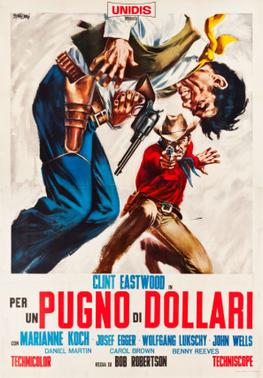
Behind the film
- Year
- 1964
- Director
- Sergio Leone
- Writers
- Sergio Leone, Duccio Tessari
- Genres
- Spaghetti western, Western, Action
- Production
- Constantin Film
- Country
- Italy, Spain, Germany, United States, West Germany
- Cast
- Clint Eastwood, Gian Maria Volonté, Marianne Koch, José Calvo, Wolfgang Lukschy, Sieghardt Rupp, Joseph Egger
About the film
Contains story spoilers.
The stranger arrives in San Miguel with little that makes him look like a conventional rescuer. Clint Eastwood's gunman is watchful, terse, and prepared to make money from a bad situation. The town is divided between the Rojo family and the Baxters, whose connection to the sheriff gives one criminal interest an official-looking face. Innkeeper Silvanito explains the balance to the newcomer, who notices opportunity rather than immediately proposing to restore justice. His first demonstration of skill makes him useful and dangerous to both sides. He can enter their business because each believes a hired fighter might strengthen its position against the other.
The rivalry turns information into a commodity. The stranger can earn more by keeping both families uncertain than by serving one loyally, so movement between their camps becomes part of his work. A massacre involving soldiers and stolen gold supplies a particularly valuable secret. He uses bodies in a cemetery to create the appearance that witnesses have survived, then directs attention toward them. The deception makes the factions act on what they think the other side might discover. Its effectiveness depends on their existing suspicion and willingness to use violence. He does not have to invent the feud; he only has to give it a new object around which to organize its fear.
Marisol exposes a different consequence of Rojo power. Ramón holds her apart from her husband, Julio, and their young son, treating the family's debt as a reason to possess her. She can be exchanged during the feud without being allowed to determine where she goes. The stranger's involvement changes when he helps her escape and gives the family money to leave. A profitable game between armed employers has become an intervention on behalf of people who cannot compete in it. He explains little about his own past, so the choice has to carry its meaning through action. Whatever his interest in payment, there is a limit to what he will leave untouched for the sake of the arrangement.
The Rojos discover his part in the escape and beat him severely. The film makes that loss of control physical: he cannot rely indefinitely on looking calmer than the people around him or knowing something they do not. When he gets away, the Rojos assume the Baxters are protecting him and destroy their rivals. The strategy that kept the two families engaged has produced a brutal imbalance, leaving the stranger dependent on help from people with far less power. Coffinmaker Piripero assists his concealment and escape, while Silvanito is exposed to retaliation. The town's ordinary workers have become necessary allies in a conflict the gunman initially thought he could manage for his own advantage.
Recovery gives the final confrontation a period of preparation rather than making it another spontaneous display. The stranger returns when Silvanito is in danger, facing Ramón in the street with a concealed metal plate protecting his chest. Ramón's confidence in his rifle encourages him to repeat the same attack even when it fails. Once that certainty breaks, the gunman's speed and control determine the encounter. Silvanito also saves him from an attack from behind, making the outcome dependent on another person's attention. The stranger rides away rather than accepting an office or a settled place in the town. Intervention has changed San Miguel without supplying a full account of how its people will live afterward.
Sergio Leone uses faces and space to make the contests readable before a shot is fired. A close view can turn a glance into a threat, while a street or courtyard establishes how far opponents must cross and who can watch them. Eastwood's poncho and restrained speech give his character a recognizable outline without explaining all of his motives. Gian Maria Volonté's Ramón is more openly forceful, expressing confidence through a willingness to dominate others. The difference is not simply quiet virtue against loud evil. The stranger is also a manipulator, but the story gradually asks what he will do when calculation places vulnerable people in his path.
Ennio Morricone's music gives the film a presence beyond realistic frontier sounds, making confrontation feel staged without dissolving its danger. The town's dust, rough buildings, and interruptions of cruelty keep that stylization connected to a place where people have to work and survive. Silvanito can offer information and practical kindness while remaining unable to command the armed men; Piripero's trade gains a bleak usefulness wherever their feud leaves bodies. Marisol and her family make the costs less anonymous. Their escape becomes important precisely because the gunman's larger maneuvers often treat other people as pieces in a contest. Helping them is one act that changes the terms of his participation.
The film takes the stranger-in-a-divided-town premise into an Italian-made western, with a clear relationship to Akira Kurosawa's Yojimbo. Its focus is on tactical independence rather than the establishment of a lawful community by a straightforward hero. The gunman can be interested in money, act compassionately, suffer for it, and still leave without becoming fully known. That mixture gives the title more than one useful emphasis: payment is a motive, but it is not a complete explanation of the decisions made along the way. By the end, his ability with a weapon has mattered less on its own than his choice of when to use it and whose freedom is worth jeopardizing his own safety.