
Behind the film
- Year
- 1988
- Director
- Charles Crichton, John Cleese
- Writers
- John Cleese
- Genres
- Heist, Crime comedy, Black comedy
- Production
- Metro-Goldwyn-Mayer
- Country
- United States, United Kingdom
- Cast
- John Cleese, Jamie Lee Curtis, Kevin Kline, Michael Palin, Maria Aitken, Tom Georgeson, Patricia Hayes, Geoffrey Palmer
About the film
Contains story spoilers.
A Fish Called Wanda begins with a group capable of completing a crime and then makes cooperation the thing they cannot sustain. The diamonds have been stolen, but possession remains unsettled because each participant wants the successful operation to become a different private success. That gives the farce a clear engine. People must keep approaching one another as useful allies while preparing to abandon them when usefulness ends. Information becomes more valuable than agreement, and an attempt to obtain it can create the interference that prevents the next plan from working. The comedy grows through that collision between a shared practical objective and incompatible intentions concealed inside it.
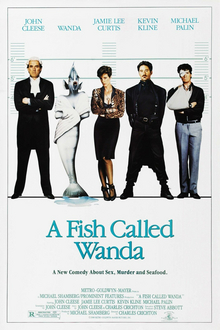
Charles Crichton directs the 1988 film, with a screenplay by John Cleese from a story by Cleese and Crichton. Jamie Lee Curtis plays Wanda, Cleese plays barrister Archie Leach, Kevin Kline plays Otto and Michael Palin plays Ken. The heist setting supplies a problem whose answer is concrete: somebody knows where the diamonds are. Around that simplicity, the film builds complications through attraction, jealousy, embarrassment and failed intimidation. London becomes a world of professional appearances that the criminals can exploit, while Archie's respectable position proves less stable than the people approaching him expect it to be.
Wanda and Otto betray gang leader George, then discover he has moved the diamonds. Wanda courts Archie to obtain their location, while jealous Otto disrupts her approach. Ken's attempts to remove a witness produce disastrous results. Wanda gives evidence against George, exposing Archie's attachment during the trial. The chase eventually reaches the airport, where Wanda abandons Otto and leaves with Archie and the loot. Ken gets his revenge on Otto, who survives the farcical confrontation. The ending lets escape emerge from a collapse of alliances, rather than giving the gang a victory its members can comfortably share.
Wanda's approach requires different people to believe different things about her. That makes performance a practical form of power, but also creates work she cannot wholly control. Each target supplies expectations that she must answer convincingly enough to retain access, and the people helping her can interrupt the account she is trying to maintain. The film's attraction-and-deception structure is funniest when control looks almost complete before another person appears with an incompatible understanding of the same encounter. The character's flexibility gives her an advantage, yet flexibility does not remove the need to keep several relationships from revealing one another's terms at the wrong moment.
Archie's position makes embarrassment a threat to an established life. The promise of something exciting arrives through conduct that his public role cannot easily accommodate, creating a gap between composure and desire. A professional person can know how to manage a formal situation while becoming remarkably ineffective in a private one. The film uses that contrast without needing his respectable world to be wholly admirable. His wish to leave its restrictions becomes understandable, but the proposed escape still involves betrayal and stolen property. Comedy allows the transformation to be enjoyable without turning the decisions involved into an uncomplicated model of personal liberation.
Otto makes confidence look increasingly detached from judgement. His insistence on being taken seriously becomes one of the conditions making him disruptive, especially when jealousy changes a supposedly practical arrangement into a contest over status. That gives the character a different relation to information from Wanda's. She adapts her presentation to obtain it, while he often tries to force people to recognise the authority he assumes he possesses. The resulting interference exposes a useful comic distinction: intimidating somebody is not the same as understanding what they know, and looking dangerous does not guarantee that a plan will survive the behaviour through which danger is displayed.
Ken's strand gives the comedy an intentionally cruel edge. The attempts to resolve the witness problem repeatedly harm the animals he cares about, making the gap between his intention and its results especially pointed. That material belongs to the film's dark farce rather than a gentle caper in which nobody's suffering matters. His treatment by Otto also makes speech and power part of the conflict, with a stutter becoming something a bully exploits. The later reversal offers comic release, but understanding the tone requires recognising how much the film builds that release from humiliation and harm, not merely from amusing confusion among equally confident participants.
The airport ending makes movement a final answer to a problem nobody has resolved through stable agreement. Archie and Wanda leave an arrangement that has exposed how quickly usefulness can become rivalry, while the diamonds reward the people who make it onto the plane rather than the most trustworthy participants. A Fish Called Wanda combines a simple missing-loot question with personalities unable to keep their private needs outside the plan. Its world is clearest when competence is understood as conditional: a person can be persuasive, intimidating or professionally accomplished and still be undone by the situation their own behaviour helps create. The farce repeatedly makes that contradiction visible at the worst possible time.