
Behind the film
- Year
- 1992
- Director
- Rob Reiner
- Writers
- Aaron Sorkin
- Genres
- Trial, Thriller, Drama, Crime
- Production
- Castle Rock Entertainment
- Country
- United States
- Cast
- Tom Cruise, Demi Moore, Kevin Pollak, Kevin Bacon, Jack Nicholson, J. T. Walsh, Kiefer Sutherland, James Marshall
About the film
Contains story spoilers.
A Few Good Men begins with a death that the surrounding institution would prefer to explain through a small, manageable group of defendants. A trial can decide what two men did, but that decision may leave untouched the system that made them believe their actions were expected. The defence has to confront both problems. Proving a chain of command exists is not the same as proving that a specific order travelled down it, and demonstrating that an order was given does not automatically settle what the people carrying it out should have understood about their own responsibilities.
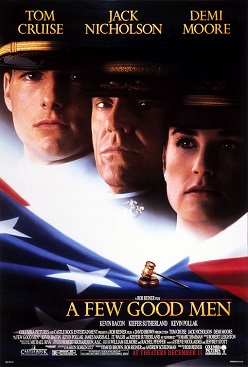
Rob Reiner directs the 1992 film from Aaron Sorkin's screenplay, adapted from Sorkin's play. Tom Cruise plays Daniel Kaffee, Demi Moore is JoAnne Galloway and Kevin Pollak is Sam Weinberg. Jack Nicholson's Colonel Jessep becomes the figure whose confidence in his authority the defence must challenge. The courtroom brings those contrasting forms of confidence into a confined public space. Kaffee needs statements he can test and contradictions he can expose, while Jessep speaks from the conviction that people outside his command cannot properly understand its demands. Their confrontation concerns who gets to define duty as much as who can establish facts, making the witness stand a test of institutional power.
At Guantánamo Bay, Santiago dies after Marines Dawson and Downey subject him to a forbidden punishment known as a code red. Kaffee initially favours a plea arrangement, but Galloway presses him to investigate. The defence pursues the possibility that superior officers ordered the action and then concealed it. On the stand, Jessep's account becomes inconsistent, and Kaffee provokes an admission that he ordered the punishment. Jessep is arrested. Dawson and Downey are cleared of murder and conspiracy, yet convicted of conduct unbecoming and dishonourably discharged. Their legal outcome does not make them innocent of failing the man they were supposed to protect.
Kaffee's early preference for a settlement makes sense as a professional habit: it offers a result that can be predicted and completed. The problem is what becomes invisible when finishing the case is treated as the primary objective. Galloway forces attention back towards the clients, the dead Marine and the implications of an account that the command is willing to accept. That pressure does not simply turn caution into cowardice or persistence into automatic wisdom. It makes Kaffee confront the difference between reducing immediate risk for defendants and investigating why they arrived in the courtroom at all.
Dawson's understanding of honour is especially important because he has treated military belonging as a source of moral certainty. Loyalty, discipline and obedience appear to give him a stable framework for judging conduct. Santiago's vulnerability disrupts that framework. If a superior's expectations are allowed to decide everything, protecting a weaker member of the unit can become secondary to proving commitment to the unit's standards. The film asks what happens when those standards have been shaped by people whose power protects them from the consequences. Dawson has to recognise that belonging cannot relieve him of judging how that belonging is being enforced.
Jessep's position depends on making his work seem inaccessible to ordinary scrutiny. The burden of protecting others becomes, in his account, a reason others should hesitate to question how protection is achieved. That argument gives his presence on the stand its particular force. He is being asked to answer within a procedure whose authority he regards as smaller than his own experience. Kaffee cannot defeat that attitude by matching its volume alone. He has to make the explanation contradict itself, so that the confidence with which Jessep speaks supplies a route to exposing what the confidence has been covering.
The courtroom also changes the meaning of performance. Kaffee's manner can initially suggest that he is relying on ease and quickness rather than taking the case seriously. As the evidence develops, those qualities become useful only when they are attached to preparation and judgment. Galloway and Weinberg are part of that process, giving the defence a collective structure rather than letting it function as one inspired man's intuition. The final examination has a personal confrontation at its centre, but it depends on information, resistance and work accumulated before the two men face one another in public.
The verdict refuses the simplest version of vindication. The defendants escape the gravest charges, yet their discharge preserves the consequence of participating in cruelty. Dawson's recognition that they failed to protect Santiago makes the ending more demanding than the exposure of a corrupt superior alone would have been. Responsibility exists at more than one level, and finding the order's source does not erase the choices made beneath it. As a fictional courtroom drama, the film uses the trial to make that distinction legible: honour must include the person who needs protection, even when defending that person means refusing the expectations of the group.