
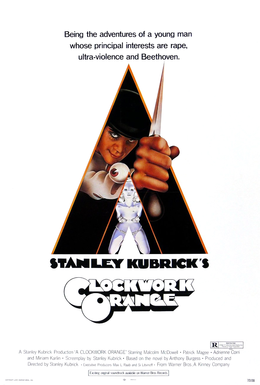
Behind the film
- Year
- 1971
- Director
- Stanley Kubrick
- Writers
- Stanley Kubrick
- Genres
- Drama, Crime, Dystopian, Thriller
- Production
- Warner Bros. Entertainment, Warner Bros. Pictures
- Country
- United Kingdom, United States
- Cast
- Malcolm McDowell, Patrick Magee, Michael Bates, Warren Clarke, Adrienne Corri, Carl Duering, Pauline Taylor, Aubrey Morris
About the film
Contains story spoilers.
Stanley Kubrick’s A Clockwork Orange opens at the Korova milk bar, where Alex DeLarge and his droogs drink milk laced with drugs before heading into a night of violence. They beat a homeless man, fight a rival gang and assault the writer Frank Alexander and his wife. Alex leads the group with charm and intimidation, but the others grow tired of his control. During a later burglary at a wealthy woman’s home, Alex kills her with a sculpture. His droogs abandon him to the police, and he is sentenced for murder.
After two years in prison, Alex volunteers for the Ludovico treatment, hoping it will shorten his sentence. The method straps him into a chair, holds his eyes open and forces him to watch images of violence while drugs make him nauseated. Beethoven accompanies some of the films, so the treatment links a composer Alex loves to physical sickness. Officials test the result by having him respond to a man’s attack and a woman’s exposed body. The prison chaplain objects that Alex has lost the ability to choose, but the minister sees the demonstration as proof that the technique works.
Alex returns to a life that has moved on without him. His belongings have been sold to compensate his victims, and his parents rent out his room. A vagrant he once attacked recognizes him and beats him; two police officers rescue Alex, only to reveal themselves as his former droogs Dim and Georgie. They take him into the countryside and nearly drown him before abandoning him; he then seeks help at the home of Frank Alexander, who now uses a wheelchair. Alexander does not initially recognize the guest as the attacker who crippled him and assaulted his wife years earlier.
Alexander’s political allies want to use Alex as evidence against the government’s treatment program. When Alex sings ‘Singin’ in the Rain’ while bathing, Alexander recognizes him and imprisons him upstairs. He plays Beethoven’s Ninth Symphony from below, triggering the violent nausea embedded by Ludovico. Unable to escape the sound, Alex jumps from the window. The attempt leaves him injured in hospital, where the government faces public criticism and wants his cooperation in a political counterattack against Alexander.
The minister visits Alex, apologizes and offers care and a job if he will support the government. After psychological tests, Alex discovers that the conditioning has been removed and he can again imagine violence without becoming sick. The film ends with him indulging that fantasy as a crowd applauds in his mind. The conclusion follows the American edition of Anthony Burgess’s novel, omitting the later chapter in which Alex grows bored with violence and changes. It leaves the question of free choice deliberately uncomfortable rather than resolving Alex as reformed.
Kubrick’s wide lenses, symmetrical compositions and bold interiors make the world feel designed around performance and surveillance. Alex’s first-person voice makes his language playful even when his actions are brutal, creating a distance the film never fully settles. Wendy Carlos’s electronic arrangements and Beethoven recur as part of the conditioning scenes, where the state weaponizes the music that gives Alex pleasure. The film’s focus is not simply whether crime can be prevented, but what a government is willing to remove from a person in exchange for measurable compliance.
The repeated displays of treatment make the state’s definition of rehabilitation visible: Alex can no longer strike back or tolerate sexual arousal, and officials call that success even as the chaplain sees a moral problem. His former victims do not receive the same attention once the government wants him as a symbol. Alexander’s attempt to turn Alex into an anti-government exhibit uses him as strategically as the minister does. By passing between these competing uses of his body, the story refuses to present conditioning as a neutral medical fix.
Alex’s prison behavior gives an early warning about the difference between appearing obedient and becoming less cruel. He assists the chaplain and studies the Bible, but turns its violent passages into fantasies in which he can participate. Religious language becomes another performance he knows how to use. His interest in the treatment is similarly practical: he wants a shorter sentence, not a difficult process of accepting responsibility. Outside prison, the same willingness to arrange appearances belongs to adults with far more power. Deltoid, the probation officer, lectures him without reaching what drives him, while the minister wants a public result that will make the government look effective. Clothing helps keep those performances distinct. The droogs’ coordinated white outfits and bowler hats present violence as a group identity; prison strips Alex down to a number, and the official demonstration places him before an audience. Throughout these changes, institutions keep finding new roles for him while the first-person narration reveals how little his sense of himself has altered.