
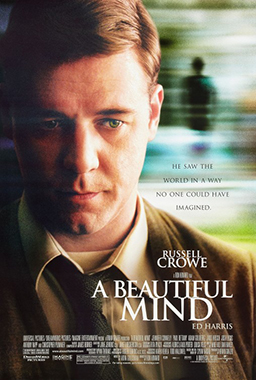
Behind the film
- Year
- 2001
- Director
- Ron Howard
- Writers
- Akiva Goldsman
- Genres
- Biographical, Drama
- Production
- Universal Pictures, DreamWorks, Imagine Entertainment
- Country
- United States
- Cast
- Russell Crowe, Jennifer Connelly, Ed Harris, Paul Bettany, Christopher Plummer, Adam Goldberg
About the film
Contains story spoilers.
John Nash enters Princeton as a brilliant but socially awkward graduate student who believes conventional academic work will not distinguish him. He shares a room with Charles, an affable literature student who becomes his closest companion, and spends long hours looking for an original idea. In a bar, Nash watches a group of women and thinks through how the men’s competing approaches could lead to a better outcome if they do not all chase the same person. The scene introduces the film’s accessible version of game theory, while Nash’s real breakthrough comes through the equilibrium concept he develops and later presents to his peers. His early rivalry with fellow students is presented as both intellectual motivation and a barrier to the collaboration that academic work requires. The campus scenes give the mathematical ambition a specific social setting, with Nash trying to distinguish himself while watching other students compete for recognition.
After completing his work, Nash becomes a professor and takes on government cryptography assignments. The film gives this work a thriller shape: a mysterious agent named Parcher recruits him to search newspapers for coded messages, and Nash believes a secret plot is unfolding around him. He also marries Alicia, one of his students, whose warmth and conviction offer him a life outside the university. At first these strands seem to expand his importance—mathematics, national security, and romance all appear to confirm his sense that he is meant for exceptional work. Their convergence later reveals how precarious his confidence has become. The film’s invented assignment gives the audience an external mission to follow before it reveals how Nash’s perception has shaped that thread.
During a Harvard lecture, psychiatrist Dr. Rosen captures Nash and takes him to a psychiatric facility. Alicia then finds unopened letters tied to his supposed secret work and follows the evidence, learning that Charles and Parcher are hallucinations. The revelation changes the meaning of earlier scenes: what looked like a covert operation has been part of an illness Nash cannot recognize. The film compresses and dramatizes the course of his treatment, including insulin shock therapy and the strain placed on his marriage. Alicia must decide how to support him while also protecting herself and their infant son.
Nash eventually stops taking medication because he fears it dulls his mind and distances him from his family. His hallucinations return, and a dangerous moment with the baby forces Alicia to understand that good intentions cannot make the situation safe. She prepares to leave after Nash trusts the imaginary Charles to watch their baby in the bath. Nash finally recognizes the unreality of Charles's niece Marcee: through all those years she has never aged. He asks Alicia for the chance to manage his condition. He begins to recognize the figures as unreal even though they remain vivid to him. The film presents this as a long, imperfect process of learning to live with experiences that do not disappear on command, with Alicia and colleagues offering support while Nash develops his own ways to test what he perceives. Alicia’s discovery is staged through everyday details that make the imagined world difficult to separate from the household around her.
Years later Nash returns to Princeton and gradually rebuilds a place in academic life. Students whisper about him, and he moves through campus with an awareness that his mind may again make persuasive claims. He chooses to acknowledge the familiar figures without treating them as authorities. The film marks this change through ordinary routines—teaching, working, and speaking with people around him—rather than an instant cure. His relationship with Alicia also changes from a romance framed by intellectual fascination into a partnership shaped by care, exhaustion, conflict, and repeated decisions to continue together.
The closing recognition at the Nobel ceremony gives the story a public endpoint. Nash receives the prize for economics for work on game theory, and he acknowledges Alicia’s role in helping him endure the years between his early promise and his return. Students who once treated him as an eccentric professor now see a celebrated scholar. The film’s emotional shape depends on that contrast, but its claims should be kept in view: this is a fictionalized dramatization inspired by the life of mathematician John Nash, not a reliable account of every relationship, symptom, treatment, or event in his biography. The return to Princeton is gradual and social as well as intellectual, with familiar people deciding how to include him again. His colleagues’ willingness to keep engaging him matters because the film makes return to shared academic life a process rather than a single public vindication.
Ron Howard and screenwriter Akiva Goldsman shape the material as a character drama that initially invites the audience to share Nash’s confidence. The later change in perspective asks viewers to reconsider earlier images, and the film uses that shift to make subjective experience central to its storytelling. Its strongest scenes keep the family and classroom consequences close: illness is not merely a puzzle to solve but a condition that affects trust and safety. The ending offers recognition without pretending the hardships have been erased, and its biographical liberties mean the film works best as a dramatized story rather than a factual guide to schizophrenia or Nash’s actual life.