
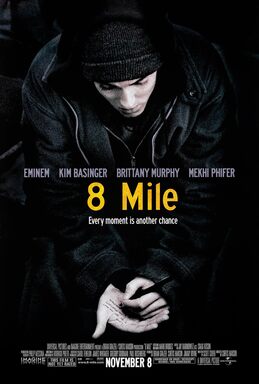
Behind the film
- Year
- 2002
- Director
- Curtis Hanson
- Writers
- Scott Silver
- Runtime
- 1h 51m
- Genres
- Musical, Coming-of-age, Hood, Drama
- Production
- Universal Pictures, Imagine Entertainment
- Country
- United States, Germany
- Cast
- Eminem, Kim Basinger, Mekhi Phifer, Brittany Murphy, Taryn Manning, Omar Benson Miller, Evan Jones, Anthony Mackie
About the film
Contains story spoilers.
In 1995 Detroit, Jimmy Smith Jr., who performs as B-Rabbit, freezes during a rap battle and leaves the stage humiliated. He works at a car factory, lives with mother Stephanie, sister Lily, and Stephanie’s boyfriend Greg, and doubts music can become a future. His friend Future encourages him, while Wink backs Jimmy’s rivals. Jimmy’s confidence grows through work and practice, and he eventually enters the Shelter’s battle again. After winning two rounds, he faces Papa Doc, reveals the class background behind the rival’s tough persona, and wins. Future offers him a hosting role, but Jimmy declines and returns to his factory shift, choosing to keep building on his own terms.
The geography in 8 Mile is social as much as physical. The road named in the title marks a boundary in the city and in Jimmy’s sense of possibility. He moves between a trailer home, factory floor, local music venue, and the spaces where his friends gather, each with its own expectations. These locations are not interchangeable backdrops. Work promises wages but limits his time; home offers family ties and instability; the Shelter makes talent visible while exposing him to public judgment. Curtis Hanson’s film gives Jimmy a world with routes between places, but no easy exit from the conditions that shape them.
Jimmy’s stage fright at the opening battle is the specific obstacle the story must overcome. The movie does not treat talent as a magic possession that guarantees success; confidence has to be made through repeated effort and through surviving failure in public. The battle format creates a sharp contrast between private preparation and immediate performance. A rapper has only a short window to choose words, read an opponent, and respond to the crowd. Jimmy’s silence at first is therefore not an abstract lack of self-belief. It is a visible interruption in the skill he wants to claim.
Eminem’s performance keeps Jimmy’s ambition grounded in awkwardness and attention. He is often listening—to friends, rivals, family, and the room—before he acts. The film draws energy from the difference between B-Rabbit as a stage name and Jimmy as a person whose responsibilities are less glamorous. His clothes, work routine, and place in the trailer park locate him within a specific material life. The character’s growth does not require him to become a new person; it requires him to use what he already notices and knows without letting embarrassment dictate every choice.
Stephanie gives Jimmy's home life an emotional weight that cannot be reduced to an obstacle on the route to success. Kim Basinger makes the family's hopes for security feel uneven and precarious, complicating any simple account of what Jimmy should leave behind. His desire for an independent future shares space with attachments that do not disappear when he becomes frustrated. This gives artistic ambition a practical cost: time and attention devoted to one possibility are not available for every other need. The film allows resentment and affection to remain close together. Home can be a place someone urgently wants to escape while still containing the people whose welfare matters to him.
The film’s friendship circle makes the music scene feel communal rather than individual. Future hosts the battles and wants Jimmy to return; Cheddar Bob, Sol, Iz, and the others offer companionship that is sometimes loyal and sometimes chaotic. Wink’s betrayal is painful because he has access to a possible path toward the music industry. Jimmy’s response to that disappointment is part of a larger process of deciding what kind of success he can control. The movie distinguishes an invitation into somebody else’s plan from the harder work of making a path under his own name.
The rap battles are built around public self-definition. A performer has to read an opponent and an audience while deciding how much of himself to expose. Concealment may protect a vulnerable point, but it can also leave another person free to define it. The movie makes that tension audible through the timing of a response and the crowd's reaction. Skill includes knowing which assumptions listeners are prepared to accept, then finding language that unsettles them. This connects the battles to Jimmy's wider struggle with embarrassment and expectation. A stage name can create room for confidence without making the person beneath it disappear. The venue becomes a place where social labels are argued over, and where attention can briefly change whose account of a life carries weight.
Curtis Hanson stages the music as a workplace-like craft with its own routines, spaces, and audiences. The editing gives battles a clear progression from one performer to the next, while close views of listeners register whether a line has landed. Sound makes the venue feel embodied: voices, crowd response, and the beat establish a shared pulse. This treatment avoids presenting hip-hop as decoration added to a coming-of-age story. The music is the community’s central form of argument, competition, and self-expression, and Jimmy’s eventual command of it is inseparable from learning how to listen.