
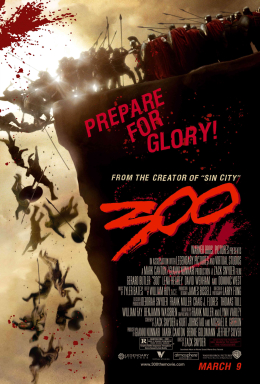
Behind the film
- Year
- 2007
- Director
- Zack Snyder
- Writers
- Zack Snyder, Kurt Johnstad, Michael B. Gordon
- Genres
- Action, War, Sword-and-sandal, Drama
- Production
- Legendary Pictures, Virtual Studios, The Stone Quarry
- Country
- United States
- Cast
- Gerard Butler, Lena Headey, David Wenham, Dominic West, Rodrigo Santoro, Michael Fassbender, Vincent Regan, Andrew Tiernan
About the film
Contains story spoilers.
Zack Snyder’s 300 presents ancient Greece through the voice of Dilios, a Spartan soldier telling the story of Leonidas and the stand at Thermopylae. The film makes no attempt at a neutral reconstruction: its bodies, creatures, battles and speeches are heightened into a graphic tableau inspired by Frank Miller and Lynn Varley’s comic. That stylization matters because the story places fantastical images beside recognizable historical names. Leonidas’s refusal of a Persian demand for submission is staged as a personal and political act, and the camera treats the king as both commander and emblem. The events belong to a historical fantasy, not an evidentiary account of the Persian Wars.
Leonidas proposes defending the Hot Gates, where the narrow terrain might limit the larger Persian army’s advantage. The Ephors warn him not to act during the religious festival, and the oracle reinforces their warning. A Persian agent has also bought influence through the politician Theron, so the spiritual and civic institutions that should protect Sparta are compromised by fear and self-interest. Leonidas responds by gathering three hundred soldiers rather than waiting for official permission to mobilize the full army. Their departure is a deliberate challenge to the council, while Queen Gorgo remains in Sparta to argue for reinforcements and confront the political obstruction at home.
The Greek force reaches Thermopylae and allies with Arcadian soldiers led by Daxos. Leonidas uses the narrow pass to hold back waves of Persian troops, building a wall from fallen attackers and turning geography into part of the defense. The battles are presented through rapid shifts between slow-motion impacts and tightly framed bodies, giving the film a comic-book sense of scale without losing the practical importance of formation and terrain. Xerxes personally offers Leonidas wealth and authority if he will submit, but Leonidas refuses. The offer frames the clash as more than a contest of armies: Xerxes wants to convert resistance into a demonstration of his own power, while Leonidas wants the Greek cities to keep their freedom to choose.
Ephialtes, a Spartan exile whose body cannot hold the shield position Leonidas requires, reveals a hidden path around the pass and asks to fight with the king. Leonidas refuses the request but treats him with compassion. Ephialtes then turns to Xerxes, whose court gives him a place the Spartan system denied him. The Persians use the path to threaten the defenders from behind. The Arcadians choose to withdraw, and Leonidas sends Dilios away to carry the account back, while the Spartans remain for the final stand. In Sparta, Gorgo argues before the council as Theron uses his influence to obstruct her.
The final battle is not a victory in the conventional sense. Leonidas leads the remaining men into a last confrontation with Xerxes and his forces, wounding the Persian king before the Spartans are overwhelmed. Dilios survives to carry the account back to Sparta. Gorgo kills Theron during their confrontation; afterward, the coins fall from his clothing and expose the corruption behind his opposition. Her speech and the report of the stand help build support for a wider Greek force. The closing movement jumps forward to that army preparing to fight at Plataea, with Dilios narrating how the sacrifice at Thermopylae became a rallying story.
Snyder builds the film from graphic silhouettes, extreme contrast and digital environments that make the Spartans’ red cloaks and bronze armor legible against muted landscapes. The voice-over gives the action a remembered, almost legendary shape, while the repeated formation of the shield wall makes cooperation visible as a physical discipline. This approach can turn individual people into icons, but the quieter exchange between Leonidas and Ephialtes complicates that heroic image by showing a moment of exclusion before betrayal. Gorgo’s story provides a parallel struggle in the council chamber: political persuasion and public memory matter alongside battlefield courage, even though the film often gives greater visual force to combat. The split between the front and the council also shapes the film’s rhythm. Battle scenes repeatedly return to the shield line, while Gorgo’s scenes rely on debate, accusation and the pressure of public reputation. The parallel does not make these struggles equal in method; it lets the film treat persuasion as another way of sustaining resistance. Its final leap to Plataea enlarges the scale without undoing the loss at Thermopylae.
The film adapts a graphic novel that itself retells the Battle of Thermopylae, and it takes substantial liberties with history, chronology and Persian representation. Its Sparta is an idealized martial society, while the invading empire is depicted through deliberately monstrous imagery. Those choices belong to the film’s polemical fantasy, not to a neutral description of ancient Persians or Spartans. Within that boundary, the story is about how people use remembered sacrifice: Gorgo exposes the corruption obstructing Sparta's response, and Dilios turns survival into a narrative that can gather a wider force. The ending presents mythmaking as part of the battle’s legacy, rather than suggesting the small force literally defeated the invasion.