
Behind the film
- Year
- 2014
- Director
- Noam Murro
- Writers
- Zack Snyder, Kurt Johnstad
- Runtime
- 1h 42m
- Genres
- War, Action, Drama, Sword-and-sandal
- Production
- Legendary Pictures, The Stone Quarry, Virtual Studios
- Country
- United States
- Cast
- Sullivan Stapleton, Hans Matheson, Lena Headey, Rodrigo Santoro, Andrew Pleavin, Andrew Tiernan, Ashraf Barhom, Ben Turner
About the film
Contains story spoilers.
300: Rise of an Empire expands the earlier film's conflict by looking towards the water and the difficulty of making separate Greek communities act together. A formidable enemy is not the only problem facing Themistocles. The forces he needs do not automatically understand their interests as identical, so the possibility of resistance depends on agreement as well as combat. That gives the naval battles a political framework. Each encounter is part of an attempt to keep a divided response from becoming a succession of isolated defeats, while Persia's advance continually reduces the time available for persuading others to join.
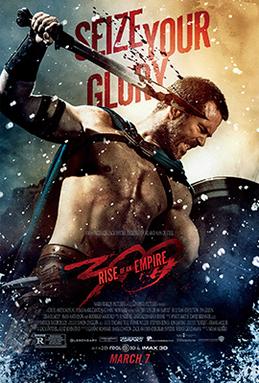
Noam Murro directs the 2014 film from a screenplay by Zack Snyder and Kurt Johnstad. Sullivan Stapleton plays Themistocles, Eva Green is Artemisia, Rodrigo Santoro returns as Xerxes and Lena Headey plays Queen Gorgo. The story takes place before, during and after the events associated with Leonidas's stand in 300. Its version of the ancient conflict belongs to a highly fictionalised comic-book world. Historical names and battles supply a framework, but the supernatural transformation, personal histories and spectacular action should be understood as elements of that fictional world rather than a dependable account of the Greco-Persian wars.
The film links Xerxes's invasion to his father's death and Artemisia's encouragement. Themistocles gathers a fleet but struggles to secure Spartan support. Artemisia, a Greek-born commander serving Persia after suffering abuse from Greeks, confronts him at sea and offers him a place beside her; he refuses. A devastating attack leaves his forces badly reduced. News of Leonidas's death makes the wider danger unmistakable. At Salamis, Themistocles faces Artemisia again as Gorgo arrives with an allied fleet. He kills Artemisia in their duel, while the joining Greek forces turn the battle towards a united resistance.
Themistocles's position requires two different kinds of persuasion. He must convince the people around him that their limited strength can be used effectively, and he must convince other communities that the threat cannot be left for somebody else to answer. Success in one task does not settle the other. A commander can inspire the men already beside him while remaining unable to summon the support that would make their situation less desperate, leaving his strategic ambitions constrained by the response beyond his own fleet. The film uses that gap to make alliance feel like something that has to be achieved under pressure, rather than a convenient condition established before the action begins.
Artemisia supplies a personal motive that complicates the division between the opposing sides. Her service to Persia grows from hostility towards the people among whom she was born, making allegiance a consequence of what she has endured rather than an uncomplicated extension of birthplace. The film's account of her past explains the intensity of her revenge without turning that intensity into a historical claim about the real commander. Within the fiction, her determination makes military power a means of answering humiliation, and the offer she makes Themistocles tests whether shared ability can outweigh the opposition defining their encounter.
Gorgo's reluctance gives the appeal for unity another emotional obstacle. Sparta's commitments and losses are not merely abstract facts to be overcome by a persuasive speech. Themistocles needs help from somebody whose position is being altered by grief, so the route towards cooperation must pass through the meaning of that loss. Her eventual participation changes the scale of the final battle because it connects a personal response with a collective undertaking. The film makes the arrival of allies the result of decisions made across the story, giving the spectacle a relationship to people who have previously resisted joining it.
Moving the conflict to sea changes the shape of the film's action. Ships place fighters inside a struggle where their immediate ground is also a vehicle that can fail beneath them, making the surrounding water part of the danger. The stylised violence and enormous contrasts of scale belong to the same heightened visual language as the first film. Bodies and fleets become emphatic forms within a world designed around confrontation, with individual duels condensing the larger conflict into a struggle between recognisable figures. The action operates as spectacle rather than an instructional demonstration of historical naval warfare.
The ending brings the personal duel and the effort to create an alliance together. Artemisia's death closes the rivalry at the centre of the naval story, while the arrival of the other Greeks gives Themistocles the collective support he has been seeking. That resolution does not need the fictional world to become a complete history of the war. It completes a dramatic movement from divided resistance towards shared action, allowing the companion film to make a different claim on the same conflict: the courage of an isolated force can matter enormously, yet surviving a wider invasion also depends on the people willing to stand beside it.