
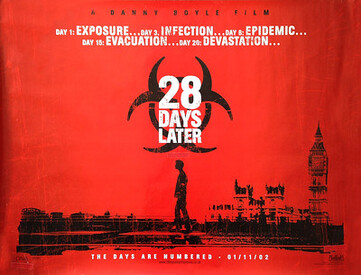
Behind the film
- Year
- 2002
- Director
- Danny Boyle
- Writers
- Alex Garland
- Genres
- Horror, Zombie, Post-apocalyptic, Dystopian
- Production
- DNA Films, UK Film Council
- Country
- United Kingdom
- Cast
- Cillian Murphy, Naomie Harris, Christopher Eccleston, Megan Burns, Brendan Gleeson, Noah Huntley, Stuart McQuarrie, Ricci Harnett
About the film
Contains story spoilers.
28 Days Later makes an enormous disaster feel immediate by beginning with a person who has missed it. Jim has no useful overview of what happened while he was unconscious. He enters a familiar city whose ordinary systems no longer answer him, and the absence of people becomes a disturbance before the cause of that absence is fully understood. Danny Boyle's film gives collapse a local texture: recognition persists after reliability has vanished. Streets still connect places, shops still contain goods and buildings retain their familiar shapes, but none of those continuities guarantees a functioning society. Survival starts with having to learn what can still be trusted.
After activists release an infected chimpanzee, a fictional Rage infection spreads through Britain. Jim wakes in an abandoned hospital and meets Selena and Mark, who explain the danger. Selena kills Mark after he is infected. Jim and Selena later join taxi driver Frank and his daughter Hannah, following a military broadcast north. Frank becomes infected and is shot by soldiers, whose promised refuge conceals a plan to sexually enslave the women. Jim escapes their custody, returns and uses an infected captive against them. He rescues Selena and Hannah but is shot during their escape. In the theatrical ending, he recovers at a rural cottage, where the three signal to an aircraft. Their survival offers hope without establishing that the catastrophe has been repaired.
Cillian Murphy's Jim begins from vulnerability rather than from the prepared competence often assigned to a survivor. His unfamiliarity with the new conditions gives the audience a way into them, but his need for other people is equally important. Knowing where to go or how to react becomes knowledge shared by someone else, with consequences when he fails to understand quickly enough. The film makes that dependence visible before it allows him to act decisively. His later violence is disturbing partly because it grows out of a person who initially seems so exposed. Protection and brutality are brought close together without becoming interchangeable moral terms.
Naomie Harris's Selena presents survival as a discipline whose severity has already been learned. Her directness can seem forbidding to Jim, yet it belongs to circumstances in which hesitation may have immediate consequences. The character brings an unsettling practical clarity to the group: emotional attachments cannot be allowed to erase danger. What develops between them is therefore more substantial than one person simply teaching another to become tougher. Their relationship asks whether staying alive leaves room for care, and whether care can return without requiring them to forget the conditions under which they are living. Selena's judgments remain part of that tension rather than becoming a permanent rule for every possible situation.
Frank and Hannah introduce a household into a story that has largely stripped everyday life of its structure. Brendan Gleeson and Megan Burns give that connection a warmth which changes the meaning of the journey. The group can begin to resemble people travelling together rather than individuals temporarily sharing a hiding place. That distinction matters because the film's quieter stretches allow the possibility of a future to become imaginable again. There are ordinary pleasures and gestures within the emergency, with the father-daughter relationship offering continuity amid disruption. Their presence gives safety an emotional content: it would mean preserving a way of caring for someone, not merely finding a defensible location.
The military setting changes the terms on which authority appears. Organisation, equipment and command can initially look like the return of a world that knows what to do. Christopher Eccleston's Major West turns that reassurance into a question about what an institution is promising and whom the promise serves. Uniforms do not make coercion disappear, and a claim to be preserving humanity does not justify treating particular people as resources. The film's horror consequently extends beyond infection. It allows deliberate human choices to become dangerous alongside the involuntary violence associated with its fictional pathogen, placing responsibility where the characters still possess the power to choose.
The fast movement of the infected makes distance unstable. A route that looks usable can abruptly become a chase, while a place that appears enclosed can lose its protective meaning. That physical pressure distinguishes the film's threats from a slowly approaching mass which leaves more time to plan. It also shapes the audience's attention: an empty frame can feel temporarily calm without becoming secure. Boyle's changing rhythms move between the openness of deserted spaces and the compression of immediate pursuit. The effect is to make safety something provisional, dependent on what happens next rather than something guaranteed by the appearance of the surroundings.
The infection belongs to the film's invented horror world; its speed and effects are not a model of disease or a public-health account. Within that world, the final rural images create a different relationship to distance from the opening city. What was initially an absence of help becomes the possibility that someone elsewhere might still be able to respond. The survivors can make a signal, but they cannot ensure its reception. That uncertainty gives the ending its modest scale. 28 Days Later does not resolve every consequence of collapse or turn its characters into conquerors of it. It preserves a small group and the chance that their effort to reach another person might succeed.