
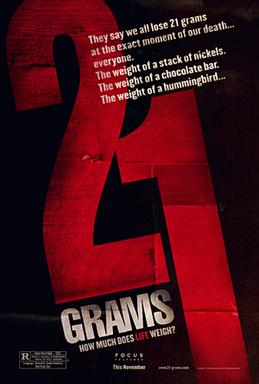
Behind the film
- Year
- 2003
- Director
- Alejandro González Iñárritu
- Writers
- Guillermo Arriaga
- Genres
- Drama, Crime
- Production
- This is that corporation
- Country
- United States, Afghanistan
- Cast
- Sean Penn, Naomi Watts, Benicio del Toro, Danny Huston, Charlotte Gainsbourg, Eddie Marsan, Melissa Leo, John Rubinstein
About the film
Contains story spoilers.
Jack Jordan kills Cristina Peck's husband and children in a hit-and-run. Her husband's heart is transplanted into Paul Rivers, whose renewed life brings him into Cristina's orbit. Jack confesses and is imprisoned, then leaves his family after release. Paul separates from his wife Mary and begins a relationship with Cristina, while his body starts rejecting the heart. Cristina wants revenge on Jack. Paul confronts him but cannot kill him, instead pretending to Cristina that he has. Jack later demands that Paul finish the act. A violent struggle follows, and Paul shoots himself. Jack and Cristina take him to hospital, where he dies. Cristina discovers she is pregnant and tentatively prepares for the child; Jack returns to his family. The film presents these events in interwoven, nonchronological fragments.
That arrangement changes how the audience learns to judge the characters. Alejandro González Iñárritu's direction and Guillermo Arriaga's screenplay make explanation something that arrives unevenly. The structure does not simply conceal an answer for a final reveal. It keeps showing how incomplete knowledge alters the moral weight of an image. A person can seem threatening, vulnerable or purposeful depending on which part of a life has become available. Following the film therefore involves revising judgments as well as connecting events. The experience gives the viewer a version of the characters' difficulty: trying to act inside a situation whose significance cannot be grasped all at once.
Sean Penn's Paul occupies a particularly uncomfortable relation to survival. Continuing to live can be an achievement and a dependency at the same time, with the means of continuation carrying a history that cannot belong entirely to the recipient. That makes gratitude more complicated than a feeling of relief. Wanting to understand where one's future came from can become a way of entering somebody else's loss, but curiosity does not automatically justify the entry. The film allows need and entitlement to move close together. A vulnerable person may still act selfishly, and recognising his vulnerability does not explain away the effect on those he approaches. Paul's position gives the wider drama an intimate account of how one life can be bound to another without possessing a clear right to define that connection.
Naomi Watts's Cristina brings a different experience of time. A life organised around familiar relationships can lose its structure so abruptly that the future ceases to feel like a continuation of the past. The film gives grief a force that cannot be contained by the statement that something terrible has happened. It changes how a person inhabits rooms, encounters others and imagines what an action might accomplish. Her relationship with Paul exists inside that altered world, making attachment difficult to separate from need. The story does not require grief to produce a consistent or admirable response. It leaves room for contradiction, including the wish to make another person's suffering answer the suffering already endured. That wish supplies direction without guaranteeing that the direction can restore anything.
Benicio del Toro's Jack confronts a similar limit through guilt and belief. A framework intended to make life meaningful becomes difficult to inhabit when an action produces consequences that cannot be undone. His problem is not simply deciding whether he is responsible. It is discovering what responsibility could look like after acknowledgment, when no declaration can return the lost lives. The distinction gives religious language a dramatic pressure without turning the film into a settled argument about religion. A person may seek a structure that explains punishment, forgiveness or change while still being unable to find a workable place inside it. Jack's distress also affects people beyond the central collision. Guilt can become so consuming that an attempt to reckon with one harm begins to create further distance from those who remain dependent on him.
The supporting relationships prevent these three lives from becoming isolated philosophical examples. Charlotte Gainsbourg's Mary and Melissa Leo's Marianne each have a perspective shaped by commitments that the principal characters cannot simply set aside without consequence. Their presence makes the drama's concentration on suffering more demanding. Being in pain does not suspend another person's needs or give someone an exclusive claim to the meaning of a shared life. The film's world contains obligations that continue even when the person responsible for meeting them feels overwhelmed. That is part of why the connections remain uncomfortable. The same event can draw some people together while pushing others out of an arrangement they thought they understood, and an intense new attachment can carry a less visible cost elsewhere.
The bodily element keeps those questions from becoming abstract. Survival, vulnerability and dependence are experienced through physical limits as well as through memory and intention. A person can want a new beginning without having the bodily security required to sustain it. The film uses that uncertainty as dramatic material rather than as medical instruction. Its title likewise belongs to its language of mortality and meaning, not to established evidence that a soul has a measurable weight. Keeping those boundaries clear allows the emotional inquiry to remain substantial without converting the story's images into factual claims about death. The characters are seeking a way to understand what has happened to them; the film can make that search compelling without promising that their desired explanations are available.
21 Grams leaves consequence more durable than resolution. Its interwoven lives cannot be separated cleanly again, but connection does not ensure reconciliation, and suffering does not automatically produce wisdom. The fractured form lets the viewer recognise ordinary hopes inside actions that may otherwise seem incomprehensible: wanting to continue, wanting someone back, wanting guilt to become bearable. Those hopes are understandable even when the actions they support cause further harm. The film's depth comes from refusing to make understanding identical with absolution. It gives attention to people whose lives have been altered by a shared event, then asks what remains possible when explanation arrives without restoration. The world continues, but continuing is an uncertain task that each surviving relationship has to negotiate for itself.