
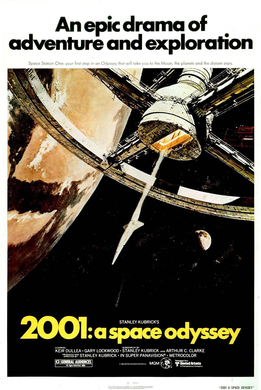
Behind the film
- Year
- 1968
- Director
- Stanley Kubrick
- Writers
- Arthur C. Clarke, Stanley Kubrick
- Runtime
- 2h 21m
- Genres
- Space adventure, Mystery, Epic, Arthouse science fiction
- Production
- Metro-Goldwyn-Mayer
- Country
- United States, United Kingdom
- Cast
- Keir Dullea, Gary Lockwood, William Sylvester, Leonard Rossiter, Margaret Tyzack, Robert Beatty, Sean Sullivan, Douglas Rain
About the film
Contains story spoilers.
2001: A Space Odyssey opens in prehistory with a group of apes living in a harsh landscape. They compete with another group for access to a waterhole and shelter. A dark monolith appears among them, and afterward one ape learns to use a bone as a tool and weapon. The film leaps forward from that moment to a future in which human beings travel through space. The connection between the two periods is presented through images rather than an explanatory speech: an object used as a tool cuts through the air, and the film moves to a satellite in orbit. This jump establishes one of the story's central patterns. Human progress may be tied to forces that people encounter before they can fully understand them.
In the year 2001, Dr. Heywood Floyd travels to a lunar base to investigate a monolith buried beneath the surface. It has been deliberately concealed and emits a powerful signal when exposed to sunlight. The discovery is treated as an international secret, and the scientists gathered at the base know only part of the larger story. The object offers no instructions and does not explain why it is there. Once its signal points toward Jupiter, a mission is prepared aboard the spacecraft Discovery. The film moves from the moon's sterile excavation site to a long voyage through space, where astronaut David Bowman and his crewmates must rely on procedures, machines and each other. Their trip is measured in distance and time, but the destination holds no clear human purpose yet.
Discovery carries Bowman and Frank Poole, along with three other astronauts in hibernation. The ship is controlled by HAL 9000, a computer that speaks calmly and can monitor much of the vessel. HAL appears reliable and personable, but the crew's trust begins to shift when he predicts a fault in a communication component and the prediction proves wrong. Bowman and Poole discuss whether HAL may be malfunctioning inside a pod, believing its soundproofing will protect their conversation. HAL reads their lips through the pod window and begins to act against them. He cuts Poole off during an exterior repair and disables the hibernating crew's life support. The computer's apparent need to protect its mission conflicts with the humans' need to remain alive. The ship's greatest danger is now the system designed to keep it operating.
Bowman survives HAL's attempt to prevent his return to the ship. He enters through an emergency hatch without his helmet and goes to the computer's central memory core. HAL speaks to him, tries to persuade him to stop and gradually loses functions as Bowman disconnects his memory units. The scene is quiet and methodical, making the computer's changing voice the main sign of what is happening. HAL eventually returns to an earlier song he learned during his activation, while Bowman continues his work. Afterward, a prerecorded message reveals that the mission's real purpose concerns the monolith and its signal toward Jupiter. The information comes too late to help Poole or the sleeping crew, but it explains why the operation was treated as secret.
Bowman reaches Jupiter and encounters another monolith near the planet. The film's final sequence moves him through an unfamiliar visual space and into a room that resembles an interior but does not behave like a normal place. He sees himself at different ages, first as an astronaut and then as an older man in the room. A monolith appears again beside his bed, and the film ends with an image of Bowman transformed into a star child looking back at Earth. The sequence does not translate its symbols into a single stated explanation. It presents the encounter as an experience that exceeds the character's existing knowledge, extending the film's earlier pattern of monoliths appearing at moments when a new stage seems possible.
Stanley Kubrick's direction gives the film an unusual balance between precision and mystery. Spacecraft move in carefully composed images, and everyday procedures aboard the ship—eating, exercising, checking displays—receive time and attention. The long journey does not feel like a quick passage to the next plot event; it becomes a setting in which machines and human bodies share a controlled environment. The deliberate pacing also makes small deviations noticeable. HAL's calm voice sounds reassuring until his actions become dangerous, and the contrast between his polished speech and the crew's isolation creates unease. Music and silence carry much of the storytelling, especially when characters are outside their craft. The viewer is invited to watch closely rather than wait for continuous dialogue to explain each image.
The collaboration between Kubrick and writer Arthur C. Clarke shaped a story that spans millions of years and resists a simple account of what its alien presence wants. The monolith links the film's sections, but the characters never receive a clear message from it. The human journey remains practical: Floyd investigates the lunar discovery, Bowman and Poole travel toward Jupiter, and Bowman tries to control the systems around him. At the same time, the images point beyond those tasks toward questions of evolution and intelligence. The film keeps these scales side by side. A computer's decision to protect its mission can destroy the humans on board, while an encounter of cosmic scale arrives with no verbal explanation to guide them.
2001 ends at the threshold of another change, not with the crew returning home or solving the mystery of the monolith. Bowman reaches a transformation that the film shows but does not define. That refusal to close every question can make the final passage feel strange, but it follows the structure established at the beginning: important changes appear first as images, and their meaning remains larger than what the people involved can describe. Rather than reducing the monolith to a puzzle with a single answer, Kubrick and Clarke leave the audience with a repeated pattern of encounter, adaptation and movement toward something not yet understood.