
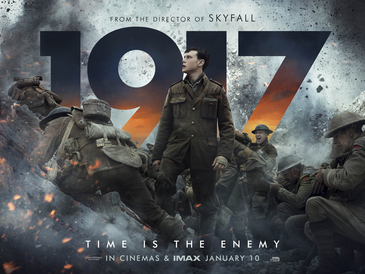
Behind the film
- Year
- 2019
- Director
- Sam Mendes
- Writers
- Sam Mendes, Krysty Wilson-Cairns
- Runtime
- 1h 59m
- Genres
- War, Drama
- Production
- Neal Street Productions, DreamWorks Pictures, Amblin Partners
- Country
- United Kingdom, United States
- Cast
- George MacKay, Dean-Charles Chapman, Mark Strong, Andrew Scott, Richard Madden, Claire Duburcq, Colin Firth, Benedict Cumberbatch
About the film
Contains story spoilers.
Sam Mendes’s 1917 follows two British lance corporals across a landscape where orders travel more slowly than danger. Blake and Schofield are summoned from the trenches and sent to deliver a message to a battalion preparing to attack. German forces have withdrawn, but the apparent retreat may be a trap; the attack must be stopped before 1,600 men move into it. Blake has an additional personal reason to hurry: his brother Joseph is among the soldiers in the target unit. Schofield has less faith in the value of rushing forward, yet accepts the assignment and goes with him. Their task is clear, but the route is not safe.
The opening gives the pair a quiet pause among resting soldiers before they are pulled into the command structure. Their superior explains that telephone lines are down and that the message cannot wait for a runner to return through the same chain of trenches. The men receive written orders and a map, then move toward the front. Trench walls narrow their view to the few steps ahead; every turn can lead to a dugout, a junction or a way out into exposed ground. The camera’s continuous movement keeps the audience close to their pace and makes the journey feel like one unbroken present, even though the film is assembled from carefully joined shots.
Blake and Schofield cross no-man’s-land into abandoned German trenches, where signs of withdrawal conceal hazards. A rat triggers a tripwire in an underground shelter, burying Schofield in debris until Blake frees him. The empty position offers no reassurance: the Germans have left traps behind, and an apparently quiet landscape can become dangerous without warning. At a farmhouse, the men pull a German pilot from a crashed aircraft, but he stabs Blake while Schofield fetches water. Schofield kills the pilot and stays with his dying companion. The rescue was Blake’s decision, and its consequences turn the shared assignment into a promise Schofield must now carry alone.
Schofield takes Blake’s belongings and the order, then briefly joins a passing British unit. Its lorries cannot take him across the damaged canal bridge near Écoust, so he resumes the journey on foot. A sniper’s shot knocks him unconscious; when he wakes, daylight has given way to a ruined town illuminated by flares and fire. A French woman shelters there with a baby, and Schofield shares the food and milk he carries. Her refuge creates a pause in the military journey, showing people trying to preserve ordinary life within the destruction. He cannot stay: the clock still governs his promise, and soldiers in the streets threaten to stop him before he reaches the battalion.
Pursued through the town, Schofield escapes into a river and is carried downstream. He reaches British soldiers in the woods, then discovers the attack is already beginning. The final obstacle is no longer enemy territory but the congestion of his own army: men fill the trenches between him and Colonel Mackenzie. Schofield runs across open ground beside the advancing troops to reach the command dugout. The apparent continuous shot makes this stretch especially urgent. His destination is close, yet bodies, earthworks and the movement of the attack keep getting between him and the person who can stop it. The message has to arrive before obedience to yesterday’s order costs more lives.
When Schofield finally finds Mackenzie, the colonel is reluctant to stop the attack on the strength of a message. Schofield insists that the order must be read, and the written warning stops the attack from continuing into the German trap. He then searches for Joseph Blake among the soldiers. The reunion does not undo the death of Joseph’s brother, but Schofield can tell him what happened and offer the small personal objects Blake carried. The mission succeeds in its immediate purpose while leaving the cost intact. The men’s work has not changed the war’s scale; it has altered what happens to one battalion on one stretch of the front.
The apparent single-shot design shapes the film’s storytelling as much as its look. The camera stays with Schofield through long stretches of danger, and when he is knocked unconscious the screen briefly goes dark, marking time without changing the sense of a continuous journey. Roger Deakins’s images move between cramped trenches, open fields and the burning town, each space changing how much Schofield can see and how fast he can move. 1917 draws on Mendes’s family history for its starting point, but Blake and Schofield are fictional characters. Their mission is a crafted story about delivering an order, not a reenactment of a documented pair of couriers. The film makes that pressure legible through movement rather than long explanations, so a blocked passage or a pause under fire can alter the whole shape of the mission. Schofield’s endurance is not presented as effortless heroism; he is repeatedly hurt, disoriented and dependent on brief help from others. The focus on one courier’s changing view gives the large battle a human scale without suggesting that his route represents every soldier’s experience.