
Behind the film
- Year
- 2010
- Director
- Danny Boyle
- Writers
- Danny Boyle, Simon Beaufoy
- Genres
- Docudrama, Drama, Biographical, Survival
- Production
- Searchlight Pictures, Pathé
- Country
- United States
- Cast
- James Franco, Kate Mara, Amber Tamblyn, Clémence Poésy, Lizzy Caplan, Kate Burton, Treat Williams, Pieter Jan Brugge
About the film
Contains story spoilers.
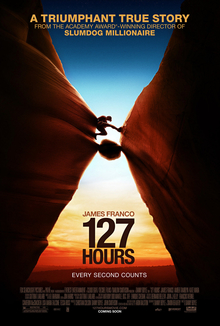
127 Hours initially gives Aron Ralston the freedom of a person who knows how to travel lightly and move through difficult country. He heads into Utah's canyon landscape with an assurance that makes the trip seem like an extension of his usual life. Meeting two hikers gives him company and an opportunity to show his familiarity with the terrain. The early movement, open views and conversation establish what he takes for granted: the ability to choose a direction, leave an encounter and continue into another space. Danny Boyle then brings that freedom to an abrupt end when a boulder falls with him and traps his right arm against a canyon wall.
The predicament is brutally specific. Aron cannot simply wait for the people travelling with him to notice his absence, because he has continued alone and nobody has a clear account of his route. The equipment that normally makes an expedition manageable becomes a small collection of possibilities whose limits he must discover. Water and food have to last, a knife is less useful than he needs it to be, and ropes cannot automatically turn an immovable weight into something he can lift. James Franco's performance begins with practical concentration. The character tries to understand the problem as something his skill can solve before the repeated failures make its scale unavoidable.
The canyon changes through small variations rather than new locations. Brief sunlight, the cold of night and the amount left in a container become events that deserve attention. Aron's attempts to shift or chip the rock make visible effort without promising meaningful progress. Boyle keeps returning to objects that a freely moving person might barely consider: a bottle, a blade, the camera and the narrow space around a trapped limb. Their importance comes from use. Something ordinary can offer a little comfort or another failed solution, and losing access to it would further reduce what remains possible. Time becomes physical in the gradual deterioration of both supplies and Aron's body.
The camera allows Aron to speak to somebody who is not there. His recordings move between observation, humour and messages directed towards the people he may never see again. Franco can make that conversation feel like a performance the character invents to remain composed, then let the composure weaken without needing another actor to intervene. Memories and imagined encounters expand the film beyond the canyon while preserving its isolation. Family, a former relationship and chances to be with other people return with a force they did not necessarily possess during the original moment. He can reconsider those connections, but he cannot use the reconsideration to communicate with anybody outside his immediate surroundings.
Hunger, thirst and exhaustion make the boundary between recollection and imagination less dependable. The mental journeys are not a separate adventure in which Aron escapes the situation for a comfortable interval. They carry desires back into it: water becomes more vivid because he cannot obtain it, and an imagined future matters because his present appears to have none. A vision involving a child helps connect survival with a life that might still be ahead. The film's interest in his earlier independence therefore develops into something more complicated than blaming him for going alone. It asks what independence has cost when it prevents the people who love him from knowing where to begin looking.
The decision to amputate his trapped arm provides the film's most explicit confrontation with bodily pain. It is the outcome of exhausted alternatives rather than an effortless demonstration of toughness. Boyle's sound and close attention to the act make it difficult to treat as an abstract solution to a puzzle. Escape still does not place Aron safely back among people: he must leave the canyon and find help. When other hikers finally appear, the simplest human exchange carries a weight that it could not have possessed at the start of the trip. The later glimpse of family life and continuing outdoor activity locates survival within an altered future, with others now informed about his journeys.
Boyle and Simon Beaufoy's screenplay adapts Ralston's account into a drama with an unusually restricted physical centre. Editing can move rapidly through a thought or an earlier experience while the trapped body remains almost stationary. This prevents confinement from becoming mere visual repetition: a familiar angle can acquire a different meaning as Aron understands another limit. Kate Mara and Amber Tamblyn's hikers briefly embody companionship before the accident, while the people recalled afterwards give emotional shape to a world he can no longer reach. The film presents a dramatized account of an actual ordeal, and its imagined images belong to that dramatic form rather than offering direct access to the historical person's private thoughts.
Franco has to communicate changes that are often too small to become conventional action. A joke to the camera, a pause before trying again or the way Aron looks at his remaining water can show the effort of keeping himself organized. The landscape stays indifferent to those efforts; it is neither a villain with a motive nor an obstacle designed to reward the correct moral lesson. That makes the eventual contact with other people especially important. His technical knowledge has helped him endure and make an extraordinary decision, but reaching somebody else completes the movement towards safety. The film's closing sense of continuation rests on an altered relationship with the outside world, not on a promise that survival has removed every consequence of what happened.