
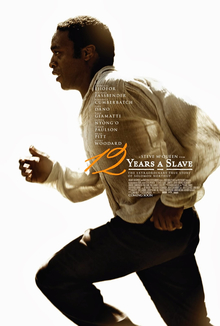
Behind the film
- Year
- 2013
- Director
- Steve McQueen
- Writers
- John Ridley
- Runtime
- 2h 14m
- Genres
- Drama, Biographical
- Production
- Plan B Entertainment, Film4 Productions, Regency Enterprises
- Country
- United Kingdom, United States
- Cast
- Chiwetel Ejiofor, Michael Fassbender, Benedict Cumberbatch, Lupita Nyong’o, Paul Dano, Paul Giamatti, Sarah Paulson, Brad Pitt
About the film
Contains story spoilers.
Steve McQueen’s 12 Years a Slave follows Solomon Northup, a free Black violinist living with his wife and children in Saratoga Springs, New York. Two men offer him work as a musician in Washington, D.C., drug him and sell him into slavery. When Solomon insists that he is a free man, he is beaten and warned to take the name Platt. The film begins from an ordinary family life and then shows how quickly legal identity can be stripped away by violence and profit. Its title marks a long span of captivity, but the story moves through specific relationships and choices rather than treating the years as an abstract passage.
Solomon is taken to a slave pen and then transported south. William Ford buys him and recognizes his skill, giving him work as a carpenter and violinist. Solomon’s ideas help Ford with a timber raft used to move logs downriver, but his success draws the hostility of overseer John Tibeats. A confrontation escalates until Tibeats and other men try to lynch him. The plantation overseer Chapin stops the group from completing the lynching, while Solomon remains suspended by the rope, barely able to keep his feet on the ground. Ford later cuts him down. He decides Solomon cannot be kept safe on the plantation and sells him to Edwin Epps, whose authority depends on constant threat.
At Epps’s plantation, Solomon meets Patsey, a gifted cotton picker who is both valued for her work and targeted by Epps’s sexual violence and his wife’s jealousy. Epps uses religious language to justify his commands, while the people around him have to read his moods to survive. Solomon is forced to pick cotton and hide his literacy and past. A shortage in the crop leads Epps to lease his enslaved workers to another plantation for a season, giving Solomon a temporary change of conditions without freedom. The film shows how forced labor reaches into every relationship: people may share moments of care, but they are still made to live inside a system that can separate or punish them at will. Patsey’s position is especially precarious because Epps praises her labor while treating her as someone he can punish or sexually assault at will. His wife directs anger at Patsey instead of challenging the husband who holds power over the household. The plantation’s hierarchy turns personal jealousy into another danger Patsey cannot escape by working harder. Solomon sees what is happening but has little authority to intervene; helping openly could bring retaliation against both of them.
The Epps plantation’s violence reaches its breaking point when Epps forces Solomon to whip Patsey after she seeks soap at a neighboring plantation; Solomon resists as much as he can, but Epps takes the whip and beats her himself. Later, while building a structure with Canadian carpenter Samuel Bass, Solomon cautiously reveals his identity. Bass openly opposes slavery and agrees to help; he writes to Solomon’s contacts in New York rather than carrying the message himself. Earlier, Solomon had entrusted a letter to Armsby, a white laborer who promised to mail it but betrayed him to Epps. Solomon talks his way out of that accusation by persuading Epps that Armsby is lying for favor, but the attempt fails. Trusting Bass means taking another risk after the betrayal, but his willingness to contact people outside the plantation creates a route that Solomon cannot arrange safely on his own.
A sheriff arrives with a man who can identify Solomon, and the recognition gives the authorities grounds to remove him from Epps’s plantation. Solomon returns to New York after twelve years and reunites with his family. He has missed births, deaths and changes that continued while he was absent; his freedom does not restore the time taken from him. The film closes on his return and the reality that many people who abducted and sold him escaped punishment. Its final context cards move beyond his individual story, but the dramatic ending stays with the family’s reunion and the unease of knowing that legal relief did not undo the violence.
McQueen’s direction often holds on a face or a body in a fixed frame, making waiting and watching part of the experience. The plantation landscape is beautiful in composition but never offered as a place of safety; open fields and large houses sit alongside labor enforced through threat. Hans Zimmer’s score and the film’s use of sound vary from music to long stretches where movement and breathing carry the scene. This form resists turning violence into action spectacle. The camera’s restraint places attention on Solomon’s attempts to endure and the lives around him, without implying that endurance makes the conditions bearable.
The film is based on Solomon Northup’s 1853 memoir and dramatizes a documented kidnapping and enslavement, while compressing events and arranging encounters for a feature narrative. The historical record remains distinct from the film’s particular performance, dialogue and scene construction. Its story shows how a free person could be seized and sold despite his status, and how plantation owners, traders and officials participated in systems that made that possible. Patsey and the other enslaved characters also have distinct experiences within the narrative; their suffering is not only a backdrop for Solomon’s escape. The closing reunion gives the film a clear endpoint without suggesting that justice followed automatically.