
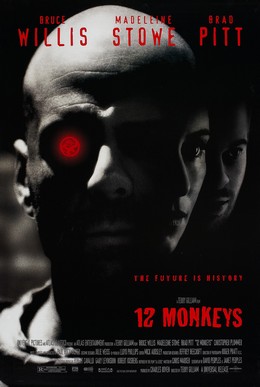
Behind the film
- Year
- 1995
- Director
- Terry Gilliam
- Writers
- David Peoples, Janet Peoples
- Runtime
- 2h 9m
- Genres
- Dystopian, Neo-noir, Post-apocalyptic
- Production
- Universal Pictures
- Country
- United States
- Cast
- Bruce Willis, Madeleine Stowe, Brad Pitt, Christopher Plummer, David Morse, Christopher Meloni, Jon Seda, Frank Gorshin
About the film
Contains story spoilers.
In 2035, James Cole lives in an underground compound beneath the ruins of Philadelphia, where most of humanity has died from a virus. Scientists select him for a dangerous mission: travel back to 1996 and gather information about the original outbreak so they can study the disease. Cole is a prisoner, and the scientists control when and where he is sent. His recurring dream of a shooting in an airport terminal links his fragmented memories to the lost world the scientists are trying to understand.
The first jump lands Cole in Baltimore in 1990 rather than the target year. Police arrest him, and psychiatrist Kathryn Railly diagnoses him before he is confined to a hospital. There he meets Jeffrey Goines, a patient whose outspoken opposition to consumer society attracts attention and suspicion. Cole insists that the Army of the Twelve Monkeys released the virus. His certainty sounds like delusion to the doctors, while the film keeps the viewer close to the same uncertainty. An escape attempt with Jeffrey ends when Cole is abruptly taken back to the future.
On another mission, Cole briefly arrives on a First World War battlefield and encounters José, another man from the future, before he is shot in the leg. The scientists send him again, this time to 1996. Railly is giving a lecture about the Cassandra complex and meets Dr. Peters, who speaks of humanity’s destruction of the environment. Cole kidnaps Railly and asks her to drive him to Philadelphia; during the journey she removes the bullet from his leg. Their relationship shifts from doctor and patient toward an uneasy partnership, though she still cannot be sure his story is true.
Their investigation leads them to Jeffrey, whom they find connected to the Army of the Twelve Monkeys. Cole is pulled back to the future again, and Railly later identifies him in a historical battlefield photograph, confirming that he had been in the past decades earlier. When Cole returns to 1996, he tells Railly he thinks he is delusional. She does not dismiss him so quickly now. They plan to leave together for the Florida Keys, trying to step away from the mission while following the clues they have collected.
On the way, they discover what the group’s name actually refers to: Jeffrey’s animal-rights organization has freed animals from the Philadelphia Zoo. Its graffiti about having done it describes that action, not the release of the virus. Cole records a message saying the group is a false lead and that he will not return to the future. Railly then recognizes Dr. Peters at the airport from a newspaper photograph with Jeffrey’s father, virologist Dr. Leland Goines. Peters, not the organization, is connected to the virus that will devastate the future.
José reaches Cole at the airport and gives him a gun. After Railly explains that she has found Peters, Cole tries to shoot him, but police shoot Cole first. He dies in Railly’s arms as a young boy watches the scene. Peters boards a flight carrying the virus, taking a seat beside one of the scientists who sent Cole back. The image of the boy watching the shooting is the memory that has haunted Cole throughout his life. His mission has not prevented the outbreak, but the film makes the loop of memory and history unmistakable.
Terry Gilliam’s visual design keeps the underground future cramped and mechanical, while the 1990s streets and hospital spaces feel crowded with information Cole cannot reliably sort. The time jumps make his reliability a genuine question rather than a puzzle with an easy answer. Bruce Willis plays him as forceful but vulnerable; Brad Pitt’s Jeffrey is restless and performative, and Madeleine Stowe’s Railly changes as she moves from clinical certainty to investigation. The film draws inspiration from Chris Marker’s La Jetée while building its own characters and causal chain around the virus.
The scenes in the cinema give Cole and Railly a brief refuge while bringing another film about unstable identity into view. They watch Vertigo, then Railly changes her appearance with a blonde wig as part of their attempt to evade recognition. Cole has to see someone he knows through a new image, echoing his larger difficulty with a memory that has never arrived whole. The references do not supply a solution to the time-travel problem; they extend its fascination with the gap between what a person sees and what that image means. The scientists’ interviews create a different kind of uncertainty. Their equipment and coordinated questions make Cole look like a test subject even when they insist his experience is valuable. The hospital has its own procedures for classifying him, so neither past nor future gives him a place where his account can simply be heard. Railly’s changing response becomes important because she is prepared to examine evidence that conflicts with her original explanation. The old bullet and photograph do not make every interpretation correct, but they make dismissal harder. The scientist seated beside Peters in the final flight leaves another unresolved purpose in view: the future has acquired access to the source of the disaster, even though Cole cannot escape his place in its history.