
Choose a Team Buy Without Memorising an Economy Chart
On this page
A useful buy starts with a team decision. In Competitive and Premier bomb-defusal rounds, decide whether you are equipping for this round or preserving enough money for a later one. Then choose equipment that fits the plan. This guide concerns the money used during a match.
Agree on what this round is for
Players use a few common terms for spending decisions:
| Team call | What players usually mean |
|---|---|
| Full buy | Equip the weapons, armour and utility needed for the intended round. |
| Eco or save | Spend little or nothing to conserve money. |
| Light or partial buy | Buy a limited set of equipment while keeping a reserve. |
| Force buy | Commit money to contest this round despite the risk to the next buy. |
These terms describe a plan, so ask what the team means if the call is unclear. A partial buy might involve one useful grenade and a modest weapon; it does not have a universal price threshold.
Check what teammates already carry. Valve’s buy menu includes equipment indicators, which help you spot a mismatch before you spend. A rifle in your hands does not create a well-equipped team if everyone else is saving. Valve’s buy-menu explanation.
Read the next-round minimum
The buy menu displays the minimum money you are guaranteed to have next round. Use that lower bound when thinking about a future purchase. Extra earnings may change the eventual amount, but a plan that needs those earnings has more uncertainty. Valve’s explanation of the minimum-money display.
Choose your reserve using the current prices of your intended equipment. Subtract that reserve from the displayed minimum to estimate the room for a limited buy, and check the display again as you make purchases.
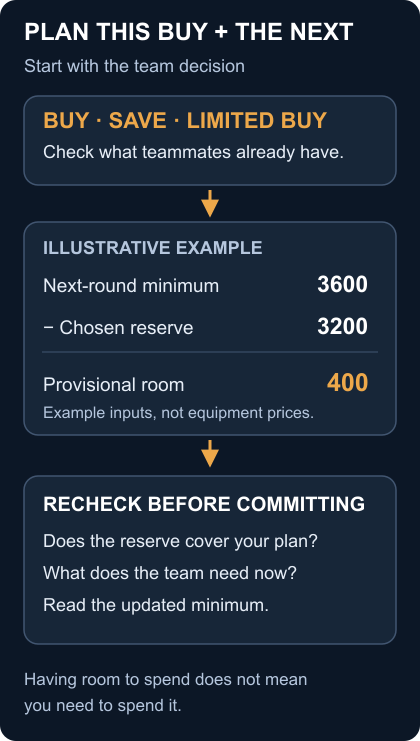
For example, a displayed minimum of 3600 and a personally chosen reserve of 3200 leave 400 of provisional room. That only helps if the reserve covers the equipment you actually intend to buy. It also remains subject to the team’s decision: having room to spend does not mean you must spend it.
Assemble the equipment around a job
Work through the buy in this order:
- Confirm the team call and inspect the equipment you already have.
- Choose the main weapon you intend to use for your position.
- Check what armour, utility and any CT defuse kit the plan requires.
- Recheck the next-round minimum and your agreed spending limit.
If the purchase leaves no room for the grenade your team needs, reconsider the weapon before the round begins. Likewise, if a teammate can provide an affordable weapon drop, explain what you need early enough for them to make their own purchase.
The Dropped Weapons panel lets you pick up weapons that you or teammates have dropped in the buy zone. Check it before buying a replacement. Unused purchases from the same round can also be refunded; that is different from selling equipment carried over from an earlier round. Valve’s dropped-weapons panel, refund rules.
Fix a recurring bad buy
If you keep entering rounds without the equipment you planned, look at the previous purchase. Did a small extra buy consume the reserve? Did you force without agreeing on the following round? Try setting the reserve first and buying around it for a few rounds.
Saving money during buying and trying to preserve a weapon during a difficult round are different decisions. For the latter, consider the remaining objective, time and teammates’ positions. Avoid treating either saving or attempting the objective as an automatic answer to every situation.
Use live prices and the current display. Valve changed several SMG prices in January 2026, and Competitive CT economy includes a team award for each Terrorist eliminated. Older charts can miss those changes. January 2026 update, CT team-award update.
For a wider introduction, follow the starter practice plan. Once your equipment has a purpose, rehearse using it with the aiming and utility drills.