
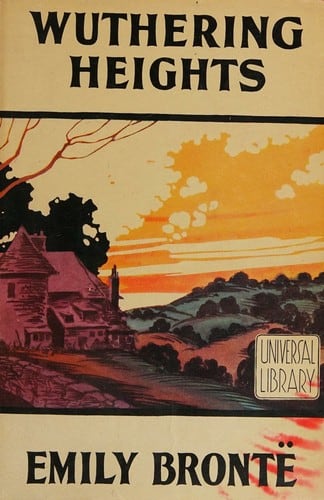
Wuthering Heights
Mr Lockwood takes a lease on Thrushcross Grange and rides over to meet his landlord at Wuthering Heights, a farmhouse on the moors where nobody seems pleased to see him.
About
Spoiler notice: Contains full-story spoilers, including the fates of the central characters and the closing resolution.
The novel opens in 1801 with Mr Lockwood, a new tenant at Thrushcross Grange, visiting his landlord at Wuthering Heights. The farmhouse stands high on exposed moorland, braced against the wind, and its people meet him with suspicion rather than hospitality. Heathcliff is the grim master; Hareton Earnshaw, a rough young man, resents Lockwood’s questions; and the widowed Catherine Heathcliff appears both striking and unhappy. Snow traps the visitor overnight. In a locked bedroom he finds Catherine’s name written in several forms and dreams of a child at the window begging to be let in. Heathcliff’s reaction to Lockwood’s account shows that the past behind this household remains painfully present.
Back at the Grange, Lockwood asks his housekeeper, Nelly Dean, to explain what he has seen. Nelly has served in both houses and narrates most of the history, though she admits where her knowledge comes from and occasionally distinguishes memory from what another person told her. Her account returns to Heathcliff’s arrival as a child, brought home from Liverpool by Mr Earnshaw. Catherine befriends him, while her brother Hindley treats the foundling as an intruder. After Mr Earnshaw dies, Hindley inherits the Heights and reduces Heathcliff to a servant. Catherine and Heathcliff keep slipping out onto the moors together, but a visit to the neighbouring Lintons introduces a different household and a different model of refinement. Nelly’s position inside both households gives her access to private quarrels and practical details, yet she also scolds, conceals, and interprets. Lockwood interrupts at points to ask for clarification, so readers hear a remembered story being shaped for a listener as well as the events it recounts.
The two estates shape the next decisions. Wuthering Heights is governed by inheritance, work and Hindley’s worsening abuse; Thrushcross Grange offers Edgar and Isabella Linton a more polished domestic life. Catherine returns from the Lintons’ house changed in appearance and manners, yet her attachment to Heathcliff remains intense. When she tells Nelly that marrying him would lower her position, Heathcliff overhears only part of the explanation and leaves before hearing how deeply she feels bound to him. Catherine marries Edgar. Heathcliff disappears for several years and comes back with money, authority and a deliberate interest in everyone who helped put distance between him and Catherine. The missed portion of Catherine’s confession matters because the story turns on people acting on fragments: rank, money and what a character happens to hear can alter the course of a household. Heathcliff’s return is not a simple reunion; he uses Hindley’s debts to gain control at the Heights and makes himself a presence the Grange's inhabitants cannot ignore.
The reunion does not restore the childhood companionship. Heathcliff’s return unsettles both households: he draws Isabella into an elopement, provokes Edgar, and seeks access to Catherine despite the harm their encounters cause. Nelly’s narration makes the consequences unfold through illness, arguments and visits between the houses rather than through a single uninterrupted account. Catherine becomes dangerously unwell after a confrontation between the men, gives birth to a daughter, and dies. The child, also named Catherine, grows up at the Grange under Edgar’s protection, separated from the history that shaped her parents. Heathcliff remains nearby, but his attention shifts toward the next generation and the people whose future he can control. Isabella eventually escapes the Heights and raises her son, Linton, away from his father; after her death, Edgar brings the boy to the Grange. This family link draws young Catherine into contact with Linton and with Heathcliff again, while Hareton is kept at the Heights under the authority that Heathcliff has taken from Hindley.
That second generation includes young Catherine, Edgar’s nephew Linton Heathcliff, and Hareton, Hindley’s son. Their encounters repeat old family divisions in altered form. Linton is frail and easily manipulated by his father; Hareton has been kept from education and taught to take pride in the very roughness that isolates him. Catherine’s curiosity draws her toward Wuthering Heights, where Heathcliff uses the young people’s affection and kinship to arrange a marriage that secures his claim over both estates. Catherine and Linton first correspond in secret, with Nelly trying to stop the visits; Heathcliff later traps Catherine at the Heights and forces the marriage before she can return to her dying father. After Edgar and Linton die, Catherine is left living at the Heights, grieving and furious, while Heathcliff’s revenge has finally placed the Earnshaw and Linton inheritances in his hands. The repetition is material as well as emotional: homes, names and property keep passing through the same family network.
The last movement changes direction through the slow friendship between Catherine and Hareton. At first she mocks his difficulty with reading, repeating the humiliation he has endured; later she offers to teach him, and the two begin to share books and walks. Their growing alliance gives Hareton a future not dictated by Heathcliff’s scheme. Meanwhile Heathcliff becomes increasingly withdrawn, speaking of Catherine Earnshaw as if their separation no longer holds. He neglects food and sleep, wanders outside and tells Nelly that he can sense Catherine near him. His death leaves the young couple able to marry and return to Thrushcross Grange. Lockwood’s closing visit to the churchyard supplies the novel’s final frame: he sees the three graves on the moor’s slope and wonders at the quiet of the place that Nelly’s history has made so restless. The ending allows the younger pair a practical future together but leaves Lockwood’s dream and Heathcliff’s longing beside the reader’s last view of the moor.
Book details
- Author
- Emily Bronte
- First published
- 1847
- Series
- No series listed
- Subgenre
- Gothic horror, Historical romance
- Tags
- No tags for this book.
Review
Editor profile
Baby Bat
Goodreads and social links will be added soon.
- Goodreads — link coming soon
- Social media — link coming soon