
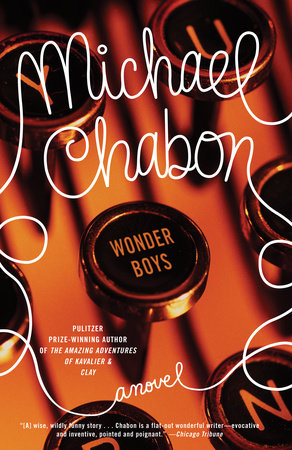
Wonder Boys
Grady Tripp, a former publishing prodigy now teaching at a Pittsburgh university, has spent years on an unwieldy second novel that still has no ending.
About
Spoiler notice: Spoilers cover the premise, Grady and James’s circumstances, and the novel’s central entanglements; later outcomes and the ending are withheld.
Wonder Boys places a writer in the difficult space between an earlier success and the work that is supposed to follow it. Grady Tripp was once a publishing prodigy; now he teaches at a Pittsburgh university and remains stalled inside a second novel that has grown far beyond a manageable shape. The gap between public promise and private progress gives the book its central comic tension. Grady’s unfinished manuscript is not simply a project waiting for its final pages. It has become a way of postponing decisions, while the expectations attached to his first success keep pressing on the life he is actually living. Chabon makes literary ambition part of the action, so the question of whether a book can be finished also becomes a question about how a person can move forward.
The student who enters Grady’s orbit, James Leer, offers a revealing counterpoint. James is a budding writer with a strong fascination for Hollywood self-destruction and the dramatic patterns of fame. His stories and interests suggest someone trying out identities through the cultural material he knows, even as he searches for a more personal way to understand himself. Grady, older and already publicly defined by a former success, has a different problem: he has to live with the distance between the person others remember and the writer he is now. Their connection gives the novel two versions of the same pressure. One character is trying to become legible; the other is trying to escape a definition that no longer fits.
Chabon’s own account of the book’s beginnings sharpens this contrast without making Grady a direct stand-in for the author. Before Wonder Boys, Chabon spent more than five years on a novel called Fountain City, then abandoned it. In a 1995 interview he said that he gave Grady some of the anguished feelings he had carried about that unfinished work, while also explaining that Grady is more lost in his manuscript than Chabon himself had been. That distinction matters to the novel’s tone. It draws emotional material from the fear of wasting time and failing to complete a large undertaking, but transforms those feelings into fiction, with room for exaggeration, detours, and comedy. The result is not a confession disguised as a story; it is a story interested in what prolonged creative uncertainty can do to a person.
The setting places these private struggles within an academic and literary world. Grady’s university job brings him into contact with young writers, while a visit from his editor makes the unfinished book difficult to keep at a safe distance. The campus is therefore both workplace and pressure chamber: it contains the routines that let Grady delay the next step, and the people who make those delays visible. Around him, professional labels carry a peculiar weight. A former prodigy is expected to produce another success; a student writer is already studying the images and myths through which success is made. Chabon uses this environment to look at literary prestige as a social force, something built from reputation, attention, and the hopes other people attach to a writer.
The novel’s comedy comes from the mismatch between grand artistic self-conceptions and the awkward, material lives people have to manage. Grady’s enormous book gives ambition a physical scale, but its sheer size has not brought him closer to an ending. James’s attraction to stories of spectacular collapse similarly shows how readily a life can be interpreted through familiar cultural scripts. Chabon’s humor can hold affection and embarrassment together: the characters’ illusions are exposed, yet their need for purpose and recognition is treated as recognisably human. This balance keeps the book from reducing writers to vanity or failure. Its satire targets the machinery of fame and the romantic poses people adopt around it, while its characters remain more complicated than their poses.
Desire in Wonder Boys also exceeds the wish to publish a successful book. The publisher frames the novel as a portrait of young and old desire, and that phrase fits the way its central pair reach toward lives they have not settled into. Grady’s private and professional entanglements complicate the image of the detached writer observing his own decline. James’s searching heart sits uneasily beside his interest in Hollywood’s polished stories of damage. Each character wants something that cannot be supplied by a role alone: being called talented, notorious, or promising does not resolve the more intimate question of what one wants from other people. Chabon lets these motives cross and disturb one another, giving the comedy emotional stakes without turning it into a tidy lesson about maturity.
The book’s self-awareness about writing is part of its structure and its subject. Grady’s unfinished manuscript sits inside Chabon’s completed novel, a device that makes the act of writing visible while keeping the character’s stalled project distinct from the book in the reader’s hands. That contrast invites a useful question: when does a work in progress remain an imaginative possibility, and when does it become a shelter from choosing what comes next? Chabon’s answer is not a simple rule about discipline. Instead, he gives that question to characters whose aims, appetites, and responsibilities pull in different directions. First published in 1995, the novel turns a writer’s stalled second book into a comic story about reputation, self-invention, and the uneasy passage from promise to an actual life.
Book details
- Author
- Michael Chabon
- First published
- 1995
- Series
- No series listed
- Subgenre
- Literary fiction, Campus novel
- Primary genre
- Literary Fiction
- Tags
- No tags for this book.
Review
Editor profile
Baby Bat
Goodreads and social links will be added soon.
- Goodreads — link coming soon
- Social media — link coming soon