
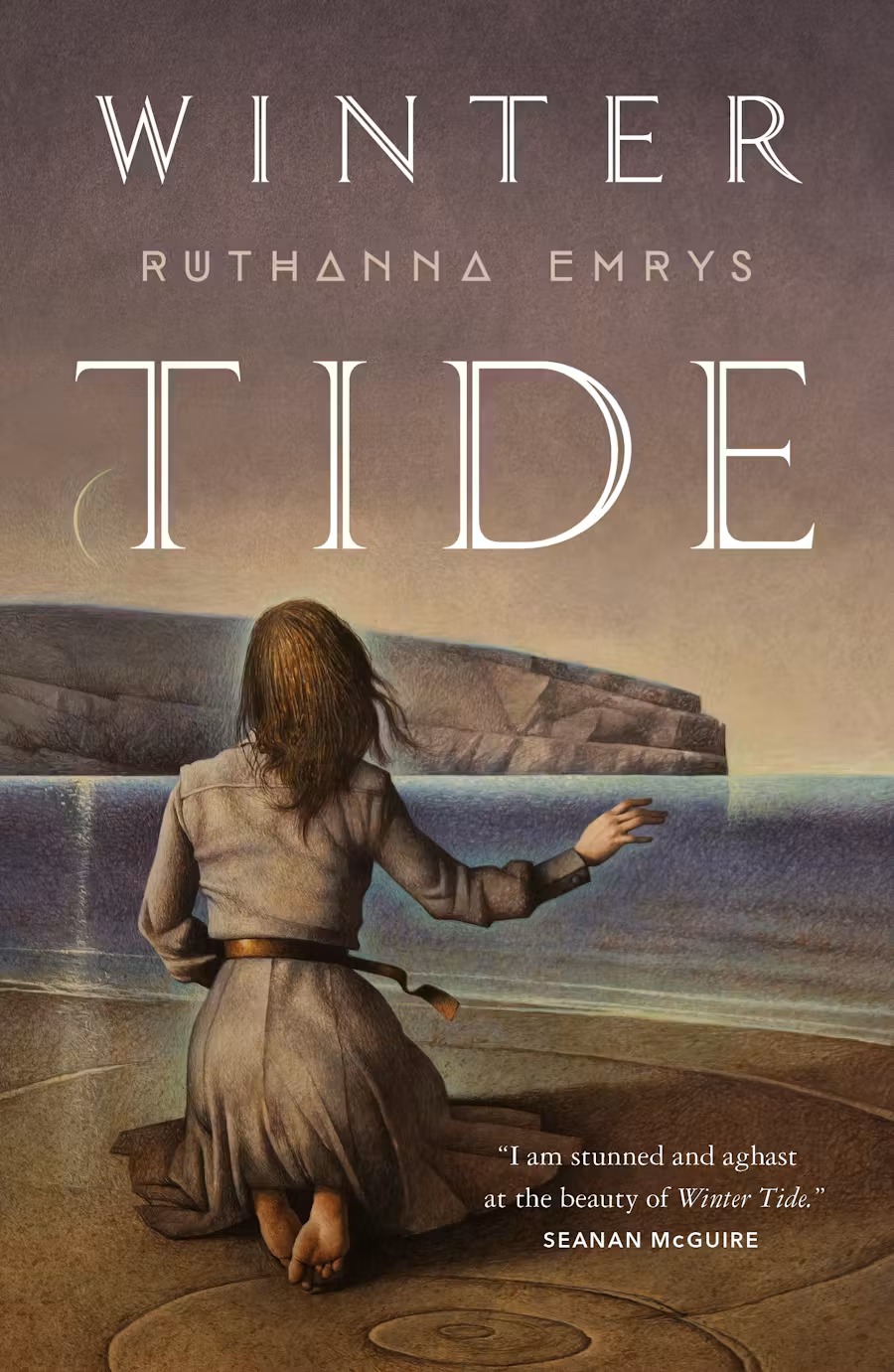
Winter Tide
In 1948, Aphra Marsh has made a life in San Francisco among books, magic and a family formed after wartime displacement.
About
Spoiler notice: This account covers Aphra’s background and the opening situation, including the return to her community’s history. It avoids the novel’s late revelations and ending.
Winter Tide opens in 1948 San Francisco, where Aphra Marsh has built a precarious but meaningful life around books. She works with Charlie Day, a bookseller whose private collection includes occult texts, and the two study magic together. Their friendship has formed through shared work and the boundaries they each keep around their past. Aphra has spent years concealing where her knowledge came from and why she lives with a family that is not her own. The opening’s quiet focus on an estate sale, old volumes and a possible magical manuscript gives the story a tactile center: knowledge survives in objects, but recovering it can require a person to decide how much of herself to disclose.
Aphra’s withheld history reaches back to Innsmouth. In the novel’s account of 1928, the government took the town’s people from their coastal home and confined them in desert camps. Aphra and her brother Caleb were among the few survivors. The family around her in California includes people whose own wartime displacement has brought them into one another’s lives; the publisher excerpt shows how their shared household offers care while also revealing differences in what they regard as home. For Aphra, belonging is tied not only to the people beside her but to a culture, a history and a body of knowledge that the camps tried to sever from her.
That history makes the books more than a scholarly interest. Aphra and Caleb each seek traces of their people’s libraries, and the publisher’s opening pages connect a missing or recovered text to Miskatonic University, where Caleb is trying to learn what remains. Books can preserve names, commentary and family memory as well as spells. The distinction matters to Aphra: an outsider might see duplicate titles or obscure lore, while she understands that the marks left by generations make each volume part of a living archive. The search therefore carries both practical and emotional weight, joining research to the harder work of reclaiming what was taken.
The government’s renewed interest in that knowledge creates the central mystery. FBI agent Ron Spector asks Aphra to help investigate magical secrets stolen from Miskatonic, with the possibility that Communist agents could use them to escalate the Cold War. The request comes from an institution connected to the destruction of Aphra’s former life, so cooperation has an uncomfortable cost even before the danger is clear. She must weigh what her expertise could prevent against what it means to help the same state that imprisoned her people. The premise gives the investigation a political tension alongside its occult one: secrecy and power are not confined to ancient books or supernatural forces.
Aphra’s perspective also changes the shape of the Cthulhu Mythos material the novel draws on. The people associated with Innsmouth are not treated simply as a threat to be hunted; the opening gives Aphra a family history, a religious and intellectual tradition, and her own understanding of the future awaiting her people in the sea. Her physical differences are part of that identity, not a sign that she is less human in the moral sense that matters to the story. Through her, ideas of monstrosity and danger become questions about who gets to describe another community, whose account the state believes, and how fear can turn into policy.
Magic in these pages is learned rather than handed down as a convenient solution. Aphra and Charlie work from texts and practice, and their efforts are shaped by partial training, uncertainty and the limits of what they can safely reveal. The book’s historical setting makes that process feel specific: postwar San Francisco, the memory of the camps, the surveillance of the early Cold War and the institutional authority of Miskatonic all affect what characters can say or do. A spell may open a possibility, but it cannot restore a lost family or make a former captor trustworthy. The practice is collaborative: Charlie brings fresh questions to the material, while Aphra carries memories and methods he cannot acquire from a book alone. That difference gives their partnership a productive asymmetry, and places Aphra in the position of deciding what knowledge can be shared, with whom and under what risks. The same questions recur when Spector asks her to enter the university’s investigation. That balance lets the supernatural investigation remain tied to ordinary questions of safety, obligation and grief.
The emotional center is Aphra’s effort to decide what kind of life can follow survival. Caleb’s search, Charlie’s friendship, the Koto family’s care and Spector’s request pull at different parts of her loyalty. Each relationship asks something distinct: preserve the past, accept the support offered in the present, or risk working with an institution whose power has already harmed her. The novel’s use of Lovecraftian cosmic material thus sits beside intimate concerns about memory and chosen bonds. Its mystery begins with a stolen body of knowledge, but the stakes include whether Aphra can make a future that does not require abandoning her people’s account of themselves.
Book details
- Author
- Ruthanna Emrys
- First published
- 2017
- Series
- The Innsmouth Legacy, book 1
- Subgenre
- Historical fantasy, Cosmic horror
- Primary genre
- Fantasy, Historical Fiction, Horror
- Tags
- No tags for this book.
- Reading order
- This is the only The Innsmouth Legacy title on the shelf right now.
Review
Editor profile
Baby Bat
Goodreads and social links will be added soon.
- Goodreads — link coming soon
- Social media — link coming soon