
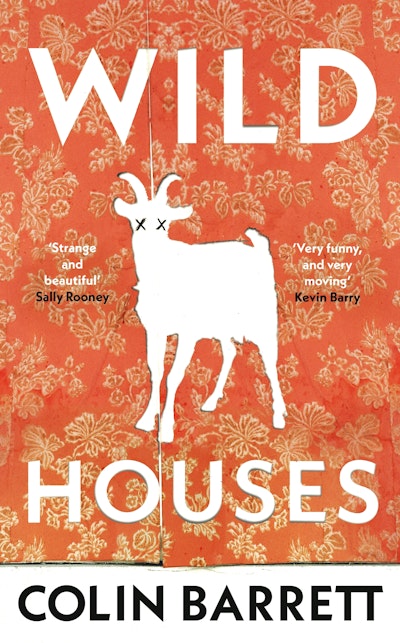
Wild Houses
In Ballina, County Mayo, Dev Hendrick’s quiet Friday night is disrupted when his cousins Gabe and Sketch Ferdia bring Doll English to his home.
About
Spoiler notice: Spoilers cover the opening setup: Dev receives Doll in his home with Gabe and Sketch, and Nicky begins trying to find her boyfriend. Later turns and the ending are not disclosed.
Wild Houses is Colin Barrett’s first novel, published in 2024 after two collections of short stories. It takes place in Ballina, the County Mayo town where a close network of locals is pulled into a kidnapping and a revenge plot. Barrett builds the story around a single pressured weekend, using the small scale of the setting to make every arrival consequential: relatives, neighbours, associates and former schoolmates already carry histories with one another. The crime gives the narrative its immediate motion, but the book’s attention is wider than the mechanics of a hostage situation. It considers what happens when people with limited room to manoeuvre are caught between loyalty, fear, need and the wish to escape the lives they know.
The first point of view belongs to Dev Hendrick, a large, quiet man living alone in his late mother’s house. On Friday night his cousins Gabe and Sketch Ferdia bring a bruised young man, Doll English, to stay there. Doll is the younger brother of Cillian, a small-time dealer whose conflict with the Ferdias has set the kidnapping in motion. Dev has connections to both sides and cannot pretend that the situation is someone else’s concern: the Ferdias are family, Doll is under his roof, and the dispute reaches into the local world where Dev himself has been keeping a low profile. In the opening scene, he is asked to accommodate the men before he has time to decide what their presence will mean. The ordinary rooms of the house become a temporary holding place for a crisis that began elsewhere.
Dev’s reluctance matters because the plot does not turn him into a conventional action hero. He is accustomed to being underestimated and to letting louder people set the terms of an encounter. His connections with the Ferdias and their criminal work place him close to danger, but that closeness does not automatically give him authority. Barrett’s opening establishes this tension through practical details: who is allowed through the door, who controls the phone, who can leave, and who is expected to comply. These small decisions show how power operates in the house before anyone makes a grand declaration. The domestic setting also brings the characters’ vulnerabilities into view. Dev’s care for the home and its dog sits beside his uneasy involvement with the men who have entered it, making safety feel contingent rather than secure.
The novel also follows Nicky, Doll’s seventeen-year-old girlfriend. After a difficult Friday night, she becomes convinced that something has happened to him and sets out to find him. Her movement through Ballina gives the story a second line of urgency: while Dev is drawn into the hostage-takers’ immediate orbit, Nicky is trying to learn where Doll has gone and what she can do. She is not simply an observer waiting for information to arrive. She has her own unsettled history, her own reading of the town and a future she is beginning to question. By placing her search alongside Dev’s constrained position, the book shows different kinds of limited agency. One character is pulled into a room by family and criminal obligation; the other moves through the town trying to find out where Doll is being held.
The wider cast is made up of people whose behaviour can be threatening, absurd or unexpectedly tender, sometimes within the same encounter. Gabe and Sketch are not interchangeable enforcers: their temperaments, histories and relationships to the local trade shape the pressure they bring into Dev’s home. Cillian’s dispute is the catalyst, yet its consequences spread to people who did not choose to become central to it. Doll, too, is more than the object of a rescue effort; his connections and decisions affect how the crisis develops. Barrett’s short-story background is apparent in the amount of social context gathered around these characters, but the novel lets those details accumulate across a continuous, tense narrative. A joke, an insult or a gesture of care can change the temperature of a scene without making the underlying danger disappear.
Ballina is not presented as a picturesque backdrop set apart from the plot. It is a lived-in place where reputation travels, old relationships persist and the consequences of violence are difficult to keep contained. The story’s dark comedy comes from the friction between criminal self-importance and ordinary routines, but the humour does not cancel the harm at stake. The result sits between crime fiction and literary fiction: the kidnapping supplies a clear source of suspense, while attention to interior lives and local relationships gives the novel its broader shape. Barrett’s prose, as evidenced in the supplied publisher sample, moves between sharply observed domestic detail and confrontational dialogue, keeping the scene grounded in how people speak and respond. The book’s central question is not only how a kidnapping will play out, but how a town’s interlocking loyalties leave people to manage the damage around them.
Book details
- Author
- Colin Barrett
- First published
- 2024
- Series
- No series listed
- Subgenre
- Crime thriller, Literary fiction
- Primary genre
- Mystery & Thriller, Literary Fiction
- Tags
- No tags for this book.
Review
Editor profile
Baby Bat
Goodreads and social links will be added soon.
- Goodreads — link coming soon
- Social media — link coming soon