
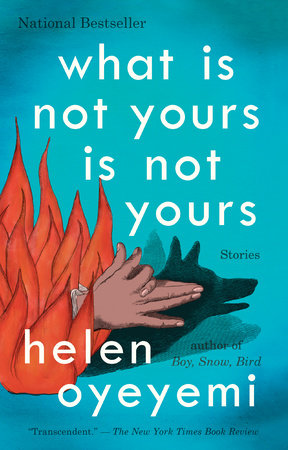
What Is Not Yours Is Not Yours
Across nine stories, keys open doors, conceal histories and invite characters into other people’s lives.
About
Spoiler notice: This overview discusses the collection’s recurring key imagery, linked characters and broad premises of selected stories. It avoids later explanations of how individual mysteries resolve and does not disclose endings.
A key is a small object with an unusually large promise: it may grant access, protect a secret, or reveal that a locked boundary was never as secure as it seemed. Helen Oyeyemi builds What Is Not Yours Is Not Yours around this familiar object in both literal and figurative forms. The book is a collection of nine stories, not one continuous novel, but images, characters and places recur, making the sequence feel connected without reducing every tale to a piece of a single plot. A key may be central in one story and incidental in another; across the book, it keeps raising questions about who is allowed in, what a person has the right to know, and what remains private even when a door opens.
The opening story, “Books and Roses,” offers a guide to the collection’s shifting habits. In Barcelona, an orphan’s connection to a special key leads toward a library and a hidden garden, while stories within the story redirect attention among people and their relationships. The key promises clues, yet access does not produce a simple answer. Oyeyemi lets people change in importance as a tale unfolds, and the reader must adjust to those changes rather than settle too early on one central figure or one stable account. That playful movement is part of the book’s structure: each story can surprise on its own, while the sequence encourages readers to remember earlier details and consider them in a new light.
Other stories move among contemporary English settings, Barcelona and places shaped by fable, myth or a less easily named geography. A puppeteering school becomes the setting for questions of desire and identity in “Is Your Blood as Red as This?”; “’Sorry’ Doesn’t Sweeten Her Tea” circles a locked house and the lives gathered around it; another tale turns a book that should remain locked into the focus of a compact fable. The situations range from everyday domestic arrangements to impossible or uncanny events. A door may lead to a secret space, a key may carry a history its holder does not understand, and a familiar social world may admit one impossible element without pausing to explain it away. The stories preserve that uncertainty as part of their atmosphere.
The links between stories are more than repeated decoration. Characters encountered at the edge of one narrative can return with a different role elsewhere, while a place, object or unresolved question may acquire another meaning when viewed from a new angle. These returns offer continuity, though they do not close every gap. A reader may learn something about a figure who appeared briefly before, but not necessarily the complete history behind that person’s choices. The collection gives the feeling of a shared world whose inhabitants continue to live beyond the frame of any one story. Its connections reward attention while preserving the independence of each narrative and the mystery surrounding what happens outside it.
Oyeyemi blends recognisable concerns with fabulist invention. Relationships, family responsibility, grief, desire, work and social expectations remain legible even when a story introduces talking puppets, a magical bargain, a hidden garden or an experiment that unsettles the boundary between presence and absence. The fantastic details do not simply decorate otherwise ordinary scenes; they alter what characters can perceive and what readers can assume. A fable may sharpen a question about care or power, while an everyday exchange can feel strange because its emotional rules are difficult to read. The resulting tone can turn from comic to tender or unsettling without announcing a strict border between realism and fantasy.
The collection also pays close attention to the limits of interpretation. Opening a lock is not the same as understanding what lies beyond it, and seeing another person’s private world does not make that world fully available. Oyeyemi’s narrators and characters often shift the reader’s expectations through changes of focus, changes in time or missing information. These moves make uncertainty active: readers are invited to connect details, but also asked to notice when a connection is only a guess. The recurring keys therefore work as more than a puzzle to solve. They give shape to the desire for access, and to the possibility that another person’s experience cannot be possessed simply because one has found a way inside.
What Is Not Yours Is Not Yours is held together by this balance of recurrence and surprise. Its nine stories share objects, characters and an appetite for crossings between the ordinary and the marvellous, yet each establishes its own emotional and narrative terms. Some passages approach the shape of a fairy tale; others build around contemporary relationships or a speculative premise. Together they form a loose architecture of locked rooms, borrowed knowledge and unexpected entrances. The collection’s title suggests a limit, while its stories keep testing what that limit means: when access becomes intimacy, when curiosity becomes intrusion, and whether any key can turn another person’s life into something fully knowable.
Book details
- Author
- Helen Oyeyemi
- First published
- 2016
- Series
- No series listed
- Subgenre
- Literary fiction, Magical realism
- Primary genre
- Literary Fiction, Fantasy
- Tags
- No tags for this book.
Review
Editor profile
Baby Bat
Goodreads and social links will be added soon.
- Goodreads — link coming soon
- Social media — link coming soon