
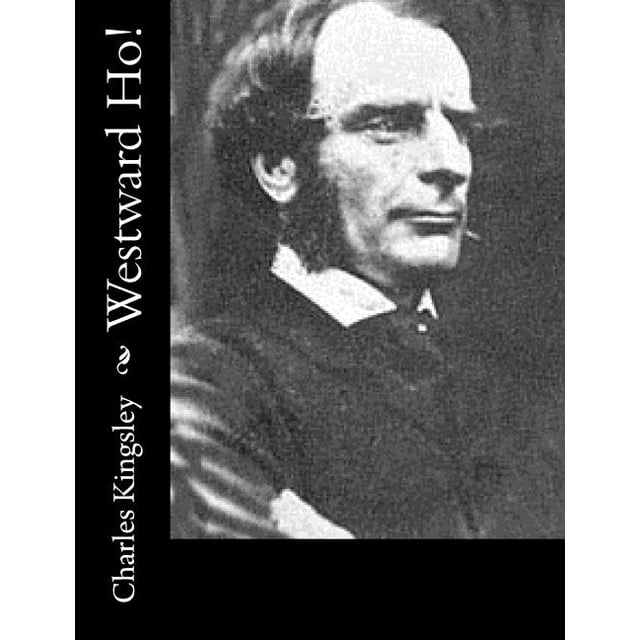
Westward Ho!
Amyas Leigh grows up in Bideford longing for the voyages and exploits celebrated by the sailors around him.
About
Spoiler notice: This overview discusses Rose and Frank’s reported execution, the storm off Lundy, Yeo’s death, Amyas’s blindness and his final reunion with Ayacanora.
Bideford is a place from which the world seems reachable in Westward Ho! Ships, sailors and stories of distant wealth give the young Amyas Leigh an irresistible picture of what his life might become. John Oxenham’s arrival strengthens his determination to go to sea, but his parents will not let him exchange training at home for immediate adventure. Sir Richard Grenville’s example connects the qualities of a gentleman with the ambitions of a mariner. Charles Kingsley’s 1855 novel sends Amyas into an Elizabethan world of voyages, rivalry with Spain and fiercely declared religious loyalties. Its opening confidence in English maritime greatness belongs to Kingsley’s Victorian historical imagination, which shapes the judgments of the narrator as strongly as the dangers and opportunities encountered by his characters.
Amyas’s return from his first voyage produces a noisy local celebration, complete with pageantry, boasts and jokes at the expense of people who stayed ashore. The welcome gives the sea adventures a community to which they can be reported and through which they become reputation. Yet Amyas also wants to know where Rose Salterne is, and his brother Frank answers carefully enough to suggest complications beyond a simple homecoming. The town’s personal relationships run alongside its enthusiasm for distant exploits. Rose’s later disappearance turns those relationships into a search: people speculate, a bloodhound follows traces from her room and suspicion settles around Lucy Passmore’s empty cottage. What has happened to one young woman becomes entangled with the wider movements of ships, religious agents and Amyas’s Spanish rival, Don Guzman.
Rose has become Donna Rosa de Soto, Don Guzman’s wife, and her position cannot be understood merely as the loss of someone the English men hoped to recover. When encountered abroad, she speaks of the faith her husband promised to respect and protect, defending a marriage whose pressures the others have not fully understood. The private conflict brings religious allegiance inside the household. Eustace’s involvement makes those promises increasingly insecure, while Amyas and Frank have to confront a woman who can speak for herself even in distress. The novel gives their rivalry a moral and religious vocabulary, but it also repeatedly shows how little the characters know of the lives over which they want to exercise influence. Information arrives late, in fragments, or through someone whose motives cannot be trusted.
The westward expedition expands that uncertainty into a long pursuit of the Golden City of Manoa. By the council beside the Meta, years of wandering have brought the men across forests, rivers and mountain country without delivering the treasure they sought. Forty-four remain of the eighty-four who began that part of the journey. Lost companions, damaged equipment and repeated disappointment make the cost visible beneath the narrator’s celebration of endurance. The Americas also become associated with Ayacanora, whose place in Amyas’s life will eventually matter more than the riches beyond reach. Kingsley’s depictions of the people encountered along the way carry the assumptions and prejudices of his own narrative outlook. Within the adventure, the promised destination keeps receding while obligations to living companions accumulate in its place.
The story of Rose and Frank reaches Amyas through Lucy Passmore’s account after imprisonment and torture have left her weak. She describes the marriage at Lundy, the journey overseas and the gradual destruction of peace in Don Guzman’s house. Later, she and Rose are taken to Cartagena, where Frank is also held. Lucy recants under the pressures of interrogation, while Rose remains steadfast. Her testimony says Rose and Frank are condemned and burned together, holding hands to the end. The execution is therefore conveyed through a survivor’s recollection rather than narrated as a scene Amyas witnesses. For him, the account renews the desire for vengeance. The language of a national and religious struggle becomes inseparable from the loss of his brother and from a grief that seeks someone against whom it can act.
Near the conclusion, that desire drives Amyas after the Spanish ship into a storm off Lundy. The galleon founders, depriving him even of the confrontation he wants. A lightning strike then kills Salvation Yeo and leaves Amyas blind. His fury gives way slowly to a reckoning with the hatred he had treated as righteous purpose. In a dream or vision, he sees Don Guzman beneath the sea and imagines them acknowledging one another’s wrongs and ending their quarrel. Kingsley leaves the experience within Amyas’s account, heard by companions who cannot see what he describes. It changes what he is able to say about himself: the conviction that he was acting as an instrument of justice has concealed cruelty and pride. His injuries do not reverse, but his relation to the enemy and to his own past begins to change.
The final homecoming starts with Yeo’s funeral, not a victory procession. Amyas honours his companion before returning to his mother, and the familiar house surrounds him with objects he can recognize by touch and smell. A dropped apple exposes the dependence that he has tried to bear with composure. Ayacanora returns it to his hand and offers to care for him; her presence brings affection he had neglected back into reach. Mrs. Leigh welcomes their reunion, and the closing passage carries Ayacanora’s restored singing through the years of their shared home. No wedding is narrated. The story ends with the voyager accepting a life whose significance can no longer depend on sailing farther or defeating another opponent. Its last westward movement is carried through memory and song, from within a household where strength must make room for receiving help.
Book details
- Author
- Charles Kingsley
- First published
- 1855
- Series
- No series listed
- Subgenre
- Historical fiction, Historical adventure, Classic adventure
- Primary genre
- Historical Fiction, Adventure
- Tags
- No tags for this book.
Review
Editor profile
Baby Bat
Goodreads and social links will be added soon.
- Goodreads — link coming soon
- Social media — link coming soon