
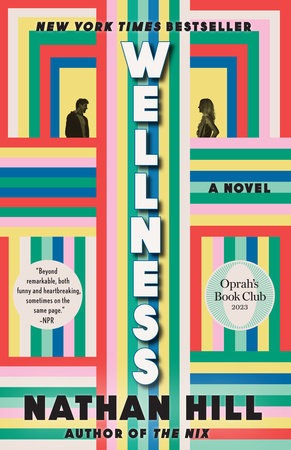
Wellness
In 1990s Chicago, college students Jack and Elizabeth meet through the underground art scene and build a life together.
About
Spoiler notice: Spoiler-light overview: this About section describes the premise, central relationships, and broad themes. It avoids later revelations and the ending.
Nathan Hill’s Wellness begins with Jack and Elizabeth as college students drawn into Chicago’s underground art scene in the 1990s. They recognize in one another the kind of companion who might understand their ambitions and help them find a place in a world that prizes independence. Their early bond grows from shared interests and a sense of being outsiders looking in. The novel then moves forward roughly twenty years, when they are married and raising a son in suburban life. The distance between these periods gives the book its central question: how well can two people know each other after the stories that first brought them together have become part of the past? Their first connection is framed by youthful attempts to belong to a scene that values its distance from the mainstream.
In the present-day strand, Jack and Elizabeth are no longer the young dreamers who arrived in Chicago. Their household carries the practical demands of parenting, work and maintaining a home, while each spouse begins to see the other as unfamiliar. Hill uses their marriage as the close centre of a broad social portrait. The couple encounter people seeking health, happiness and improved versions of themselves, from would-be romantic partners to neighbours absorbed in renovation. These situations create room for comedy, but they also sharpen the book’s concern with the effort to manage life as though every difficulty had a purchasable fix or a personal optimization plan. The contrast makes small domestic details carry the weight of a much larger change in how they see themselves.
The title points toward wellness as both an aspiration and a cultural industry. The novel considers how contemporary people are encouraged to monitor their bodies and habits, compare advice and treat ordinary uncertainty as evidence that something is wrong. Hill’s satire ranges across the pursuit of health and happiness without reducing the characters to targets of ridicule. Their attempts to feel better arise from recognizable needs: security, control, connection and relief from the sense of falling short. The book’s interest lies in the gap between a promise of perfect self-improvement and the complicated lives of people trying to care for themselves and one another. Rather than endorsing any single regimen, the book attends to the pressures that make such promises appealing.
Jack and Elizabeth’s present is connected to their earlier lives through memories of family, work and the ambitions they carried into adulthood. Both must reckon with hopes that have not developed as planned and with the influence of the households in which they grew up. The novel’s movement between the couple’s beginnings and their later marriage lets the reader see how a shared history can hold different meanings for each person. Their relationship is not presented as a puzzle solved by one revelation; rather, it becomes a changing account that each spouse must reconsider as they face the person beside them and the person they once expected to become. Their recollections matter because the couple’s explanations of the past are not automatically the same as shared understanding.
Art and science provide two important ways the novel examines belief. Jack makes what Hill calls chemigrams, images created through chemical processes on photographic paper rather than a camera. Hill made examples himself for the book, turning Jack’s creative practice into something the reader can actually see. Elizabeth’s experiments at Wellness concern the placebo effect: how expectation can alter an experience even when a treatment has no active ingredient. Their work gives the marriage two different ways of asking what counts as real and what a person can make real through attention. Those questions also sit inside the private stories they tell about love, identity and family. The novel brings art and experiment into ordinary life, where certainty about a method has to meet the limits of what it can explain about a person.
Chicago also gives the story a sense of change across time. Hill has described the 1990s Wicker Park music and art scene as a place that prized independence while making newcomers anxious about whether they truly belonged. That tension suits Jack and Elizabeth, who arrive hoping to reinvent themselves. Two decades later, their suburban routines bring a different set of expectations. The book does not recount that change in a straight line. Hill moves back and forth among courtship, midlife and the couple’s childhoods so that the reader learns about each spouse much as a partner might: by sharing a present, then hearing stories that recast it. The city and the changing household become part of that process, showing how a person can resist one identity and still inherit another.
Wellness is both a marriage story and a satirical look at the modern desire to improve every part of life. Hill moves between domestic scenes, memories and larger questions about culture, belief and self-invention, keeping the relationship between Jack and Elizabeth in view as the surrounding world expands. The book asks what happens when the narratives people use to understand themselves stop matching their experience, and whether affection can survive the work of looking again. Its tone makes room for absurdity and tenderness together. Readers interested in contemporary literary fiction, family relationships and the uneasy promises of self-help culture will find those concerns joined in one expansive novel.
Book details
- Author
- Nathan Hill
- First published
- 2023
- Series
- No series listed
- Subgenre
- Literary fiction
- Primary genre
- Literary Fiction
- Tags
- No tags for this book.
Review
Editor profile
Baby Bat
Goodreads and social links will be added soon.
- Goodreads — link coming soon
- Social media — link coming soon