
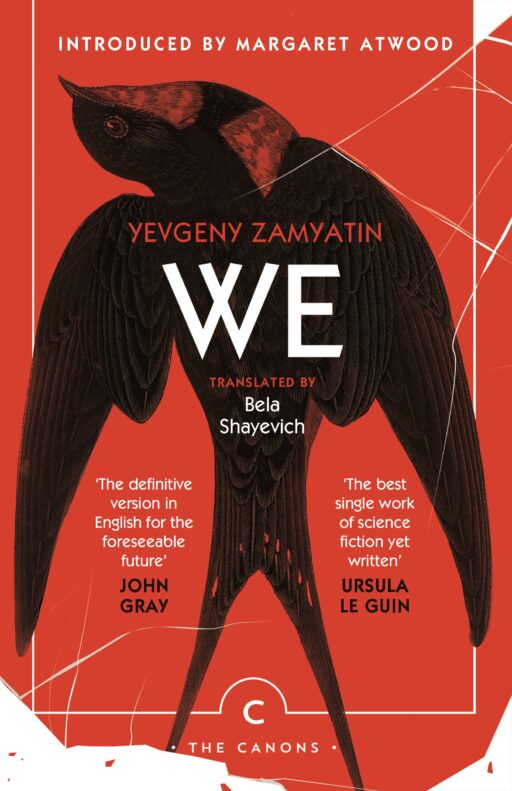
We
In a distant future, mathematician D-503 is building a spacecraft that will spread the One State’s ordered society to other planets.
About
Spoiler notice: Full-story spoilers below, including the conclusion of the novel.
D-503 begins these records as a task for readers beyond Earth: he is the chief engineer of the Integral, a spacecraft intended to carry the One State’s creed to other planets. He writes as a mathematician, trusting equations, schedules and what can be proved. The city stands behind the Green Wall, and its citizens are known by letter-number designations rather than private names. The opening announcement calls the mission a civilising gift, but its promise already contains a threat: worlds that refuse the State’s ordered happiness may be forced to accept it. D-503’s diary will test the gap between that official confidence and the mind trying to record it.
The One State has organised daily life as carefully as a calculation. The Book of Hours sets when Numbers wake, work, eat, walk and sleep; marching in uniform groups turns civic routine into public spectacle. Transparent buildings make privacy look like a defect, while lowered curtains temporarily mark permitted personal encounters. A pink ticket authorises time with a chosen partner, and even sex is framed as a practical aid to daytime productivity. The Benefactor presides over this system, supported by the Guardians and rituals such as the Day of Unanimity. D-503 initially describes these arrangements as beautiful because they remove uncertainty. His own narration, with its abrupt images and corrections, gradually shows that a life designed to eliminate surprise cannot control what a person notices or wants.
Three relationships expose different pressures inside that order. D-503’s partner, O-90, is warm and affectionate; her height falls below the State’s required maternal standard, making her wish for a child dangerous. R-13, a poet and D-503’s friend, can turn official ideas into fluent verse, but his personal loyalties complicate the neat triangle D-503 thinks they form. Then D-503 meets I-330, whose sharp manner and unexplained questions resist his habit of sorting people into predictable patterns. She smokes and drinks, interests officially associated with a discredited past, and approaches him with a mixture of teasing, intimacy and command. His attraction begins not as a clean conversion but as an irritation he keeps trying to calculate away.
I-330 draws D-503 into the Ancient House, a preserved remnant of earlier domestic life with dark rooms, old furniture and a piano. Its irregular spaces unsettle him more than the forbidden wine and tobacco. Their meetings lead through a hidden route beyond the Green Wall, where D-503 encounters people living outside the city’s measured routines. They call themselves the Mephi and are preparing to challenge the Benefactor and the One State. The excursion makes the wall’s meaning concrete: it separates a managed interior from a living world the State has labelled primitive. D-503 is both frightened by the conspirators and exhilarated by the fact that his official map of humanity is incomplete. Each return to the glass city makes his diary less like a report and more like a record of divided loyalties.
The State interprets D-503’s new thoughts as an illness. A thin doctor tells him that a soul has formed and calls the condition incurable; another doctor argues for surgery to remove the centre of fancy. The procedure is later named the Great Operation. For a time, D-503 tries to recover his earlier certainty and considers informing on I-330, but jealousy, desire and fear keep interrupting that resolve. O-90 asks him to father a child, knowing that her body falls outside the permitted limits for motherhood. D-503 finally gives O-90 a note to I-330 and helps her leave for the Green Wall when her pregnancy can no longer be hidden. Later, I-330 tells him that she has sent O-90 beyond the Wall and that O-90 will live. This choice connects private affection to the political boundary around the city: the future the State refuses O-90 is carried beyond its reach. D-503 cannot make his acts fit the tidy moral categories he once trusted.
As the Integral nears completion, the conflict spills into public life. During the Day of Unanimity, the expected acclamation breaks down: some Numbers reject the Benefactor, and the Mephi’s revolt becomes visible inside the city. I-330’s group plans to take the spacecraft as a way to breach the State’s defences and open a path between the two worlds. D-503’s position as its builder draws him into that plan, though fear and confusion still pull him toward obedience. The test flight does not deliver the Integral to the rebels: their attempt is exposed, D-503 stops the spacecraft, and the Second Builder saves it from crashing. The episode leaves D-503’s loyalties compromised rather than settled. O-90 has crossed beyond the Wall, while the revolt continues and the State’s response is gathering force.
The State regains control of D-503 by subjecting him to the Great Operation. Afterward, he can describe his new calm but no longer imagine why it should trouble him. I-330 is tortured in the Gas Chamber; she refuses to identify the other Mephi, and D-503 watches without the emotional response that had once made her matter to him. The final record does not confirm that the revolt has ended. D-503 reports continuing chaos, groaning, cadavers and “beasts” in the western section, alongside a temporary wall of high-voltage waves. He hopes—and insists—that the One State will win, but that is his assertion, not a settled outcome. The ending holds the State’s promised victory against evidence that resistance and disorder remain beyond its control.
Book details
- Author
- Yevgeny Zamyatin
- First published
- 1924
- Series
- No series listed
- Subgenre
- Dystopian, Classic science fiction
- Primary genre
- Sci-Fi
- Tags
- No tags for this book.
Review
Editor profile
Baby Bat
Goodreads and social links will be added soon.
- Goodreads — link coming soon
- Social media — link coming soon