
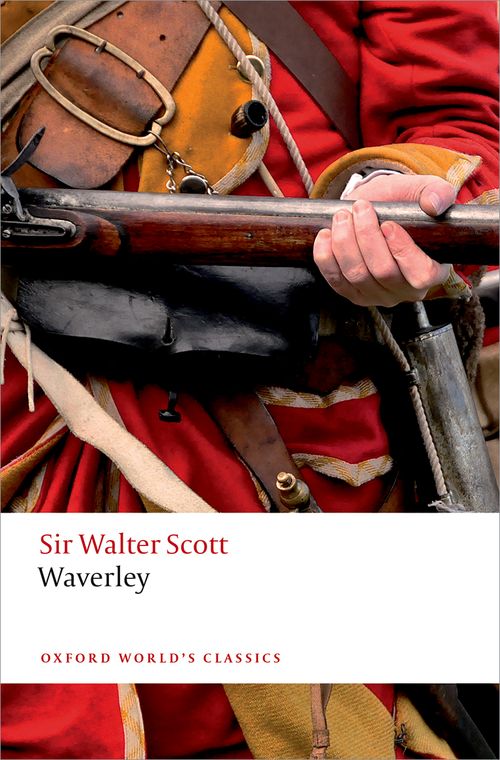
Waverley
A young English officer with a romantic imagination, Edward Waverley travels into Scotland and finds himself drawn between competing loyalties.
About
Spoiler notice: Full-plot spoilers, including Fergus’s execution, Edward’s marriage and the restoration of Tully-Veolan.
Edward Waverley grows up with a powerful imagination and very little practice in directing it. His education gives him access to a large library, indulgent instruction and the freedom to follow whatever catches his attention. He reads eagerly for a story, then loses interest when enjoyment gives way to sustained work. Walter Scott makes that habit part of the preparation for Edward’s journey into Scotland, where people and political causes will begin to resemble the romances he already knows. Published in 1814, Waverley places its young English officer in the world of the 1745 Jacobite rising. His family’s divided loyalties are already part of his inheritance, but he has not formed the settled opinions that might help him assess what he encounters beyond home.
A visit to Tully-Veolan introduces Edward to the Baron of Bradwardine and his daughter Rose. The Baron’s household has a character of its own, expressed through ceremonies, old possessions, family pride and the elaborate learning he brings into conversation. Scott allows those habits to be comic without making their owner merely ridiculous. They are ways of maintaining a connection with the past, and their importance becomes clearer when the house later suffers the consequences of conflict. Rose belongs to this domestic world, while Edward is particularly receptive to whatever seems unusual or picturesque within it. His impressions are those of a visitor who has much to learn. The novel gives the reader time among households and their customs before the political danger changes the meaning of being someone’s guest or friend.
Glennaquoich, the home of Fergus Mac-Ivor, draws Edward into another circle of hospitality and loyalty. Fergus is a forceful chief whose confidence gives him influence over a young man less accustomed to acting upon a settled purpose. His sister Flora brings beauty, accomplishment and a deep commitment to the Stuart cause into Edward’s experience. Scott distinguishes the character of her devotion from the ambitions mixed into her brother’s politics. Edward’s attraction to Flora does not become the partnership he imagines, and the difference between admiring her and understanding her matters. The Highland visit offers music, companionship and spectacle, but those pleasures belong to people whose political commitments demand real decisions. Edward cannot remain indefinitely in the position of an observer enjoying the appearance of another way of life.
Letters from home and military authority turn his uncertainty into anger. Accounts of his father’s loss of office encourage him to see the family as victims of political persecution, while a stern communication from his regiment makes his own position feel intolerable. He prepares to resign, then discovers that he has already been replaced for absence without leave. The order of events matters: the breach with his former service is not simply a clear-eyed decision to abandon it for a cause he has thoroughly examined. Edward interprets incomplete information through resentment and the loyalties of the people around him. Fergus supplies a confident political explanation where Edward lacks one of his own. His eventual participation on the Jacobite side therefore grows from personal influence, injured honour and imagination as well as allegiance.
The campaign tests what that participation means beyond its initial excitement. Edward’s connections cross the lines of the conflict, and Colonel Talbot becomes an important figure in the effort to secure his safety and understand the consequences of his conduct. Friendship cannot protect everyone. Fergus and Evan Maccombich face execution at Carlisle, where Edward’s final visit brings the cost of loyalty into a prison room. Fergus asks him to remember the Mac-Ivors and help those who may suffer after their chief is gone. Edward promises, but he cannot stop the procession leaving the castle. Scott keeps him away from the execution itself and follows his suspended misery until returning soldiers and crowds make the outcome unmistakable. The friendship that once enlarged his romantic world now leaves him with obligations that survival alone cannot discharge.
Edward’s future with Rose moves towards marriage, but the return to Tully-Veolan gives their happiness a larger setting. The Baron arrives expecting to confront the transfer of his former home to another owner. Instead, he finds the house repaired, familiar objects restored and the grounds cleared of the visible damage. Colonel Talbot and the legal arrangements gradually reveal that the estate has been recovered for him, using money Edward has advanced from the sale of his father’s property. The settlement also makes provision connected with Rose and their marriage. The surprise is managed with care for the Baron’s pride, allowing him to receive help without being reduced to a passive dependent. Family continuity is rebuilt through affection, money and legal work, rather than through the victory of the political cause he had supported.
The celebration does not remove Fergus from the story. A painting of him with Edward in Highland dress hangs in the restored house beside the weapons Edward carried, preserving the memory of a friendship whose two lives ended so differently. The final wish for the prosperity of the united Waverley and Bradwardine households is followed by a separate authorial postscript. There Scott explains his intention to preserve something of earlier Scottish manners through imaginary scenes and fictional characters, drawing partly upon remembered or reported incidents. His explanation helps account for the attention given to speech, hospitality and inherited customs throughout the novel. It also makes an essential distinction: Waverley presents a constructed story about living through historical change, rather than a documentary record in which every character and event can be treated as fact.
Book details
- Author
- Walter Scott
- First published
- 1814
- Series
- No series listed
- Subgenre
- Literary fiction, Modern classics
- Primary genre
- Literary Fiction
- Tags
- No tags for this book.
Review
Editor profile
Baby Bat
Goodreads and social links will be added soon.
- Goodreads — link coming soon
- Social media — link coming soon