
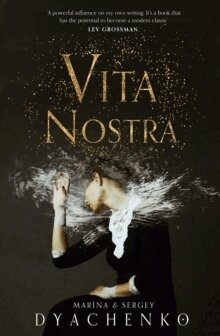
Vita Nostra
While on holiday, Sasha Samokhina meets Farit Kozhenikov, who rewards her for strange tasks with gold coins.
About
Spoiler notice: Premise-level discussion only; later plot developments and the ending are not covered because a full text was unavailable for verification.
Vita Nostra begins with Alexandra Samokhina, usually called Sasha, on holiday when she meets Farit Kozhenikov. He asks her to carry out a strange task. She is reluctant, but does it, and he gives her a gold coin. Further tasks bring more coins; eventually Farit directs her to travel to a remote village and spend the money to enter the Institute of Special Technologies. This sequence is the novel’s hinge: an encounter that could pass for an unsettling holiday incident becomes a demand that reorganises Sasha’s future. The Harper Voyager description stresses that the instruction goes against her family’s wishes. Sasha therefore reaches the school through a chain of pressure and inducement rather than a clear decision to pursue an unusual education. The promise of a place is already bound to uncertainty about who is directing her and what the coins have purchased.
The Institute is presented as a school, but its ordinary label does little to explain its purpose. The books resist reading, lessons remain obscure, and the knowledge students are meant to acquire will not stay in memory. These are not familiar academic obstacles that can be overcome by studying harder or finding a better teacher. The publisher describes learning that alters Sasha in ways that defy matter and time. That description shifts the novel’s school setting toward speculative transformation: education changes the learner rather than simply adding information. The mismatch between institutional routine and extraordinary consequences lets the story keep familiar student concerns—classes, performance, progress—inside an increasingly strange system. A reader can understand the premise without being told the precise rules of every lesson, because the published description deliberately presents the curriculum as difficult to grasp.
This uncertainty also shapes the way power works at the Institute. Its staff use fear and coercion to keep students in line, and the threat is directed beyond the students themselves: when they transgress, their families pay a terrible price. The danger therefore reaches into the relationships Sasha has left behind. The institution’s control does not depend only on grades or expulsion; it attaches consequences to people who are not attending the school. That premise makes each task morally charged. A student’s effort can no longer be treated as a private test of ambition, since compliance and failure both carry possible costs for others. The novel’s dark fantasy and psychological-suspense framing follows from that arrangement. The supernatural question of what the Institute teaches sits beside a recognisable question about coercive institutions: how much freedom remains when refusing an order can endanger people one loves?
The authors’ own description calls the book a modern literary fantasy with a coming-of-age theme, and places it first in their associated Metamorphosis cycle. Those terms help distinguish its shape from a simple school adventure. Sasha is at a threshold between adolescence and adult life, but the available publisher material describes a transformation that reaches beyond ordinary maturation. The Institute’s lessons connect study to changes in matter and time, while the threat to students’ families makes growing into new capacities inseparable from risk. “Coming of age” here is therefore a useful frame for the questions raised by the premise, rather than a promise of a conventional path from school to independence. The available sources establish the setup and the broad nature of Sasha’s education; they do not support a detailed account of every stage in her development or the book’s final resolution.
Language sits near the centre of the book’s published framing. The title comes from the Latin phrase “vita nostra,” meaning “our life,” and the authors’ announcement about the English translation connects the story to the idea of the Word as a beginning. The Harper Voyager page describes the novel as mixing adventure, magic, science and philosophy. Together, those details suggest that its speculative system concerns how reality can be understood and changed, rather than merely a collection of spells or classroom tricks. That reading also helps explain why lessons that cannot be remembered matter: the difficulty appears to be part of what knowledge is in this world, not just a hurdle on the way to mastering a textbook subject. The very act of learning carries a strange power over the student who tries to learn.
The English-language edition adds another layer to the book’s history. Vita Nostra first appeared in Russia in 2007; the Harper Voyager English paperback was released on 5 September 2019 under ISBN 9780008272890. Julia Meitov Hersey translated it, and the publisher credits her translation separately from the Dyachenkos’ authorship. The original publication year and this English edition date describe different events: 2007 marks the novel’s first publication, while 2019 identifies the specific paperback represented in this record. The authors’ site calls the work the first book in their associated Metamorphosis cycle; the publisher’s English page also connects it to a broader speculative-fiction audience. Keeping those facts distinct matters for readers comparing editions, translations and series records, especially because later English listings may display different ISBNs and publication dates.
Sasha’s journey begins with an offer that is difficult to refuse and leads to a school whose lessons she can barely understand. The gold coins make each step feel like a transaction, yet the Institute’s threats reveal how little ordinary bargaining power its students hold. The school promises a kind of knowledge that changes Sasha herself; it also makes the safety of her family depend on her obedience. That gives the familiar coming-of-age movement away from home an unsettling shape. Independence, education and self-discovery are all present in the premise, but none is free of pressure. The fantasy lies in the Institute’s impossible curriculum, while the human tension lies in Sasha’s need to keep learning under conditions she did not choose.
Book details
- Author
- Marina and Sergey Dyachenko
- First published
- 2007
- Series
- Metamorphosis, book 1
- Subgenre
- Dark fantasy, Coming-of-age, Translated literary fiction
- Primary genre
- Fantasy, Literary Fiction
- Tags
- No tags for this book.
- Reading order
- This is the only Metamorphosis title on the shelf right now.
Review
Editor profile
Baby Bat
Goodreads and social links will be added soon.
- Goodreads — link coming soon
- Social media — link coming soon