
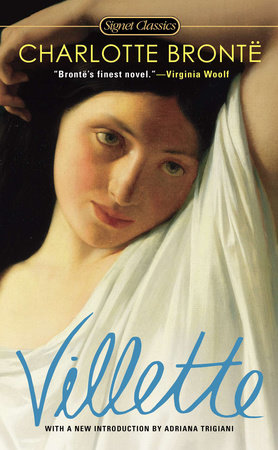
Villette
After the death of her employer leaves her without a position, Lucy Snowe travels from England to Villette and finds work at Madame Beck’s girls’ school.
About
Spoiler notice: Spoilers include Lucy’s move to Villette, Dr John’s identity, Paulina and Graham’s relationship, the explanation of the nun, Lucy’s school, and the implied loss at the ending.
Lucy Snowe tells her story from a later vantage, beginning with visits as a girl to her godmother, Mrs. Bretton, in the English town of Bretton. During one visit, the household takes in little Paulina Home, who calls herself Polly and waits anxiously for her absent father. Lucy observes the child’s grief and unusual self-command without pretending to understand it fully. Their paths later separate, and the narrative turns to Lucy’s adult life with Miss Marchmont, an invalid for whom she works as companion. When Marchmont dies, Lucy has no new position arranged and only a small amount of money. The novel gives little background about Lucy’s family, keeping attention on what she remembers and what she chooses to leave unstated.
Rather than return to the familiar household of her youth, Lucy resolves to seek work farther afield. She travels to London and then crosses to the Continent, arriving alone in the fictional city of Villette with no command of its language and few resources. After approaching a household that needs help, she is engaged at Madame Beck’s pensionnat, first to care for the children and then to teach. The school offers a place to live and work, but it is not a refuge from uncertainty: Madame Beck observes the staff and pupils closely, and Lucy knows that privacy is scarce. Her English lessons give her a practical role while her inner life remains largely concealed from those around her.
The Rue Fossette school brings Lucy into contact with two men whose attention means very different things to her. Dr John is an English physician who visits the school, and Lucy recognises him as Graham Bretton, the boy she knew at her godmother’s house. She keeps the discovery to herself, withholding it from the reader too until a later reunion. Graham does not recognise her, and his interest is fixed on the lively pupil Ginevra Fanshawe. M. Paul Emanuel, the school’s professor, is more difficult company: sharp in manner and prone to quarrels, he dominates the examinations but must leave English to Lucy. Their disagreements expose her resistance to being dismissed or controlled, even when she appears quietly compliant to everyone else.
During the long school vacation, Lucy is left behind while other teachers and pupils depart. Loneliness and illness overwhelm her; the loss of work’s daily demands leaves little to distract her from despair. Although Protestant, she enters a Catholic church and seeks comfort from Père Silas. After leaving, she faints outside, and the priest enlists Graham’s help. She recovers at La Terrasse, where Mrs. Bretton and her son finally discover who their patient is. Their kindness restores familiar companionship, but Graham’s attachment to Ginevra remains painful to witness. Lucy can advise him and enjoy his mother’s hospitality without receiving the love she privately wants. The difference between being welcomed and being loved shapes her place in this household.
Back at the pensionnat, Lucy resumes teaching and sees how little control she has over other people’s secrets. A figure in nun’s clothing appears in the school’s garret and garden, feeding on an old convent legend and on her unsettled state of mind. Letters from Graham give her private comfort, although she limits what she tells him and how much she lets herself hope. A visit to the theatre introduces the actress Vashti, whose forceful performance absorbs Lucy; the evening also brings an alarm of fire. Graham helps a young woman in the frightened crowd who proves to be the grown Paulina. The childhood connections begin to gather again, while Lucy watches Graham’s attention turn towards someone other than herself.
Other lives move forward around Lucy. Mr. Home returns to the story under the name Count de Bassompierre, and Polly becomes Paulina, his daughter and heiress. Her childhood friendship with Graham grows into a courtship that her father must consider, while Lucy acts as confidante to both sides. Ginevra’s flirtations and her interest in Colonel de Hamal reveal the gap between the romantic expectations she encourages in Graham and the life she wants for herself. At the same time, Lucy and M. Paul develop a more intimate understanding through lessons, disagreements and private conversations. Brontë keeps their feelings difficult to read: his abruptness can wound Lucy, but his attention to her independence and ability gradually becomes important to her.
The nun’s mystery eventually receives a practical explanation. Colonel de Hamal has used the costume to enter the school secretly and visit Ginevra. When Lucy later tears apart a figure laid on her bed, it proves to be a dressed bolster, arranged by Ginevra before her departure. The revelation removes a supernatural terror without making the school’s secrecy harmless. Meanwhile, M. Paul prepares a more lasting escape from Lucy’s dependence on Madame Beck: a small school in the Faubourg Clotilde, where she can work as directress. Her affection for him is bound up with the prospect of having a place and livelihood of her own, supported by someone who recognises abilities that other people have overlooked.
Before M. Paul sails, Lucy learns that his ward Justine Marie is engaged to Heinrich Mühler and is no rival for his affection. He asks Lucy to share his life, then leaves the next day. During his three-year absence, her school prospers and his letters sustain her. Money from Miss Marchmont’s heir allows her to rent the adjoining house and take boarders. Lucy describes this period as happy, but the anticipated reunion gives way to a seven-day Atlantic storm and accounts of wrecked ships. She stops short of plainly announcing M. Paul’s death, allowing hopeful readers to imagine his return. The implied loss hangs over that permission: Lucy has achieved independence and mutual love, yet the promised life together never receives a confirmed beginning.
Book details
- Author
- Charlotte Brontë
- First published
- 1853
- Series
- No series listed
- Subgenre
- Victorian fiction, Modern classics
- Primary genre
- Literary Fiction
- Tags
- No tags for this book.
Review
Editor profile
Baby Bat
Goodreads and social links will be added soon.
- Goodreads — link coming soon
- Social media — link coming soon