
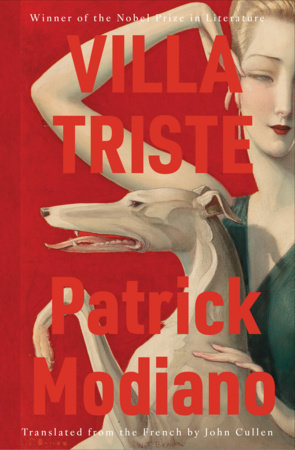
Villa Triste
In the early 1960s, an eighteen-year-old calling himself Victor Chmara retreats to a French resort town near Switzerland, where the border offers an imagined escape from the danger he fears.
About
Spoiler notice: Spoilers for the opening premise and character relationships; the later revelations and ending are not described.
Patrick Modiano’s Villa Triste first appeared in French in 1975. Other Press published John Cullen’s English translation in 2016; the edition used for this entry is the later Other Press paperback released in September 2026. The novel looks back from an uncertain present toward a summer in the early 1960s. Its young narrator arrives in a French lakeside town close to Switzerland carrying a name and a story that may offer protection. Modiano builds the book around the distance between a person’s account of himself and the incomplete evidence available to others. The town’s resort life offers shelter, while the narrator’s unease keeps the apparent holiday from becoming a simple idyll.
The narrator calls himself Victor Chmara, an eighteen-year-old who has adopted a stateless, wandering posture. He has come from Paris during the Algerian War and fears a danger he cannot clearly name. War, catastrophe and other people all seem possible sources; nearby Switzerland becomes an imagined route to safety. His borrowed identity allows him to move among the summer visitors without fully explaining himself. He is not simply hiding a secret that the reader can solve from a list of clues. Instead, his guardedness establishes the book’s central question: how much of a person’s past can be recovered from the name, habits and stories they choose to present? The novel follows that question through encounters and recollections rather than through a conventional investigation.
Victor meets Yvonne Jacquet, a young actress, and René Meinthe, a doctor whose eccentric presence draws him into a wider circle of acquaintances. Their summer includes local pageants, social evenings and late nights, a world whose rituals can make the resort seem self-contained. Yvonne becomes the emotional centre of Victor’s stay, but his account of her is filtered through his later memory. He remembers the intensity of their closeness and the details of a setting that has since receded; he cannot offer a complete explanation of either her or Meinthe. The novel’s relationships therefore carry two kinds of uncertainty at once. Victor is trying to understand the people he knew, while the reader is hearing about them through a narrator who admits how little he could see. Their social ease and his temporary welcome do not erase the larger unease that brought him to the town.
The story’s retrospective movement changes the meaning of its summer scenes. Victor speaks from years later, when the people and place have become difficult to reach except through recollection. Memory preserves particular images and encounters, but it also arranges them into a narrative after the fact. A moment that seemed casual to the young man can acquire weight in the telling, while a gap in his knowledge remains a gap rather than turning into a fully explained answer. This structure keeps the novel attentive to time: the remembered season feels vivid, yet it is already lost. Yvonne and Meinthe occupy both positions, as people Victor once encountered and as figures shaped by what he can now recall. The book’s suspense comes partly from that separation between event and memory. It invites attention to what Victor describes, what he cannot confidently interpret, and the distance between those two things.
Identity in Villa Triste is practical as well as emotional. Victor’s chosen name gives him a way to enter a town while keeping his previous life at a distance, but a name cannot make uncertainty disappear. He can take part in the summer’s social routines and become attached to Yvonne without becoming fully legible to the people around him. The narrator’s position also complicates the reader’s sense of intimacy: a first-person voice can reveal private impressions while still withholding the context needed to understand them. Modiano’s plot uses that limitation instead of resolving every ambiguity into a neat explanation. The result is a story in which evasion, attachment and self-invention remain connected. Victor wants temporary reassurance and a place in another person’s world, yet he is also moving through it as someone prepared to leave. His later effort to recall that period cannot turn a provisional life into a settled one.
The resort setting gives these private uncertainties a public surface. Pageants and gatherings depend on display, names and roles, while the town’s holiday atmosphere appears set apart from the political anxiety beyond it. Victor’s fear of the Algerian War’s wider context does not make the resort a direct account of the conflict; it shadows his decision to flee Paris and shapes the safety he imagines near the border. Social life can look complete for an evening, but Victor’s presence remains temporary and the wider world has not gone away. By placing an uncertain young man among people who seem to belong to the town’s summer world, the novel makes belonging something performed and fragile. Its scenes of leisure carry the pressure of what they cannot fully keep outside.
Villa Triste brings its concerns together through the act of looking back. Victor’s summer with Yvonne and Meinthe is a love story, a flight from fear and a record of encounters whose meaning remains partly unresolved. The book does not need to choose between treating the remembered season as precious and showing that recollection cannot restore it. The 1975 French original, the 2016 Other Press edition of John Cullen’s English translation, and the selected 2026 paperback are distinct publication events; the latest edition continues to offer Cullen’s translation. Across those layers, the same questions persist: what makes a name feel like a self, what can memory preserve, and why do people leave places they once experienced as refuge? Modiano places those questions inside a compact social world, then lets the narrator’s distance from it reveal how much remains beyond his account.
Book details
- Author
- Patrick Modiano
- First published
- 1975
- Series
- No series listed
- Subgenre
- Literary fiction, Translated literary fiction, Modern classics
- Primary genre
- Literary Fiction
- Tags
- No tags for this book.
Review
Editor profile
Baby Bat
Goodreads and social links will be added soon.
- Goodreads — link coming soon
- Social media — link coming soon