
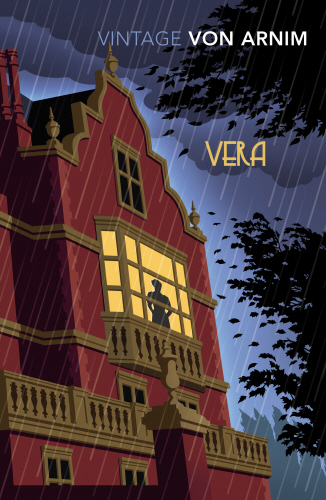
Vera
After her father dies suddenly in Cornwall, Lucy Entwhistle meets Everard Wemyss, a widower whose wife Vera recently died at their riverside home, The Willows.
About
Spoiler notice: This overview discusses Vera’s death, the marriage at The Willows, Aunt Dot’s expulsion and the novel’s final scene.
Lucy Entwhistle is standing in a garden in Cornwall when Everard Wemyss enters her life. Her father died that morning, and she is looking out at a brilliant, motionless sea without being able to feel the grief she knows should follow. For years she has cared for him, travelled with him and shared his delight in books, friends and small discoveries. His death removes the person around whom her days have been arranged. Vera begins in that stunned interval before Lucy can imagine another life. Wemyss approaches as a stranger with a bereavement of his own. To someone who has just lost her closest companion, his readiness to talk and remain nearby offers an immediate answer to the frightening prospect of being alone.
His wife, Vera, has recently died after falling from an upstairs room at their home, The Willows. Wemyss describes a marriage in which, by his account, everything was done for her and nothing should have made her unhappy. He is indignant that the inquest returned an open verdict rather than confirming an accident, and blames the uncertainty on a servant's testimony and a jury he regards as unfit to judge. Lucy initially hears this as an account of suffering that deserves her sympathy. The reader also hears how quickly his grief becomes a defence of his own conduct. The circumstances of Vera's death remain unresolved; Wemyss's insistence that he understands them is part of his character, rather than an explanation the novel requires everyone to accept.
Wemyss makes himself useful during the practical work that follows Lucy's father's death. Arrangements have to be made while she can scarcely think, and his confidence fills the gap. Her aunt Dorothy, usually called Aunt Dot, also has reason to be grateful for help. Gratitude becomes more difficult to separate from misgiving as Wemyss's attention develops into courtship. Lucy's father's friends question the match, and her aunt begins to see how little space he allows for another person's wishes. Lucy experiences the objections from within an attachment that has already brought her comfort. The people urging caution cannot simply take away the reassurance she believes she has found. That difference in perspective lets affection and alarm occupy the same scenes without making Lucy's trust feel incomprehensible.
Marriage brings Lucy to The Willows, which Wemyss has no intention of abandoning. She had hoped the house might belong to a finished part of his life, but instead she must make a home where Vera lived and died. Rooms and windows become reminders of a woman she never met and cannot question. Vera's continuing presence is made from traces, memories and the dreadful possibility of imagining what life there was like for her. Lucy also has to learn what Wemyss expects of the new occupant. His attachment to his arrangements survives the change of wife. The house consequently feels settled in ways that offer him security while leaving her unsure where she can place a preference or thought of her own.
Much of the pressure develops through ordinary domestic exchanges. Wemyss believes his feelings should determine what happens next and interprets resistance as a failure of love. Lucy tries to respond with affection, explain an unintended offence and find a way to restore peace, yet explanations do not give her an equal say. The narration moves close enough to both minds to expose the distance between them. He can hold her tenderly while she discovers that her thoughts have withdrawn beyond his reach. She becomes consciously afraid of him, then worries about her own capacity to endure another scene. Her efforts to manage the situation are constrained by the conviction that so much professed love ought to make a happier understanding possible.
Aunt Dot's arrival when Lucy is ill brings someone into the household who is prepared to act on her needs. Calling a doctor seems to her a necessary act of care; Wemyss treats it as an unauthorised decision and insists that the bill belongs to the aunt who summoned him. The dinner conversation makes his grievance painfully specific. He can dispute medical help and complain about the absence of fish while Lucy's condition is the reason for the visit. Aunt Dot attempts politeness, questions him and finally presses the need for kindness. His response is to establish that she will not be allowed to keep visiting or influencing his wife. The confrontation ends with her being forced to leave the house.
The final chapter follows Wemyss after the expulsion, pleased with having asserted his authority and cautious that Aunt Dot might return to challenge it. He waits, checks the grounds and gate, and satisfies himself that she has really gone. Lucy has fallen asleep expecting her aunt to say goodnight. When Wemyss enters quietly, she takes his good mood as evidence that the two have made peace; he has no wish to wake her fully and answer questions. She returns his kiss without knowing what has happened downstairs. The book closes within that mistake. There is no later escape or discovery to relieve it, and no final verdict that resolves Vera's death. Lucy's apparent comfort depends on information being withheld from her, while the person who might have challenged that arrangement is outside the house.
Book details
- Author
- Elizabeth von Arnim
- First published
- 1921
- Series
- No series listed
- Subgenre
- Psychological thriller, Domestic suspense
- Primary genre
- Literary Fiction, Mystery & Thriller
- Tags
- No tags for this book.
Review
Editor profile
Baby Bat
Goodreads and social links will be added soon.
- Goodreads — link coming soon
- Social media — link coming soon