
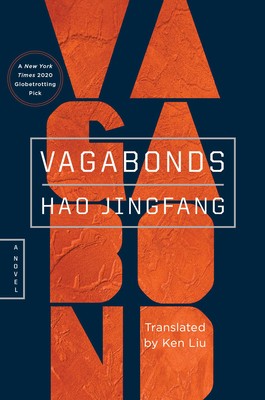
Vagabonds
After decades of separation following Mars’s war of independence, Earth and Mars try to ease their tensions through cultural exchange.
About
Spoiler notice: About and synopsis discuss the premise and early character situations; they avoid the ending and major late revelations.
Vagabonds opens in a future shaped by a war of Martian independence. Earth and Mars have been separated for decades, and the distance between them is political as well as physical. Mars has built a society around collective provision and carefully managed civic life; Earth is wealthier and more permissive, with markets and private influence shaping opportunity. Neither world offers a simple answer to the other’s problems. Their renewed contact is fragile, and a cultural exchange intended to ease suspicion carries the weight of history, trade and competing ideas about how people should live.
At the centre of that exchange is the Mercury Group, young Martians who spent five years on Earth and are now returning home. Their journey aboard the old interplanetary vessel Maearth brings them together with officials, artists and other visitors from both planets. The ship has long served as a link between former enemies, carrying delegations, negotiations and exhibitions across the gap. Its worn, deliberately unthreatening presence reflects the diplomatic work it performs: the passengers share a route and a destination, but they do not share one account of the past or one expectation of what cooperation should mean.
Luoying, one of the returning students, is a dancer whose time away has changed how she sees her home. On Earth she encountered a culture of abundance, personal choice and constant commercial exchange. Back on Mars, the familiar rules feel newly visible. The society she returns to organises access to work and daily necessities through ateliers, which connect a citizen’s credentials and identity to practical parts of life. Such arrangements promise support and a place in the community, yet they also make belonging something administered through systems. Luoying has to discover where she fits when childhood memories, her Earth experience and the expectations of home no longer line up neatly.
Her return is complicated by her family history. Luoying is the granddaughter of Hans Sloan, Mars’s powerful consul, and other people read her position through that connection. The novel lets political privilege enter ordinary choices: who receives attention, whose past is remembered, and whether a public figure’s family can ever be treated as private. Questions around Hans and Luoying’s parents sit beside her more immediate effort to establish an adult identity. Her uncertainty is not only about which planet she prefers. It is also about what she owes to the people who raised her, and whether affection or inherited status can tell her what kind of person to become.
The Terran delegation adds another perspective through Eko Lu, a filmmaker sent to document the visit. His work places him near Luoying while giving him a reason to observe how the Martians present themselves. Earth’s visitors arrive with their own national and commercial interests, and the official language of cultural understanding exists alongside efforts to secure technology and influence. Eko’s camera makes representation part of the story: a record of Mars can be shaped by the person behind it, the audience expected to watch, and the questions that a sponsor wants the images to answer. The visitors also carry their own rivalries, even when public ceremony requires them to appear unified. That gap between a polished presentation and private calculation gives Eko’s assignment a political edge. Luoying’s dance raises a related problem. Artistic expression can carry a person’s history across a boundary, but it can also be interpreted by institutions and publics that do not share that history.
Hao gives these social differences concrete form in encounters, public events and the daily details of returning to Mars. The students reunite after years apart, delegates prepare exhibitions, and the two planets try to make contact through carefully planned ceremonies. Under that visible diplomacy, old grievances and personal motives continue to shape conversation. The exchanges expose how little either side can know about the other from slogans alone. Earth’s freedoms come with their own inequalities and commercial pressures; Mars’s security and solidarity depend on rules that can narrow individual choice. The narrative follows how people live inside those arrangements instead of reducing the planets to a single political argument.
The book’s scope is broad, but its questions often arrive through art, family ties and uncertain friendships rather than military action. Luoying’s return makes cultural change personal: the world she left has changed her, while Mars has continued without her. Eko and the other visitors bring another set of motives into a society that is still deciding what openness should cost. Their encounters ask whether a community can learn from another without simply copying it, and whether a person can belong to more than one place without being forced to choose a single identity. The title’s sense of wandering fits characters caught between homes, though the novel also treats that in-between position as a vantage point from which each world’s assumptions become easier to question.
Book details
- Author
- Hao Jingfang
- First published
- 2016
- Series
- No series listed
- Subgenre
- Space opera, Dystopian, Translated literary fiction
- Primary genre
- Sci-Fi
- Tags
- No tags for this book.
Review
Editor profile
Baby Bat
Goodreads and social links will be added soon.
- Goodreads — link coming soon
- Social media — link coming soon